
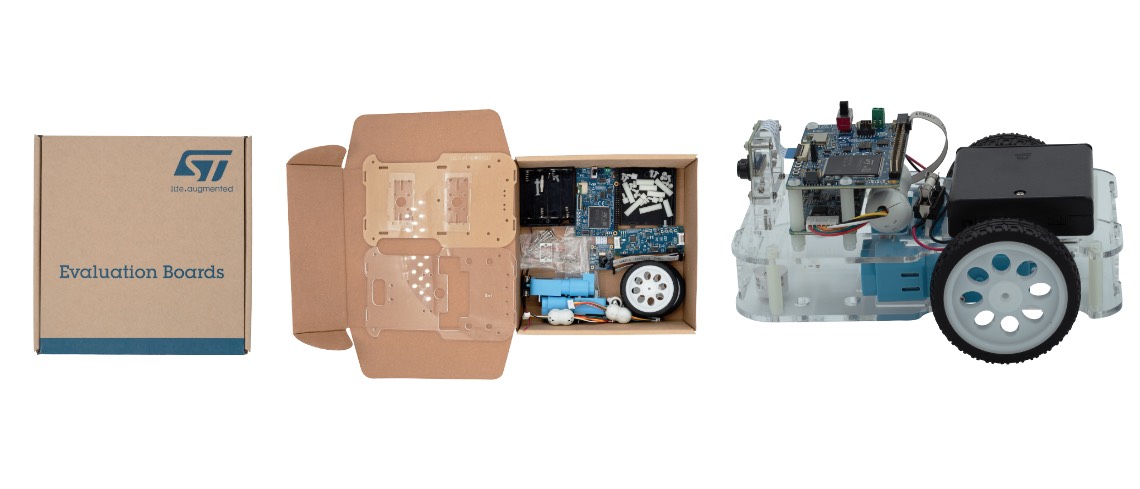
The STEVAL-ROBKIT1 is our first “ready-to-go” evaluation kit for robotics applications, designed for traditional engineering teams and educational purposes, thereby lowering the barrier to entry for what is often thought of as a complex subject. It comes with three boards: a central system, a motor-control PCB, and a camera module, together with a robotic frame, wheels, and motors with encoders. ST designed the STEVAL-ROBKIT1 for easy and soldering-iron-free assembly by students, making it approachable regardless of experience level. We also provide a firmware, the STSW-ROBKIT1, and a mobile application called STRobotics for iOS and Android. Let’s dive into each component to explore why our community and academia have already adopted them.
STEVAL-ROBKIT1: More hardware than meets the eye
Main board
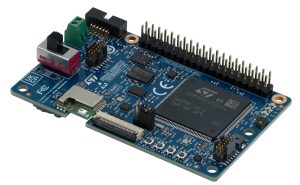
The main board of the STEVAL-ROBKIT1 features a high-performance STM32H725IGT6 microcontroller, enabling users to run demanding applications, such as computer vision. Indeed, too often, educational platforms have significant hardware limitations that restrain the scope of applications they can run. By choosing an STM32H725IGT6, ST wants engineers to run a wide gamut of programs. It also explains why we added an LSM6DSV16BX 6-axis IMU, which features one of the best performance-per-watt ratios. Additionally, we find an LIS2MDL magnetometer and an MP34DT06J microphone. Put simply, developers get the sensors they need to create applications that help the robot navigate its surroundings and other advanced control systems, all on one board.
ST also included the BlueNRG-M2 system-on-chip to provide low-power Bluetooth® LE 5.2 capabilities. This is particularly important for students because they can use our mobile application over wireless and learn how to design for Bluetooth. Indeed, since we provide the source code for our implementation, the STEVAL-ROBKIT1 serves as an object lesson in creating a low-power Bluetooth application. While we know most students will stop at the robotics application itself, engineers can use the main board to learn more about low-power applications and PCB design considerations.
Motor control board
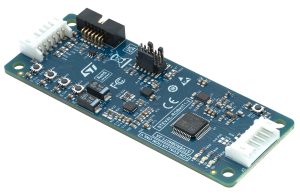
The motor control board comes with an STM32G071CBT6. The STM32G0 series requires less than 100 µA/MHz at 64 MHz, further building on the main board’s low-power design. However, we also chose that MCU because it can still run important motor control algorithms, such as field-oriented control (FOC) (not available in this release), making it a vital teaching tool. The system also features the STSPIN240 motor driver for the wheels of the STEVAL-ROBKIT1, and an LSM6DSR always-on 6-axis accelerometer and gyroscope. And since all these components are the same that many companies use in their industrial applications, students gain experience that will serve them throughout their careers.
Camera board
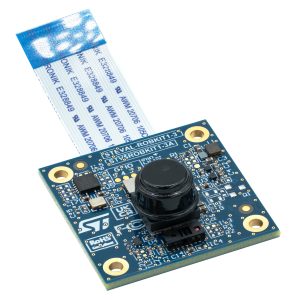
Finally, the camera board comes with the CAM-6G-152CLR camera module, which houses the VD56G3 1.53 megapixel image sensor. We chose a monochrome sensor because it can fit many computer vision applications, and its global shutter provides a better signal-to-noise ratio, as we saw in our Xvisio Technology coverage. The camera board also includes the VL53L8CX time-of-flight sensor, the same one used in our smart presence detection solution. Engineers can use it in an object detection application to prevent the STEVAL-ROBKIT1 from colliding with its environment. The board also aims to keep its power consumption in check thanks to the highly efficient ST1PS01 nano-quiescent step-down converter.
Modular at heart
Readers will notice that this three-prong approach inherently makes the STEVAL-ROBKIT1 highly modular and expandable. Beginners have everything they need to get started and develop advanced expertise. But the evaluation kit can also evolve with users, who could add a completely different sensor board thanks to the 40-pin Raspberry-like connector on the main board, or use a PCB with an entirely different host MCU, like an STM32N6, as long as they build the firmware for it. Similarly, it is possible to experiment with a much more powerful control board using an STM32G4 to run vastly more complex control loops or use higher-resolution camera modules. It would teach users about middleware and open up a new range of applications.
STEVAL-ROBKIT1: Stepping stone software
STSW-ROBKIT1
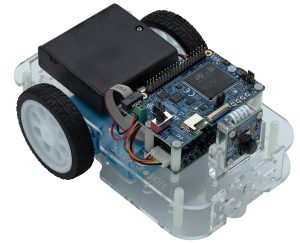
The software is also integral to the evaluation kit, which is why we are providing STSW-ROBKIT1, a ready-to-use package with two primary components. The first one runs FreeRTOS on the main board to teach about scheduling, error handling, and other key concepts associated with real-time operating systems. It also serves as an object lesson on Bluetooth stacks, computer vision, or sensor fusion. The second component governs the motor control application and will help master classical algorithms. STSW-ROBKIT1 also integrates with the STM32Cube ecosystem to help build the skills needed for many industrial projects. For example, it’s possible to use STM32CubeMX to reconfigure the pinout configuration or clock tree, among many other things.
STRobotics
To make the robotics application more accessible, we are releasing STRobotics, a mobile application that connects to the STEVAL-ROBKIT1 using its Bluetooth SoC. A virtual joystick can move the robot around, and a data logger helps visualize the information captured by all the sensors. We even provide a console so users can send commands and view logs, which is essential for understanding why a program behaves a certain way. Underneath all this, the application uses the BlueST-SDK, which provides a common programming platform so users can easily reuse what they learn with the STEVAL-ROBKIT1 in other applications. Put simply, this evaluation kit is the first step toward the latest trends shaping today’s industries.