

The AEK-AUD-C1D9031 is ST’s latest AutoDevKit automotive development platform for audio applications, enabling engineers to play audio with only a microcontroller rather than a far more costly DSP. It features an SPC582B60E1 general-purpose MCU and the FDA903D Class D audio amplifier, which provides current-sensing capabilities. Hence, not only does this combination allow designers to easily and efficiently add audio applications such as simulated engine sounds, but it can also detect if a speaker is disconnected. Moreover, as a standalone MCU system, it offers enhanced resiliency by operating independently from the main infotainment system.
The booming challenges of bringing audio to cars
More than just music
There’s a lot more audio in cars than most assume. When consumers think about it, they typically envision their entertainment system, which remains a critical component. However, there are chimes, warning bells, notification dings, and so many other audio cues that enhance the user experience. In addition, many of them must be available before the entertainment or even the engine is switched on, meaning that not all of them can rely solely on the sound system that drivers and passengers use to listen to music. Furthermore, since electric cars are so quiet, thanks to the absence of a combustion engine, manufacturers add sounds for safety and to improve the user experience.
More than just a central entertainment system
The problem is that while audio in cars, and acoustic vehicle alerting systems (AVAS) are far from new, they are also not easy to implement and can easily add to the bill of materials. Indeed, the cost of a DSP, an equalizer, and all the components needed by the audio pipeline can quickly add up, which is why many manufacturers opt for a central entertainment system. The problem is that it is a complex system for what are, in effect, computationally trivial tasks, and engineers need to account for safety considerations. For instance, a critical audio warning must still play regardless of the main speaker volume, which requires the design of safeguards and other complex systems.
More than just cars
Teams working on modules are also looking to reuse their systems in many more types of vehicles than just the car they originally had in mind. Whether we are talking about two- or three-wheeler trucks or something as small as a forklift, all require AVAS, and being able to reuse a system across many more platforms provides tremendous economies of scale. However, this isn’t possible when using an entertainment system designed primarily to play music from a phone or the radio. Consequently, more and more makers are taking a different approach to audio alerting systems, exploring solutions that are simpler, more cost-effective, and more flexible.
The resounding solutions of the AEK-AUD-C1D9031
A different melody: a new approach to AVAS
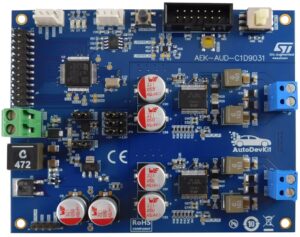
The AEK-AUD-C1D9031 is a development platform that helps car makers approach AVAS differently, and many customers have already adopted it to address these challenges. At its core, it is one of the most straightforward systems possible. Playing sound is as simple as sending power to the module. Thanks to its SPC58 microcontroller, it doesn’t need a complex operating system or workarounds to fit a platform designed to perform a myriad of other functions. The AEK-AUD-C1D9031 even demonstrates how developers can use a dedicated mute pin, which makes turning the sound on and off far simpler. Similarly, the current-sensing feature of the FDA903D amplifier means engineers don’t need to add additional components, thus further reducing the bill of materials.
Familiar tunes: common standards and practices
Developers can use standard interfaces, which save significant development time. For instance, they can talk to the flash or program the amplifier via an I2C interface, or use I2S to send audio samples. In practice, programmers can play audio samples directly from storage, further eliminating the need for intermediate steps. Developers will have to sample the sounds, as they cannot use a compression format like MP3. For instance, they can play a pre-recorded engine noise from a traditional uncompressed WAVE file and then attach a potentiometer to an AEK-CON-C1D9031 connector board plugged into the AEK-AUD-C1D9031 to interact with the sound.
Indeed, it is possible to run a demo that modifies the sound output based on potentiometers that users can move sideways. By using bit-shifting, developers can lower or increase the pitch. Similarly, increasing or decreasing the number of samples directly impacts playback speed. Hence, it’s through those mechanisms that developers can simulate an engine accelerating or decelerating without using expensive DSPs or EQs. Similarly, the system can generate one note at a time to reproduce complex melodies without having to play a traditional file. In fact, ST developed a demo that uses AutoDevKit and the AEK-AUD-C1D9031 to play the famous Rondo All Turca.
Music to engineers’ ears: more features, less complexity
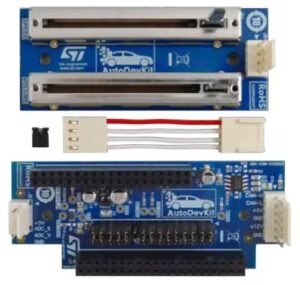
The AEK-AUD-C1D9031 also shows the advantages of a system independent of the central infotainment system. Since the SPC582B60E1 supports CAN bus, plugging our platform into an existing car safety architecture is simple, enabling engineers to trigger critical alerts very quickly. In most traditional systems, offering all these features would require a far more complex integration process. It’s why we have seen module makers adopt the AEK-AUD-C1D9031. By offering the SPC582B60E1 and the FDA903D on a cost-effective platform, we were able to offer a set of features that help them stand apart, without taking away from the budget they had allocated to other, more costly parts of the vehicle, like the battery management system or onboard charging.
- Learn more about the AEK-AUD-C1D9031
- Check our use case