
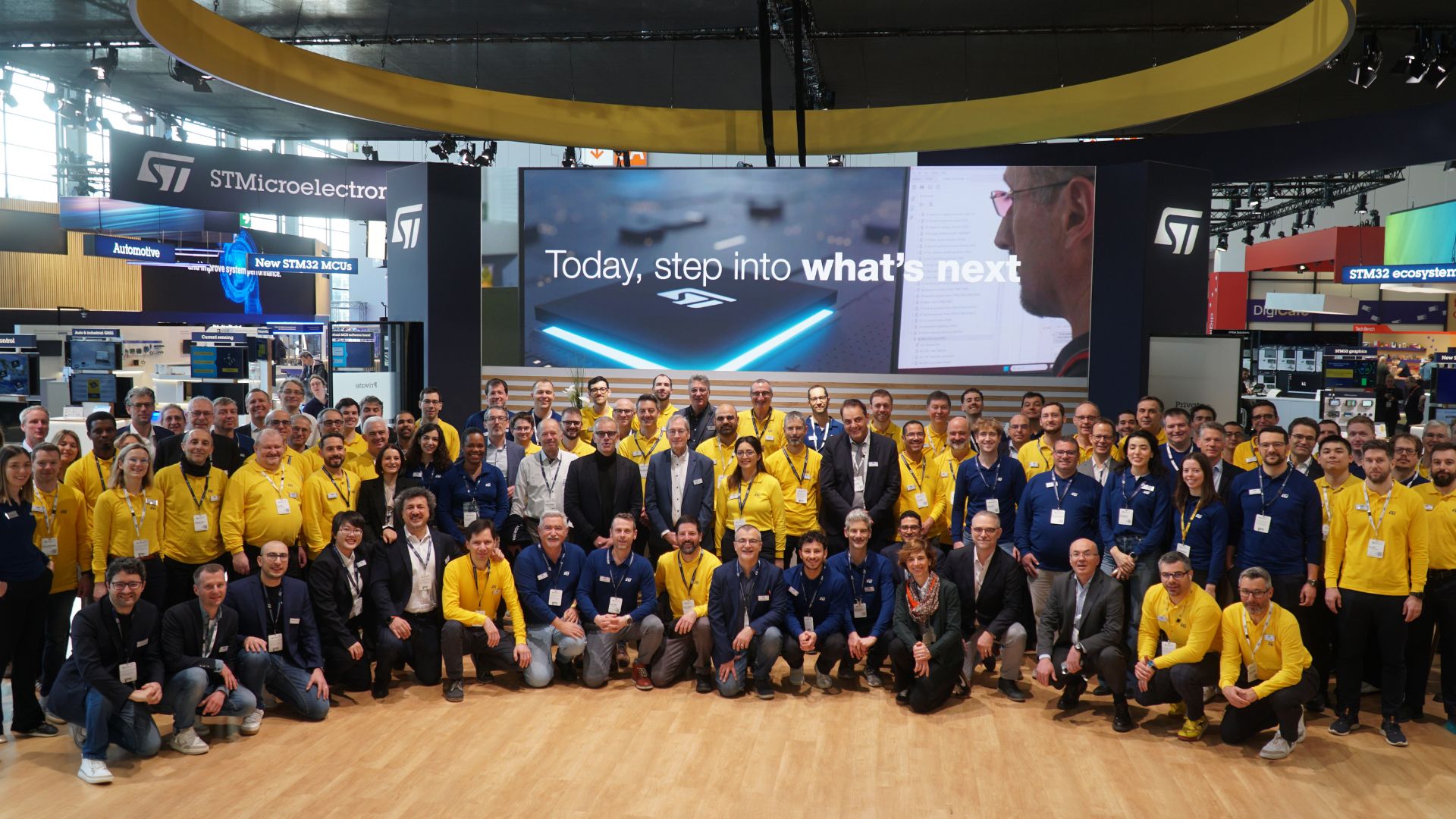
Every year we bring new innovations and products to embedded world in Nuremberg . This year, from 10 to 12 March, we showed more than 50 live demonstrations spanning edge AI, cybersecurity, RF connectivity, automotive, sensing, power, and the STM32 ecosystem. Visitors at our booth were able to talk to our engineers, try hands-on demos, and see complete functional chains, from sensing to decision-making to actuation, and from device provisioning to regulatory compliance.
For those unable to attend or looking to catch up on the latest developments, here’s a look at the event’s most significant highlights, including new solutions like STM32C5, STM32CubeMX2, CRA compliance workflows, and Aliro access control. We also showed post-quantum cryptography in action and demonstrated how current trends like physical AI and software-defined vehicles play out on real hardware.
Physical AI: sense, decide, and act at the edge
The factory floor is from fixed-function systems to adaptive physical AI, environments where sensing, reasoning, and actuation have to happen in milliseconds. At EW26, we demonstrated how ST enables this entire chain, from obstacle avoidance to predictive maintenance. Humanoid robotics may seem futuristic, but we see the same trajectory that the early days of IoT followed: a decade ago, billions of connected devices seemed far off. Now it’s standard. Humanoid robots are on a similar trajectory.
STM32N6 and edge AI: running neural networks where data is generated
The core of Physical AI is local inference, running neural networks where data is generated, with no cloud round-trip. At our booth, visitors could see anomaly detection, gesture recognition, and environmental classification running on STM32 MCUs. With the STM32N6 and its Neural-ART Accelerator delivering 600 GOPS on-chip, workloads that once required a microprocessor now run on an MCU at a fraction of the power. Developers deploy models via STM32Cube.AI Studio or build them from scratch with NanoEdge AI Studio.
Many embedded engineers are experimenting with generative AI for coding, but some remain cautious about embedding AI components they do not fully control into production firmware. Our approach: make edge AI concrete. A bicycle, a drone, smart glasses, and a power drill all ran on-device AI delivering measurable benefits. Edge AI is not a black box; it is a tool engineers can validate and deploy with confidence.
STM32U3 and energy harvesting: Edge AI inference without a battery
One of the more memorable demos was neural network inference powered entirely by energy harvesting, with no battery at all. The enabling technology is the STM32U3, the first STM32 with near-threshold design, delivering 117 CoreMark/mW at just 10 µA/MHz. Its hardware signal processor (HSP) achieves up to 3x higher DSP performance than a Cortex-M55 and up to 12x compared with a standard Cortex-M33, while consuming a fraction of the power of a CPU core. For applications running on coin cells or harvested energy, that efficiency gap translates directly into longer operating life and smaller designs, enabling maintenance-free gas and water meters, industrial GPS trackers, and activity monitoring devices without ever needing to replace or recharge a battery.
Sensing, actuation, and power: from MEMS to GaN
A humanoid robot relies on continuous inertial data for balance, fall detection, and step planning. Our high-g MEMS IMU delivers this. The same sensing function enables predictive maintenance in motors and conveyors. For healthcare, the new MIS2DU12 ultra-low power accelerometer (2x2x0.74 mm) targets FDA Class III medical applications, patient monitoring, and motion-activated clinical functions. The MPX10DP temperature-compensated differential pressure sensor addresses respiratory therapy, sleep apnea devices, oxygen ventilators, and gas and fluid flow metering, extending our MEMS portfolio into clinical-grade territory.
For actuation, our field-oriented control algorithms manage multi-axis motor drives in real time, while GaN-based power stages cut switching losses and shrink power electronics. GaN enables smaller, cooler, more efficient motor drives, which is exactly what a compact robotic platform requires.
STM32MP2: compute, safety, and long-lifecycle support
Sensor fusion, combining camera, Inertial, proximity, and force data, requires significant compute headroom. The STM32MP2 family and the new STM32MP21 deliver this within the thermal constraints of a mobile platform. The STM32MP2 series offers pin-to-pin compatible packages, so designers scale up or down without reworking their PCB. Our Linux distribution is now supported for five years, an important commitment for products with long-lifecycle industrial products.
Automotive: the software-defined vehicle takes shape
The car is becoming a software platform. Zonal architectures are consolidating dozens of ECUs into a handful of high-compute controllers. X-in-1 electrification merges inverter, DC-DC, and on-board charger into a single unit. At EW26 we demonstrated how automotive teams develop, validate, and debug vehicle software in a fully simulated environment, including peripherals, interrupts, and timing. This shift-left approach cuts development cycles and enables Software-Defined Vehicle (SDV) workflows where software and hardware evolve in parallel. It means engineers can start writing and testing code months before the physical chip is available.
Stellar P3E: the first automotive MCU with an integrated NPU
The Stellar P3E is our first automotive MCU with an integrated Neural Processing Unit. It brings neural network inference directly into zonal controllers for virtual sensing, predictive diagnostics, and occupant monitoring. Together with Stellar P6 for SDV compute and Integration MCUs powering Pagani hypercars, it completes an automotive AI portfolio from real-time control to high-level workloads.
Connectivity, positioning, and in-cabin innovation
The Audio over Ethernet demo, running on the Stellar G6 automotive MCU, moved in-cabin entertainment from analog wiring to Ethernet-based distribution. The Stellar G integrates an embedded TSN switch, Ethernet AVB with traffic shaping, audio clock recovery, and sample rate conversion for up to six channels, delivering high-quality 24-bit audio over a multipurpose Ethernet ring. The result: less cable weight and significant cost savings.
Security and connectivity: CRA compliance, post-quantum cryptography, and next-gen connectivity
Smart buildings, smart cities, and industrial infrastructure all face the same three imperatives: connect heterogeneous devices, secure them with hardware-rooted trust, and prove compliance with the EU Cyber Resilience Act. At EW26 we showed the full chain.
CRA: from regulation to silicon
The Cyber Resilience Act (CRA), effective from 2027, mandates security by design for every connected product sold in Europe, including secure boot, authenticated firmware updates, and vulnerability management. The burden is real: manufacturers must publicly disclose vulnerabilities, report security risks within 24 hours, and provide a first response within 72 hours. Many customers at Embedded World told us they are actively seeking silicon-level solutions to simplify the compliance path.
Why does this matter in practice? Consider an electricity meter. If the boot process is not secure, an attacker could replace the firmware with a version that measures half the actual consumption. Secure boot prevents this by verifying firmware authenticity before any code executes. Security has to be designed into silicon, it can’t be added after the fact.
At our demo pod, visitors experienced CRA and RED compliance workflows on the STM32WBA6, targeting SESIP3 and PSA Level 3 certification. The demo showcased the complete device lifecycle: risk analysis, security function mapping, SBOM and vulnerability handling, conformity assessment, and incident response. We also featured the Identify I Authenticate platform for hardware-rooted authentication and eSIM for IoT for over-the-air credential provisioning. For the highest level of key protection, STSAFE, our Common Criteria EAL5+ certified secure element, stores cryptographic keys in tamper-resistant hardware, because where you store the key matters as much as the lock itself. All of this runs within the STM32Trust framework.
Post-quantum cryptography: preparing today for tomorrow’s threats
Current encryption standards like RSA and ECC face a future threat from quantum computers, which will have the power to break today’s algorithms. Our quantum-ready security demo showed Post-Quantum Cryptography (PQC), algorithms built on mathematical foundations that resist even quantum attacks.
This wasn’t a proof-of-concept demo. We ran these NIST-standardized algorithms (ML-KEM and ML-DSA) running directly on embedded devices. This transition to crypto-agile ecosystems is supported by our X-CUBE-PQC and X-CUBE-CRYPTOLIB libraries, ensuring a seamless upgrade path for developers. On the hardware side, our NesLib-PQML stands out as the first cryptographic library to achieve the highest level of industry security certifications (Common Criteria and FIPS) for post-quantum protection.
Wireless: Matter, Aliro, and the path to a new franchise
In smart buildings, interoperability is the baseline expectation now. We demonstrated how Matter solutions, paired with NFC for easy setup, are leading this shift. Since the Matter protocol requires significant memory, our STM32WBA6 is the ideal fit, while the new STM32WBA2 offers a cost-optimized path for Bluetooth and ZigBee designs. Interestingly, ZigBee has seen a major revival as a reliable, low-cost alternative to Wi-Fi for modern home automation.
We also showcased Aliro, a new universal standard for secure access control in offices and homes. As a founding member, ST provides a complete kit (combining processors, NFC readers, and secure elements) to support everything from simple tap-to-enter locks to advanced, hands-free entry using Ultra-Wideband (UWB). For long-range needs, the new STM32WL3R adds bidirectional communication. This ensures a vital digital “handshake” giving users confirmation that a remote command was actually executed. Finally, for city-scale infrastructure, our ST87M01 module is now in production for NB-IoT applications like smart metering, while our new occupancy sensors enable precise, demand-driven climate control by detecting true human presence.
STM32C5 and STM32CubeMX2: the next evolution of silicon and tools
Behind every demo at EW26 sits a powerful combination of hardware and software. This year, both saw their most significant evolution in years.
STM32C5: redefining the entry-level
The STM32C5 series challenges assumptions you’d normally make about an entry-level MCU. Built on the Arm Cortex-M33 core, it delivers three times the performance of typical Cortex-M0+ devices. With up to 1 MB of Flash and industrial-grade peripherals like Ethernet and FDCAN, it’s designed for easy prototyping and high-performance scaling. Pricing starts at $0.64 for 10K units.
STM32H5 and graphics: from E-bikes to coffee machines
Our graphics ecosystem now scales from entry-level MCUs to high-end MPUs. We showcased the STM32H5 using Chrom-ART2 acceleration to run a full e-bike dashboard using just 641 KB of internal Flash. Meanwhile, an STM32H7R/S coffee machine demo proved you can run advanced, high-resolution GUIs with a consumption of only 285 KB of internal RAM.
STM32V8: the first Cortex-M85 flagship
The STM32V8 is the world’s first microcontroller built on 18 nm FD-SOI technology. This device pairs an Arm Cortex-M85 core running at 800 MHz with 4 MB of embedded phase-change memory (PCM), using Helium technology for vector processing. Designed for the most demanding applications, it maintains high performance even in harsh environments with a junction temperature rating of up to 140°C. By targeting PSA Level 3 and SESIP3 security certifications, the STM32V8 stands as the most capable MCU core we’ve put into the STM32 portfolio.
• Watch event highlights on our YouTube channel
• Discover more on STM32N6, the Edge AI ecosystem and post-quantum cryptography
• Learn more about the STM32C5 and its ecosystem