
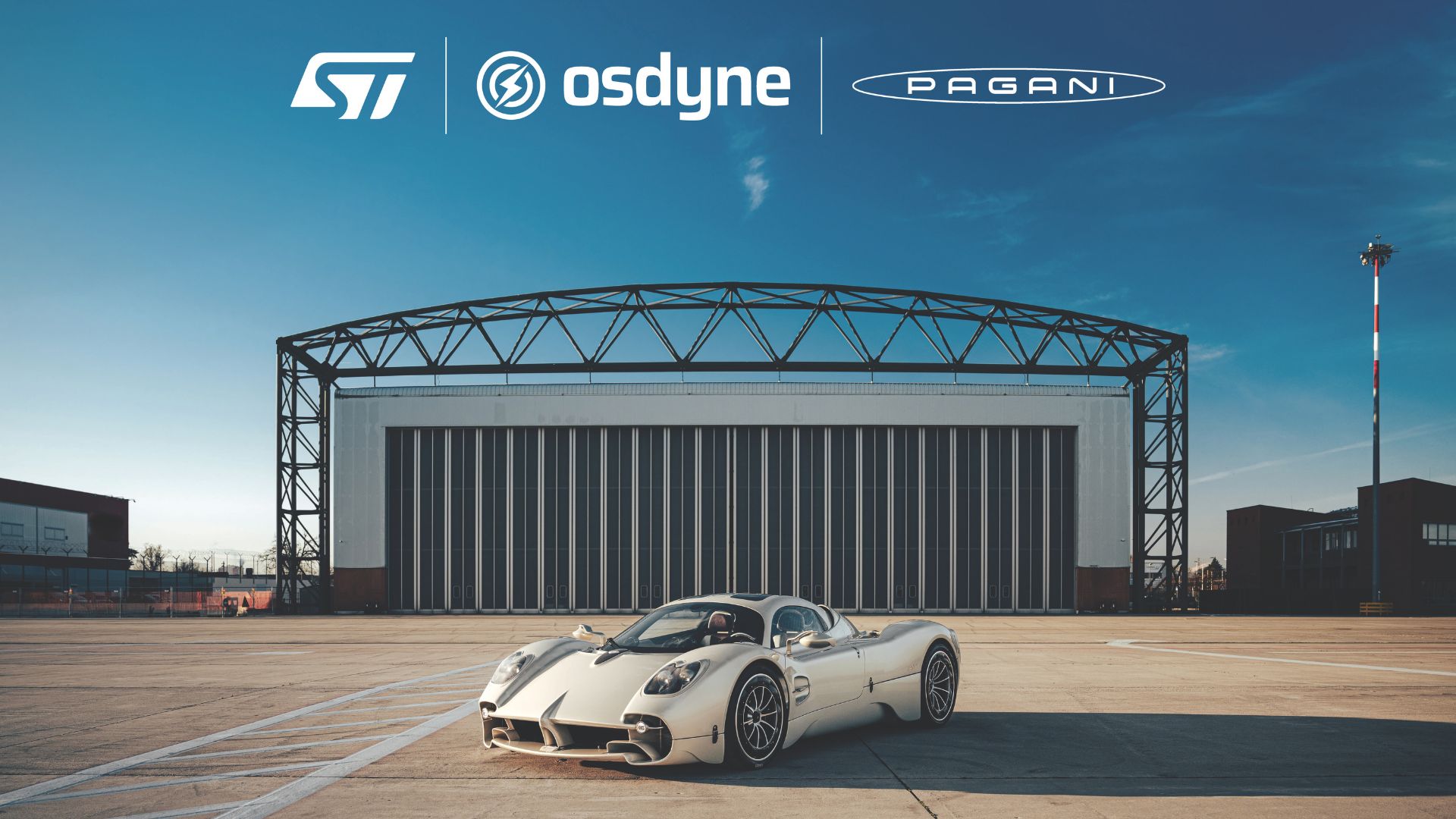
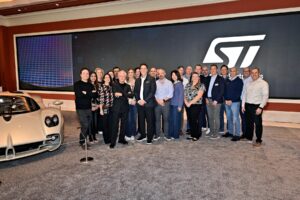
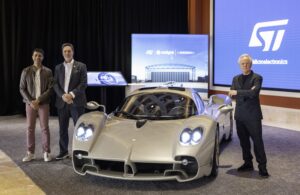
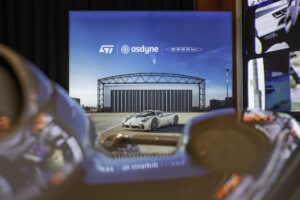
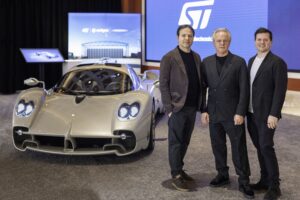
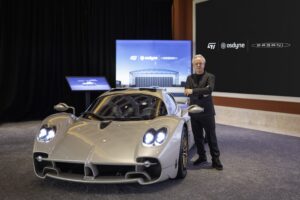
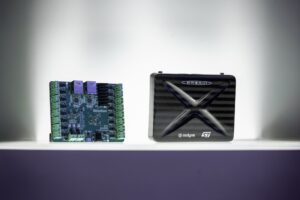
ST is thrilled to host the Pagani Utopia hypercar on its CES show floor, along with a carbon-fiber case from the automotive maker, which houses a gateway featuring a Stellar G and running the osdyne operating system and platform. It’s the first time Pagani has worked this closely and directly with a semiconductor company to source electronic components. It’s also the first time osdyne showcases its platform by creating an automotive gateway running on our MCU and destined for future cars beyond 2030. Together, they are taking advantage of CES to show more than just a vehicle or a board, but a new way of thinking about the future of embedded computing and what it means for engineers today.
Don’t serve technology; let technology serve the experience
Seeking a timeless experience
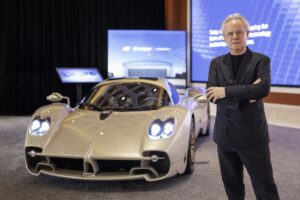
To better understand the “timeless experience” philosophy, we spoke with Christopher Pagani, Head of Marketing for the brand. As he explained,
“The best compliment we receive is that driving a Pagani feels like being back behind the wheel of the greatest cars from the past. We want it to represent the ultimate analog driving experience. However, that doesn’t mean electronics aren’t necessary. On the contrary, today, they are crucial to achieving the results we’re aiming for.”
Christopher explained that ensuring safety, comfort, and performance requires increasingly advanced technology. But maintaining that “analog” feel requires a different approach. While the company used to rely on external partners for software and electronics, the challenges today are different. The gearbox, for instance, needs to convey a premium, mechanical, manual sensation while also protecting the car from driver error. Similarly, no one buys a Pagani for autonomous driving. Yet, there’s a real need for advanced sensors and continuous updates to keep raising the bar on safety—without compromising the driving pleasure Pagani has perfected over the years.
Needing the broad range of ST expertise
It’s for this reason that ST is the first semiconductor company to work directly with Pagani. The carmaker met with our teams for a workshop in Milan, Italy, and chose to work with us, in part, because of the breadth of our offering. Pagani experienced firsthand how ST is leading in sensors, automotive MCUs, power devices, connectivity, wide-bandgap technology, and manufacturing. They, therefore, chose to change the way they interacted with a semiconductor company. Thanks to our vast expertise, Pagani’s teams got to focus on creating the best driving experience while relying on ST to provide the electronics they needed to make it happen.
The lesson we also hope to share is to never treat the bill of materials as a shopping list of disjointed components to be sourced from wherever, whenever. It’s only by relying on a partner with broad expertise that designers can change how they shape experiences. In this instance, driving a Pagani is not only about placing a piece of art behind the wheel, but a piece of history. No matter what, the electronics must never turn this art into an artifice for the sake of a future story. Pagani teaches here that engineers need to focus on serving customers rather than the technology they are trying to use.
Don’t let constraints stifle innovation; let innovation stifle constraints
Breaking artificial limitations
To dive into the more technical aspects of this partnership, we also spoke with Hannes Zanon, General Manager at Pagani. He shared that,
“It may surprise people to know that many of the technologies we implement serve as a test bench for the rest of the industry. Because Pagani has a very different set of constraints than a typical carmaker, such as much smaller production runs, we have the liberty to experiment with and implement technologies that would be prohibitive to others.”
One such example is the automotive gateway on display at CES. Because of inherent constraints, today’s car industry almost always introduces new architectures from the perspective of vehicle electrification. The automotive gateway on display aims to centralize computing to drastically reduce the number of wiring harnesses while offering more features and better performance on a platform that epitomizes the perfect classical driving. As Hannes explained, the gateway provides a new way to aggregate and propagate information to and from sensors and other modules in the car. It’s about embracing the new computing power of embedded systems to serve what has made Pagani cars so appealing.
Finding new applications
Pagani is famous for being the first to use a monocoque carbon fiber since its Zonda back in 1998. The company traditionally drives a prototype about a million kilometers (about 620,000 miles) on tracks and roads before going into production. To say the carmaker is meticulous when crafting its driving experience is an understatement. Hence, we can confidently say that Pagani chose the Stellar G and implemented this hybrid electronic architecture because it fit their extraordinary objectives. Interestingly, for the industry at large, it also serves as proof that even mainstream combustion-engine vehicles can adopt new architectures and embedded systems for the sake of a better experience for their customers. These innovations are not restricted to EVs.
Don’t allow legacy to shape the next generation; let the next generation shape its legacy
Building a new software paradigm
Another person we spoke with was Amit Singh, CEO of osdyne, who explained that,
“We take a lot of inspiration from iOS and Android, both well-designed platforms with rich libraries and developer tools that allow for any and all application logic possible. The mobile revolution truly transformed the world and created a new software economy. That transformation hasn’t happened in embedded software yet. We are bringing the same philosophy to machines.”
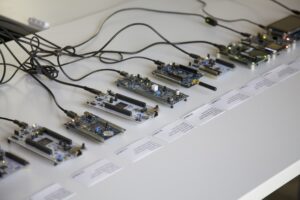
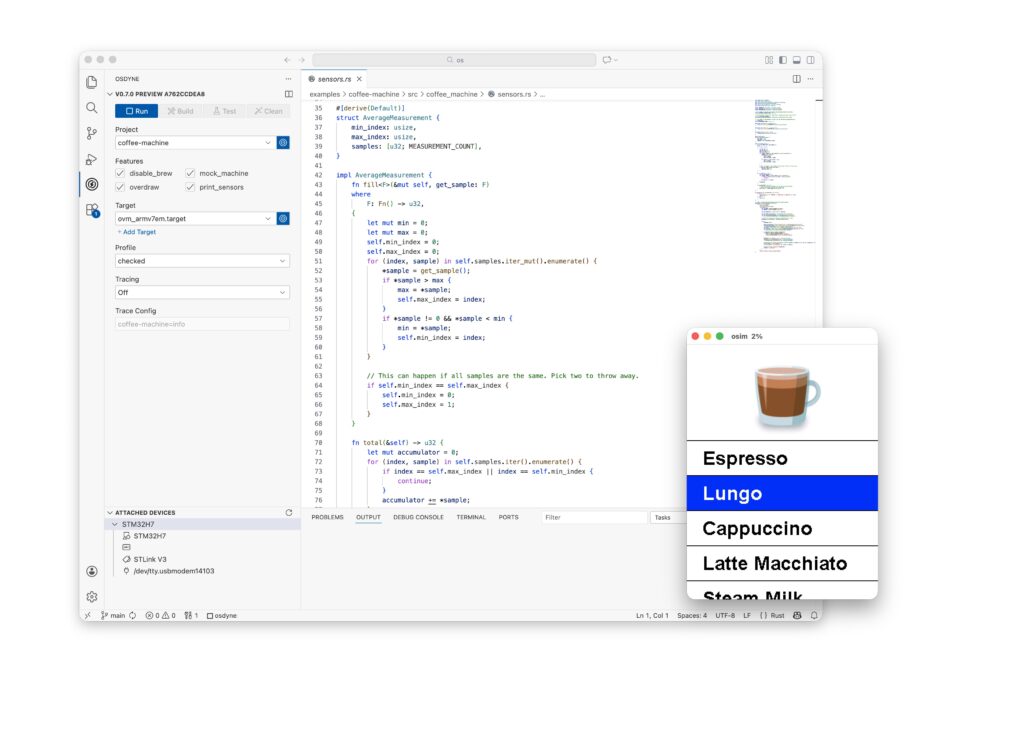
The main challenge, according to osdyne, is that while the general-purpose computing world has undergone this transformation, the embedded software world still relies on legacy or outdated frames of reference. Writing safe, portable software remains a Herculean task, especially as increasingly complex application logic is needed. That’s why the company built osdyne with one guiding principle in mind: what would embedded development be like if the industry were starting over today? The answer is an operating system written in Rust for optimal safety with libraries and tools designed for interoperability and flexibility. osdyne has a single implementation that scales across processor architectures and application types for features such as networking, storage, and encryption, thus vastly simplifying development operations.
Investing in a strong foundation
It’s why osdyne works closely with ST. The software maker not only found the computational throughput needed in our components but also the diversity required in their quest to create the “mobile revolution” equivalent for embedded systems. Its platform not only supports the Stellar G but also nearly all STM32 devices. Thanks to ST’s comprehensive hardware documentation, osdyne engineers have been able to implement first-class support for ST devices within their platform, extracting every ounce of computing power. It’s about relying on ST hardware to build the most flexible and portable platform that can extend beyond a single architecture, whether for vehicle routing, firewalls, diagnostics, telemetry, and body control, or for entirely different applications.
How to approach the next project?
ST didn’t build the Stellar G for Pagani. We built it to be the best automotive MCU possible, and Pagani chose it because our expertise can drive their vision of the optimal driving experience as the carmaker looks ahead. Similarly, osdyne didn’t build its OS and platform to fit the specifications of a car maker. They are redefining embedded systems development to make it more accessible, portable, flexible, and safe. In turn, Pagani reiterated that they don’t want to become a chip maker or a software maker. They want to use the best chip maker for their vision and the best software maker for their application, so they can focus on being the best hypercar maker for their customers.
In an age when companies feel they must design software and sometimes even processors in-house, this partnership is a testament to the fact that the future of computing is about focusing on the experience companies create rather than on the technology itself. And at the center of these interactions, ST provides the hardware and expertise so engineers can master new core competencies that will benefit their customers, rather than reinvent the wheel. We leave the wheel to Pagani.