
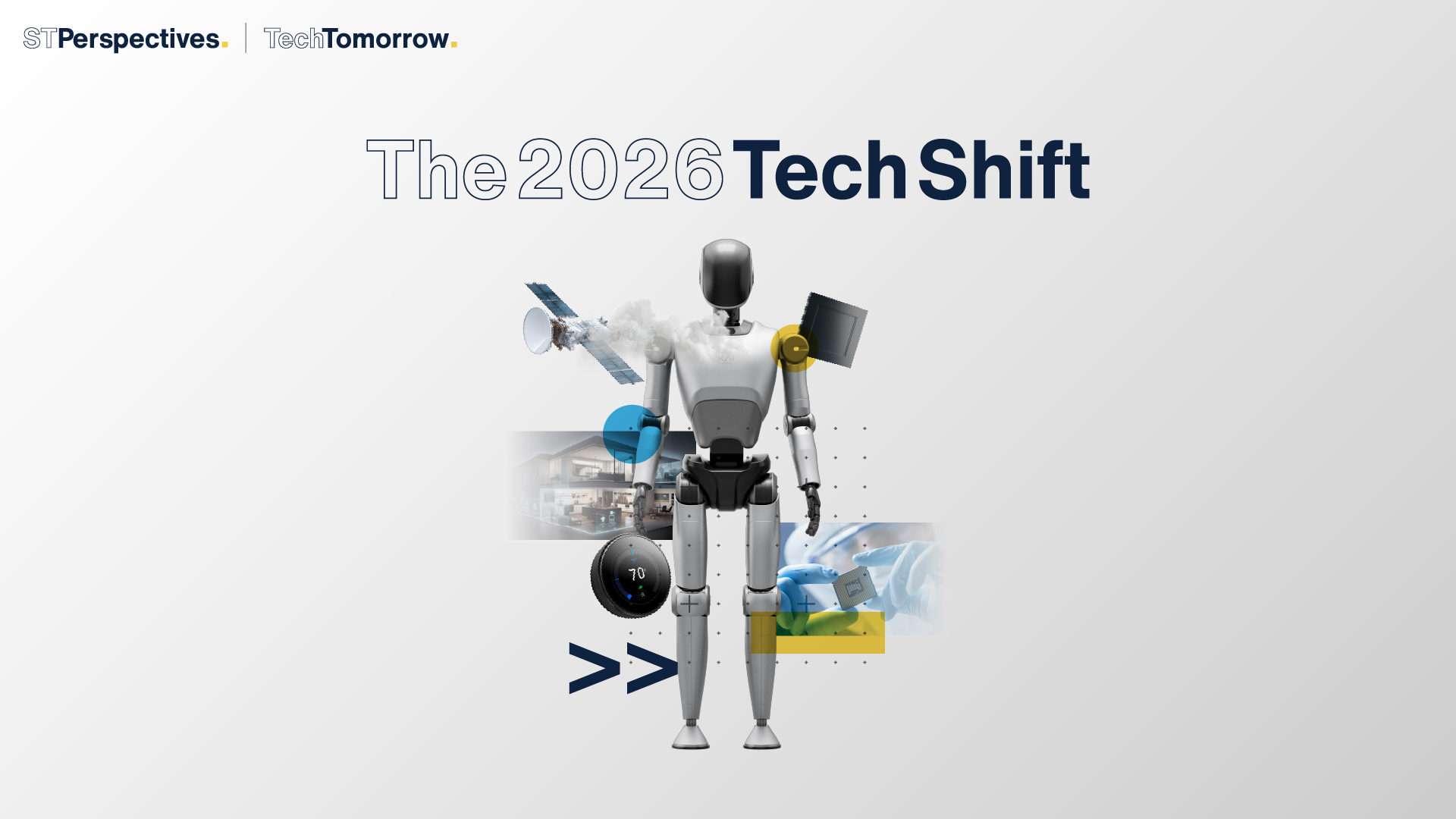
In 2026, a new class of intelligent machines will emerge. Several of the trends we’ve identified are natural extensions of those we highlighted at the start of 2025 with the new year’s advancements driven by the widespread deployment of existing technologies. Industrial sectors, robotics, automotive, consumer electronics and smart homes will all benefit from increased autonomy, underpinned by the specialized silicon platforms and advanced processing that will make this a reality.
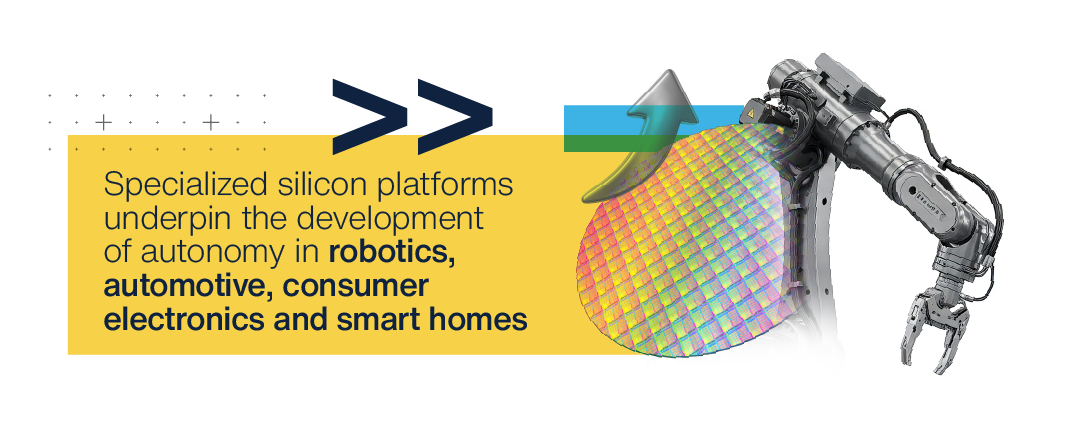
The foundation will continue to be semiconductor material innovation. Silicon carbide (SiC), gallium nitride (GaN) and silicon photonics will support increasing demands for efficient power conversion, thermal management, and data transmission. Architectural advances in neural processors, imaging sensors, microcontrollers and microprocessors will enhance the capabilities of autonomous and intelligent systems. Security of these systems will remain in sharp focus. In summary, our view for 2026 is: smarter machines will be built on faster and more secure semiconductor technologies.
1. Edge AI: Everything, everywhere, all at once
Edge AI innovation continues to be the lynchpin connecting these trends. In 2025, we saw the momentum of more AI finding its way to the edge. For 2026, this momentum accelerates, as embedded AI finds its way into almost every category of device and sensor. These edge AI and TinyML-enabled devices will benefit from enhanced awareness and analytical capabilities, in turn enabling them to act more autonomously. We will also see the emergence of more domain- and application-specific AI chips, optimized for workloads in different environments and sectors.
The next evolution of robotics (see below), industrial systems, automobiles, smart home technology, consumer devices and more will be supported by powerful and energy-efficient AI at the edge. In turn, these will become more active participants and partners in every aspect of our lives.
2. Robots start speaking a different language
Large language models (LLMs) – AI trained on massive text datasets – have been dominant in the AI discussion of recent years. As highlighted last year, these advancements, along with those in neural processing, allowed machines to “think” better. A new type of model will help turn thinking into action in 2026. New large action models (LAMs), sometimes called vision-language-action (VLA) models, are enabling robots to interpret their surroundings, make decisions, and perform tasks in the physical world, what some are calling “embodied AI”.
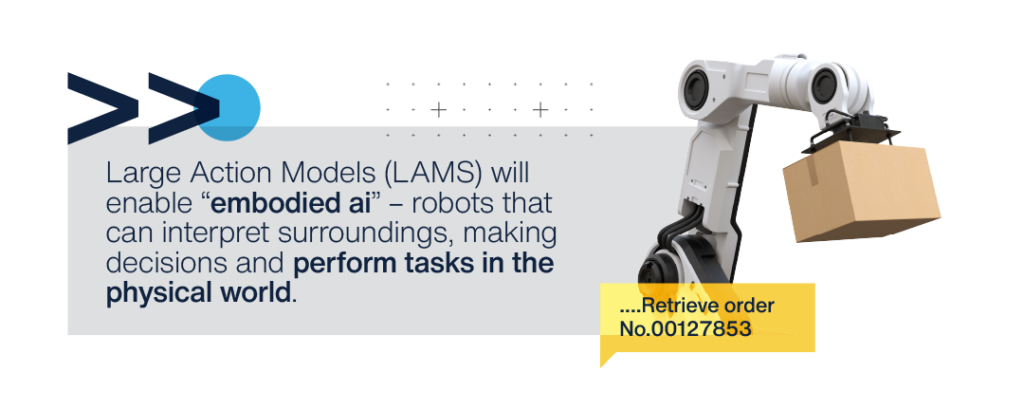
LAMs supporting robotic inference will drive the widespread emergence of edge AI-powered cobots working alongside humans, deployments of humanoid robots, and autonomous industrial systems that act independently with advanced sensing and motor control. The combination of enhanced intelligence and dexterity will pave the way for robotics to move from factories into retail, hospitality, and the home.
3. Quantum progress becomes a cyber priority
Last year we predicted how the ability to use traditional semiconductor technologies would help advance the development of quantum computing. This has been the case, and the coming year will see quantum computers based on FD-SOI processes move from the lab to deployment. However, in 2026, the quantum-related priority for all organizations will relate to one topic: cybersecurity.
Cybercriminals are already preparing to add quantum computing to their armory through cryptographically-relevant quantum computers (CRQCs). They are harvesting encrypted data today, confident that quantum computing will provide the power to access it in the future – which poses a real and immediate risk to every organization. Post-quantum cryptography (PQC) provides a solution; PQC algorithm standards being established and made available to preemptively secure devices and software. The time to act is now.
4. A tipping point for autonomous vehicles?
Self-driving taxis provide the highest profile examples of the progress of autonomous vehicles, underpinned by advances in LiDAR, AI-enabled cameras, and integration with infrastructure. The number of cities around the world allowing the use or trial of so-called “robotaxis”, notably in the US and Asia, grew significantly in 2025, suggesting positive momentum. Challenges remain, with Level 4 autonomy remaining restricted to controlled environments (Level 5 being complete autonomy in any environment) and major manufacturers scaling back timelines to full autonomy.
Consumer confidence is also a barrier to adoption, though studies have shown that acceptance is far higher following use. With the opportunities increasing for consumers to experience the benefits, along with technological enhancements and efficiencies, 2026 should see progress accelerate.
5. Homes become even smarter, better connected and more secure
In 2026, several trends will converge to transform domestic technology. Edge AI, advances in connectivity protocols such as Matter and Thread, and approaches to security adopted from the commercial environment will make our homes smarter, better connected, and more secure.
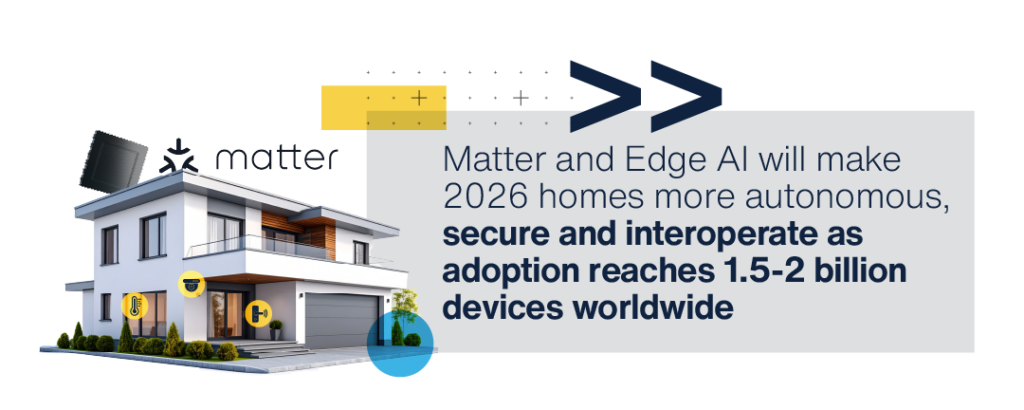
Improving the collection and sharing of data between domestic devices along with increased intelligence at the edge will act as a force multiplier, delivering what analyst Gartner has defined a “ambient intelligence”. Among other benefits, this will allow for the creation of domestic digital twins, a concept we touched on in 2025 as an opportunity in every sector, optimizing the efficiency of our homes.
As smart homes become more intelligent and connected, cybersecurity will be an increasing concern. We expect to see principles crossing over from commercial environments to the home, and in particular best practice such as a Zero Trust approach to security in smart home technologies.
6. The integration of satellite and terrestrial networks
As we predicted in 2025, there has been no slowdown in the desire to launch more satellites into space, and particularly those low Earth orbit (LEO) satellites forming part of the communications mega-constellations. 2026 will see advancements in how these satellites are used to provide truly global connectivity. For communications network operators, the decision between traditional terrestrial networks and the growing mega-constellations of low Earth orbit (LEO) satellite networks is no longer “either/or”, but “both”. Mobile network operators are already integrating LEO networks as backhaul, filling coverage gaps in earth-based networks or to improve connection speeds.
This integrated use of networks will continue in 2026, creating a unified “network of networks”, managed by AI and advancing towards goals for seamless global connectivity. The economic and educational benefits to previously unconnected parts of the globe will be huge, with significant additional enhancements to connectivity across worldwide consumer, commercial and industrial sectors.
7. A revolution in imaging
Imaging technology provides the foundation for many of the innovations that allow devices to operate more effectively and efficiently. Yet the central concept of lenses as stacks of curved glass to refract light has remained unchanged for centuries. Metasurface technology shifts this paradigm by recreating optical functions on perfectly flat, ultra-thin layers patterned with nanostructures. Imaging becomes smaller, less costly, and more flexible wherever it is embedded. Imaging improvements will impact every area of life, work, and industry, from more spatially-aware robotics and automobiles, to more secure devices, from enhanced photography to applications that vastly improve power efficiency.
2026 wrapped
Technology rarely moves in straight lines, but the direction is becoming clearer. The trends emerging for 2026 indicate a world shaped by greater autonomy, deeper intelligence, strong intelligence and more, all shaped by advances in semiconductor technologies. The opportunity for organizations that understand these trajectories early enough is to simply react but to shape what comes next. The systems designed today will define how people live, work and connect with each other in the years to come.
The future is already taking form, it’s a matter of how boldly we choose to build it.
- Discover more on our product portfolio