
STMicroelectronics is enabling a shift from dedicated audio wiring to Audio over Ethernet in next-generation vehicles. The Stellar G6 automotive MCU integrates hardware-level Time-Sensitive Networking, Media Clock Recovery, and a dedicated communication engine to deliver high-fidelity, zero-jitter audio over the vehicle’s existing Ethernet backbone. The approach eliminates the need for proprietary A2B cables and transceivers, saving automakers approximately $70 per vehicle while enabling new capabilities such as real-time Active Noise Cancellation at the zonal level. A joint solution with AutoCore has already demonstrated end-to-end latency under two milliseconds, and ST is showcasing the technology live at Embedded World 2026 in Nuremberg.
Bringing high-fidelity audio to the software-defined vehicle
In a car, sound is personal. Listeners sit in fixed, asymmetrical positions surrounded by dozens of speakers, and their brains are ruthlessly precise about timing. A delay of just five milliseconds between two speakers is enough for the Haas Effect to kick in, tricking the listener into “pinning” the sound to whichever speaker fired first. A delta of two milliseconds can pull the entire soundstage to one side of the cabin, destroying the “phantom center” that makes a singer feel like they’re standing on the dashboard. When speakers fall slightly out of sync, sound waves collide destructively, creating nulls in the frequency response that make audio sound hollow or metallic. This is comb filtering, and it’s the acoustic signature of a timing problem.
These are not edge cases. They are the everyday reality of in-cabin audio, and they explain why the automotive industry has relied on dedicated wiring like A2B (Automotive Audio Bus) for so long. A2B is effective, but it demands its own cabling and transceivers, adding weight, complexity, and cost to the vehicle harness. Now that the industry is shifting toward Software-Defined Vehicles and zonal architectures, a new question is taking center stage: can a single Ethernet backbone carry diagnostics, control signals, and high-fidelity audio at the same time, without compromising the millisecond precision that human hearing demands?
With the Stellar G6 automotive MCU, we set out to prove that it can.
Latency is a number; jitter is the real enemy
Engineers often focus on latency, the constant delay between source and speaker. However, in automotive audio, jitter is far more destructive. Jitter is the variation in that delay. On a standard Ethernet network, an audio packet can get stuck behind a burst of sensor data. If the delivery time “jitters” by even a few microseconds, it introduces phase distortion that smears the music. For applications like Active Noise Cancellation, where a microphone signal must be inverted and played back through a speaker in near real-time, jitter doesn’t just degrade quality. It breaks the physics entirely.
Solving this requires more than a fast processor. It requires determinism , meaning the guarantee that a packet arrives exactly when it’s supposed to, and clock coherency, ensuring every node in the vehicle shares the exact same nanosecond. These are hardware problems, and they need hardware answers.
What Stellar G6 brings to audio over Ethernet
The Stellar G6 was engineered to treat audio as a time-critical stream, not as generic data. Three hardware-level capabilities make this possible. First, the Stellar G6 features a built-in L2+ Ethernet Switch supporting the full suite of Time-Sensitive Networking (TSN) standards. IEEE 802.1AS (gPTP) synchronizes every node in the vehicle to a sub-microsecond master clock. IEEE 802.1Qbv (scheduled traffic) creates protected time slots for audio and microphone data, ensuring they always get priority even on a congested network. IEEE 802.1CB enables seamless redundancy through Ethernet ring topologies, eliminating the single point of failure that plagues traditional star configurations.
Second, even with a perfectly synchronized network, the audio sample clock can still drift. The Stellar G6 includes specialized Media Clock Recovery hardware. Rather than relying on a software-based PLL, a dedicated digital hardware loop recovers the Audio Master Clock directly from the Ethernet stream, keeping speakers and microphones in perfect phase. The result: virtually zero jitter on the recovered clock, which is the critical enabler for professional-grade audio delivery.
Third, Stellar embeds a dedicated communication engine that offloads all data-moving and synchronization tasks from the main CPUs. This hardware isolation means that a processing spike in the vehicle’s body-control zone cannot cause a pop or a glitch in the audio. Communication runs at the lowest possible latency, completely decoupled from whatever else the host cores are doing.
From central processing to localized intelligence
Traditionally, all audio processing happened in a central head unit. Moving to an Ethernet-based zonal architecture changes this fundamentally. With a Stellar G6 acting as the Zonal Controller at each vehicle zone, significant compute now sits closer to every speaker and microphone.
This unlocks capabilities that were previously impractical. In-Cabin noise cancellation becomes possible by placing microphones near individual seats, identifying noise sources such as a loud conversation in the rear, and cancelling them locally. Road noise cancellation works on the same principle: the system captures vibration and road noise through zone-level microphones, generates an anti-noise signal, and plays it back through nearby speakers with near-zero latency. The processing happens at the edge, in the zone, rather than travelling back and forth to a central unit. For the passenger, the result is a cabin that can become a sanctuary, a workspace, or a private sound bubble, all updated over-the-air as easily as a smartphone app.
The cost equation: saving up to $70 per vehicle
Beyond acoustic performance, Audio over Ethernet carries a straightforward economic argument. By eliminating dedicated A2B cables and transceivers and reusing the vehicle’s existing Ethernet backbone, automakers can save approximately $70 per vehicle. In an industry where every cent on the bill of materials is scrutinized, consolidating audio onto a network that already exists for diagnostics and control is not just elegant engineering. It’s a significant cost reduction that scales across millions of units.
From proof-of-concept to production validation
In January 2026, we announced a collaboration with AutoCore on an Ethernet-based Zonal Controller distributed audio solution. By combining Stellar G6’s Media Clock Recovery with AutoCore’s TSN protocol stack, the joint solution achieved end-to-end audio latency of less than two milliseconds. That is fast enough to run high-performance Active Noise Cancellation over a standard Ethernet backbone.
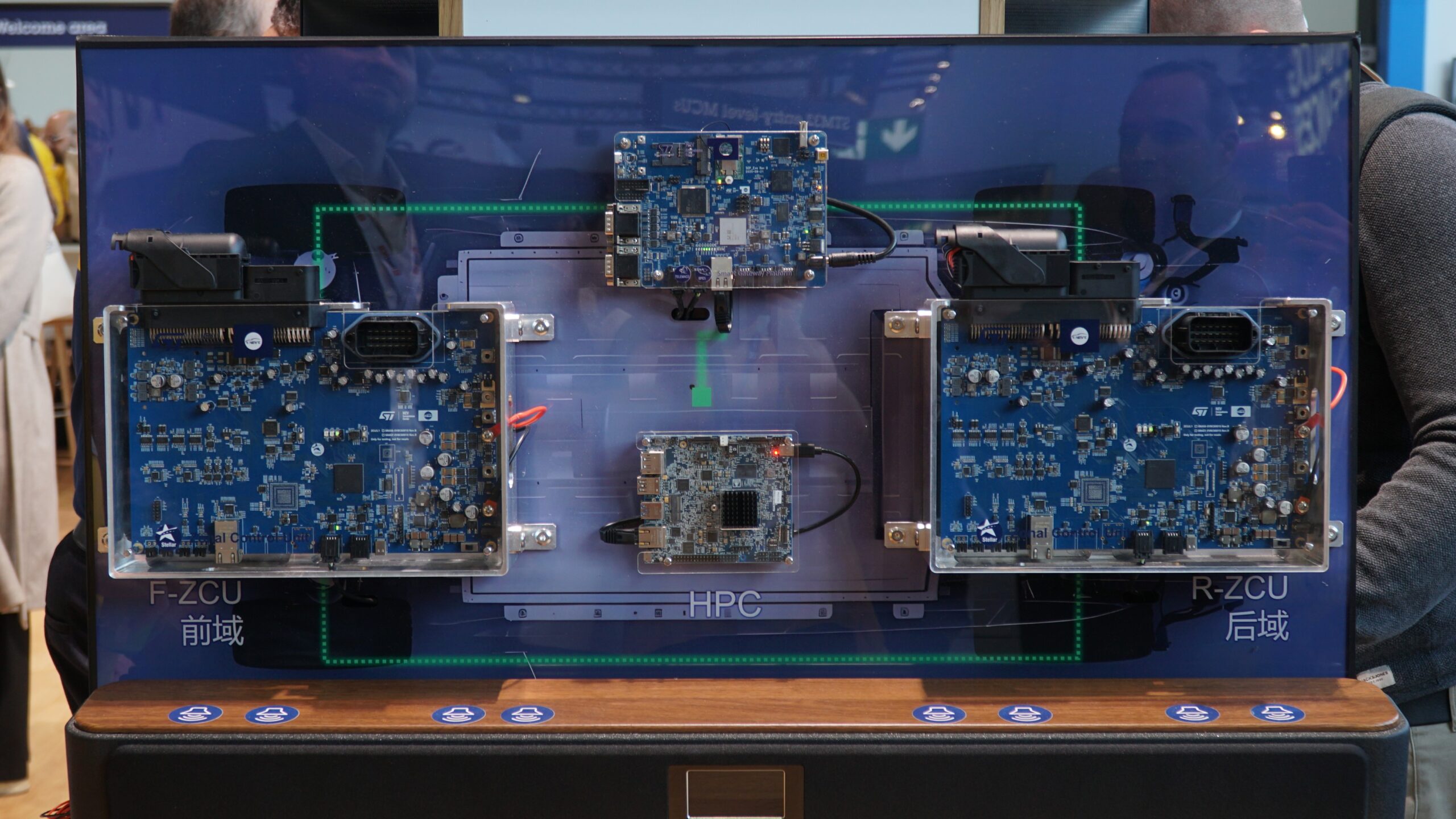
At Embedded World 2026, we are taking this further with a live demonstration of Stellar G6’s native Audio-over-Ethernet capabilities. The demo features two Zonal Controller Units, each built around a Stellar G6, connected in a ring topology. Each ZCU streams four channels of 24-bit audio over Ethernet, for a total of eight high-fidelity streams running simultaneously. Visitors can witness the audio clock recovery in action, hear the zero-jitter playback quality firsthand, and see the resilience of the ring topology through live plug-and-unplug trials that demonstrate fault tolerance without audio interruption. It is a concrete, audible proof point: dedicated audio cables are no longer a requirement for premium in-cabin sound.
The Ethernet backbone as the nervous system of the SDV
We are moving toward a future where the vehicle’s Ethernet backbone becomes its nervous system, and Audio over Ethernet is one of the most visible, and audible, ways this transformation is taking hold. When a vehicle can use its Zonal Controllers to deliver immersive sound, suppress road noise, or create a private acoustic zone for every passenger, the concept of what a “car” offers fundamentally changes.
Stellar G6 is not just a processor in this journey. By solving one of the most demanding timing and synchronization problems in hardware, it allows automotive engineers to focus on the experience rather than the plumbing. As the industry embraces the zonal revolution, we are ready to help redefine what the drive actually sounds like.