
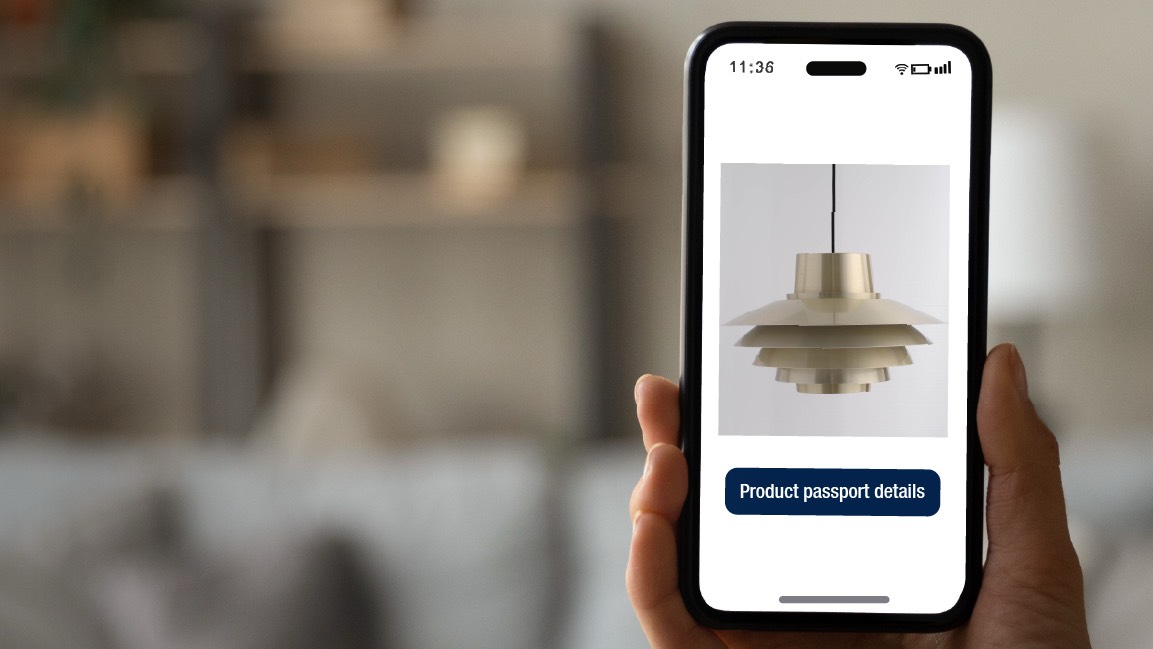
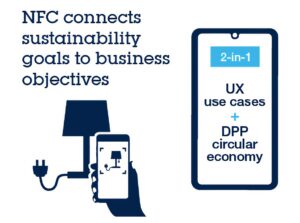
By 2027, nearly all markets in the European Union will be required to provide a Digital Product Passport (DPP). Surprisingly, many businesses and customers are not only unaware of it but also lack the perspective to understand the regulation and the opportunity it represents. In a nutshell, a data carrier, in the form of an NFC tag, QR code, or UHF module, will provide immediate and valuable online information to customers, such as the origin or content of a product, recycling guidelines, available updates, warranty information, ownership transfers, links to relevant content online, like manuals, and a lot more. What does it mean for customers and businesses? Let’s find out.
Digital Product Passport and the data carrier
What is a data carrier?
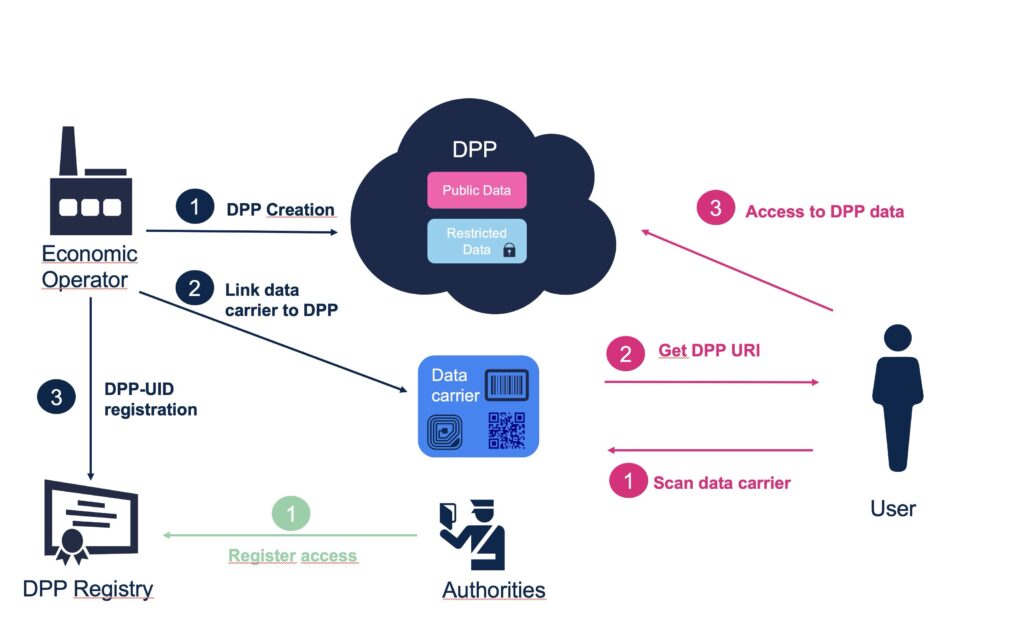
According to EU regulation published in 2024 (Chapter 1, Article 1, Section 29), “‘data carrier’ means a linear barcode symbol, a two-dimensional symbol or other automatic identification data capture medium that can be read by a device.” Manufacturers must adhere to a strict list of requirements, which greatly limits what constitutes a lawful data carrier. According to the regulation, it must include a “unique product identifier” and a “unique operator identifier” and be physically present on the product, its packaging, or its documentation. As a result, it cannot be a generic label and must include information accessible offline to protect customers from link rot or a manufacturer’s disappearance.
Why NFC, QR code, or UHF?
To keep the regulation relevant to the various industries that must showcase this new Digital Product Passport, the EU is consulting with market leaders and will draft delegated acts which could supersede ESPR (Ecodesign for sustainable products) by defining additional requirements. In that context, delegated acts could define the data carrier to use for each domain. Indeed, besides food, feed, and medicine, nearly all markets will require the use of DPP. Hence, while requirements will vary, nearly all cases will prioritize one of three technologies: NFC, quick response (QR) codes, or UHF. Since the data carrier must be “easily accessible by scanning,” according to the EU framework, and smartphones are so prevalent, QR codes and NFC tags are often the data carriers of choice for industries that are not already relying on dedicated RFID readers.
How is it more than carrying data?
There are other considerations, such as reliability over the product’s lifespan. For instance, a QR code on a document is far more likely to be scratched, lost, or damaged than an NFC Tag embedded in the product. Even engraved codes on metal pieces, such as those found on EV batteries, aren’t immune to this. Similarly, certain technologies can store much more data and offer additional features, such as encryption. This is particularly important for products that must deal with counterfeiting, data poisoning, ownership transfers, warranty fraud, and more. Furthermore, a data carrier like NFC may be easier to scan than UHF because nearly all smartphones now include a compatible reader.
Digital Product Passport and the data being carried
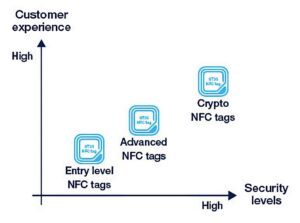
ST is working with many companies to help them prepare for DPP and, more importantly, reach their customers with valuable information while offering tags for a wide range of budgets. The reason is that while the EU mandates some information, we expect all ranges of products, from low- to high-end, to provide way more data to gain a competitive advantage. Moreover, products already using near-field communication would benefit from the technology, with near-zero marginal costs and new ways to build brand awareness and loyalty, enhance transparency, offer anti-counterfeiting, and improve customer interactions. That’s why we are working with partners to help them meet DPP requirements and more using our SDK and other development tools.
Where to begin?
The ability to meet the new EU requirements easily will also be important, as industries with little to no experience with data carriers will have to rapidly learn to integrate them into their products to remain competitive. For instance, furniture makers will not only have to use new technologies to provide a unique product ID as required by new regulations, but can also gain an edge over the competition by offering additional information on maintenance, or share a unique story about the product, the materials’ provenance, the inspiration behind the design, proof of authenticity, and more.
All this would be impossible to fit onto a QR code or impractical on a UHF module, but already works on an NFC tag as luxury goods have already demonstrated. Brands are already using devices like the ST25T to deliver more value without altering the product’s aesthetic at scale. It has never been easier to find partners to guide companies with no experience in adding a tag and its inlay to non-electronic goods. It also means that a new generation of customers is becoming accustomed to getting more digital content from products that previously had none. Put simply, market expectations are shifting from asking why use NFC to how a brand is using the technology.
On the other end of the spectrum, companies more familiar with technologies can use NFC tags and dynamic tags, such as the ST25D family of devices, as an alternative to content that typically lives online. As companies rely on the cloud to provide additional information to their customers, an NFC tag can store some of this data for offline retrieval. This is especially important for information critical to the user experience, such as troubleshooting steps or a serial number. There are no European Union regulations mandating such a mechanism, but a recent article published by the NFC Forum attests to a growing desire to go beyond basic compliance to offer a unique experience.
Another reason to use a dynamic tag would be to leverage its unique I2C interface with the microcontroller. Thanks to this link, users can get up-to-date information on specific products, such as batteries. For instance, an eScooter could carry a digital passport that uses a dynamic tag that offers updated information on the battery’s health, such as the number of charge-discharge cycles, the total remaining battery capacity, and more. All of a sudden, what started as a simple way to track unique identifiers becomes a powerful system that educates and informs consumers, leading to better management and a longer lifespan before replacement.
Where to go next?
And this is just the beginning. Other regulatory agencies around the world are already considering replicating the EU’s initiative. Concretely, adopting DPP could help companies prepare for future international regulations. It also means that choosing a data carrier with some overhead and flexibility would enable companies to more easily meet future requirements. That’s exactly why ST anticipates NFC to be the data carrier for a wide range of products and industries, as no other solution offers the same amount of future proofing.