
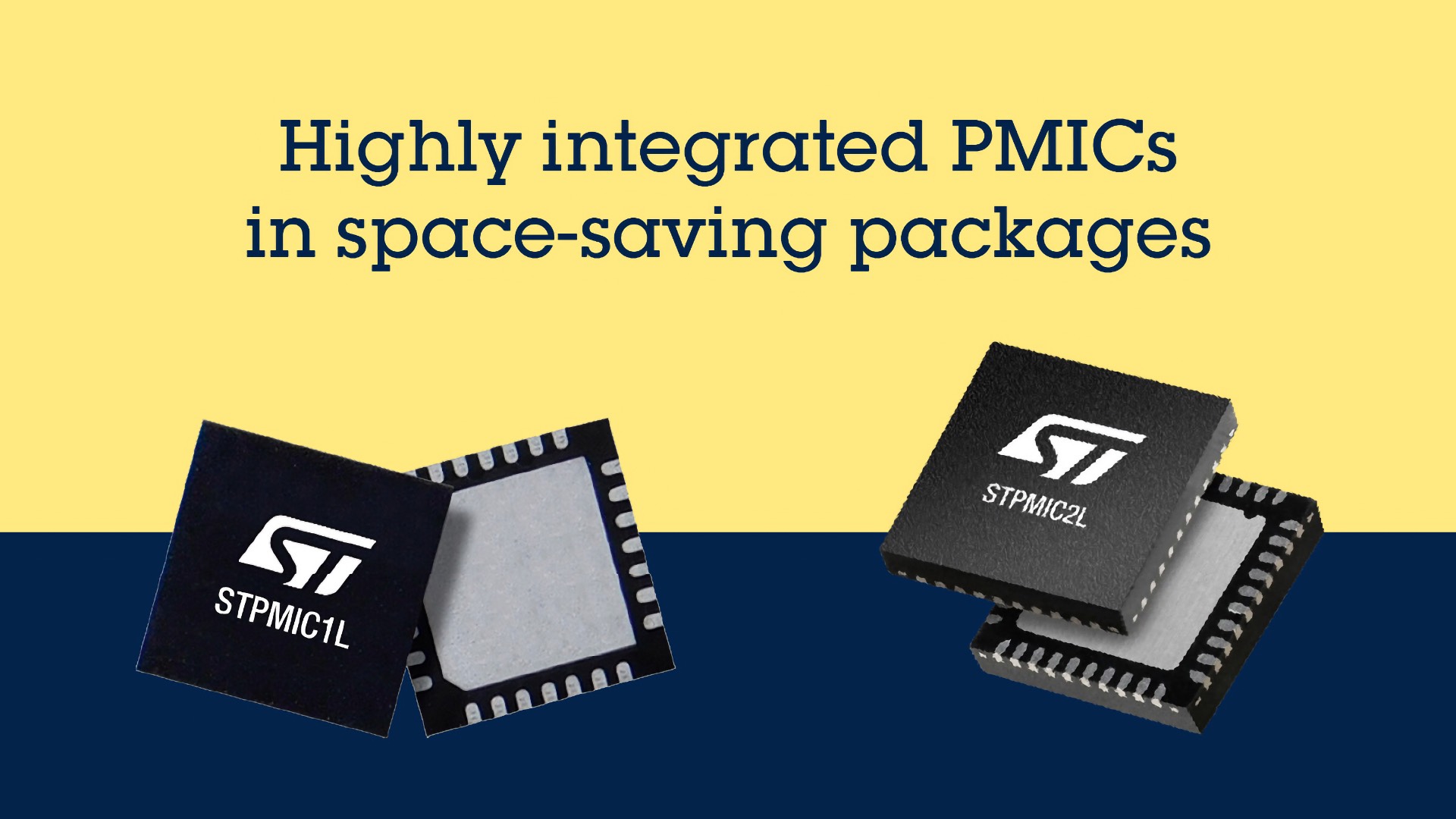
ST is launching today the STPMIC1L and STPMIC2L, two new power management ICs tailored for the STM32MP13x and the STM32MP23x/21x, respectively, thus making them even more affordable and accessible by matching the number of power rails a system using those microprocessors would require. After having launched the STPMIC1 seven years ago and the STPMIC25 alongside the STM32MP2, we are seeing an increasing rate of adoption with early customers already evaluating the new STPMIC1L and STPMIC2L. This is validation that our community increasingly seeks power management solutions that simplify their bill of materials, leverage the capabilities of their STM32 MPU devices, and benefit from the broad ST ecosystem, which includes reference designs and schematics.
How it started?
Learning from the STPMIC1
The STPMIC1 features four buck converters, a boost converter, six LDOs, and two switches. In essence, it was our first power management IC for our first MPU, and, as such, ST designed it to support the broadest possible use cases. That’s why it is our only STMPIC with a boost converter for a switched-mode power supply powering USB ports. Indeed, in a battery-powered application, the input current would be insufficient to supply the required 5 V, necessitating a boost converter. However, as customers used our product, we learned most consumers were not using it, which led us to take a completely different approach with the STM32MP2 microprocessors.
Building with the STPMIC25
Indeed, one lesson we have learned since launching the STMPIC1x is that customers strongly favor solutions that simplify their designs. Concretely, that meant that while the first STMPIC helped power the MPU, the flash, and the RAM, the STPMIC25 took on an even bigger role by also powering the USB controller, the GPU, the Ethernet port, PCIe lanes, and more. It partly explains why the adoption of STPMIC skyrocketed. According to rough internal estimates, about 60% of our customers who use an STM32MP1 also chose to use an STPMIC1. However, that number rose to nearly 100% with the STM32MP2 and the STPMIC25, especially since the latter also helps leverage MPU features such as dynamic voltage scaling.
Understanding new trends
Over the years, we also noticed one particular trend: customers who chose to implement their discrete solution almost always did it for cost reasons. They embraced the added complexity and the more intricate PCB layout because their operations enabled them to reduce costs by tailoring their power management system to their specific needs. As a solutions provider, ST was sensitive to this, and we even helped customers who chose this particular path, thus making our platform more accessible. We also learned from their experience and are now offering the STPMIC1L and STPMIC2L, which make discrete ICs significantly less relevant and cost-effective.
Where is it going?
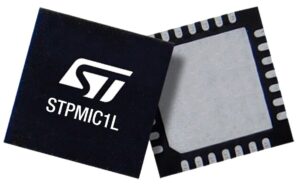
STPMIC1L
The STPMIC1L reduces the number of buck converters to two and the number of LDOs to four, compared to the STPMIC1, with one LDO for the RAM and one for USB. Engineers can then use the other two for the flash and I/Os, thus serving systems with more basic needs that don’t require more than six power rails, which is why the STPMIC1L serves the STM32MP13x. This tighter design also led to a smaller 4 mm x 4 mm VFQFPN28L packaging. Comparatively, the STPMIC1 uses a 5 mm x 6 mm QFN44L package. Additionally, despite the smaller size and greater cost effectiveness, the STPMIC1L still features the same fault protection and monitoring capabilities as the STPMIC1.
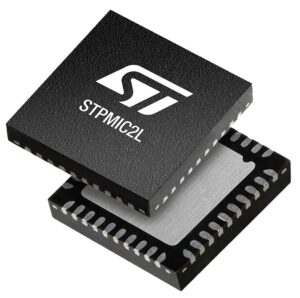
STPMIC2L
The STPMIC2L takes the STPMIC25 but shrinks it down to three buck converters and seven LDOs, with the same dedicated LDO for RAM and USB as the STPMIC1L. The new device serves the STM32MP23x and the STM32MP21x. Indeed, for applications that use the latter MPU, three buck converters will be sufficient. However, designs using the STM32MP23x may sometimes require more. Hence, we ensured that both the STPMIC25 and the STPMIC2L could serve the STM32MP23x, enabling designers to choose the option that best suits their needs. The new power management IC also comes in a smaller VFQFPN40L package (5 mm x 5 mm) instead of the 6.5 mm x 6.5 mm WFQFN56L package used by the STPMIC25.
Evaluation kits
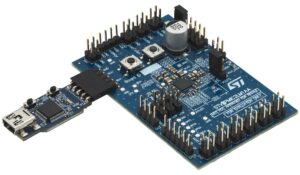
The best way to start experimenting with the new devices is to grab a development kit, such as the STEVAL-PMIC1LKV1 and the STEVAL-PMIC2LKV1. Both include a board and a USB dongle, which enables access to the I2C interface needed to configure the STPMIC devices by setting registers that define voltage settings, power sequences, protection thresholds, and more. We even ship a GUI (the STSW-PMIC1LGUI and STSW-PMIC2LGUI) to make the process even more accessible, providing one of the best ways to program the integrated non-volatile memory. We also offer circuit schematics to help designers with their PCB layout.