
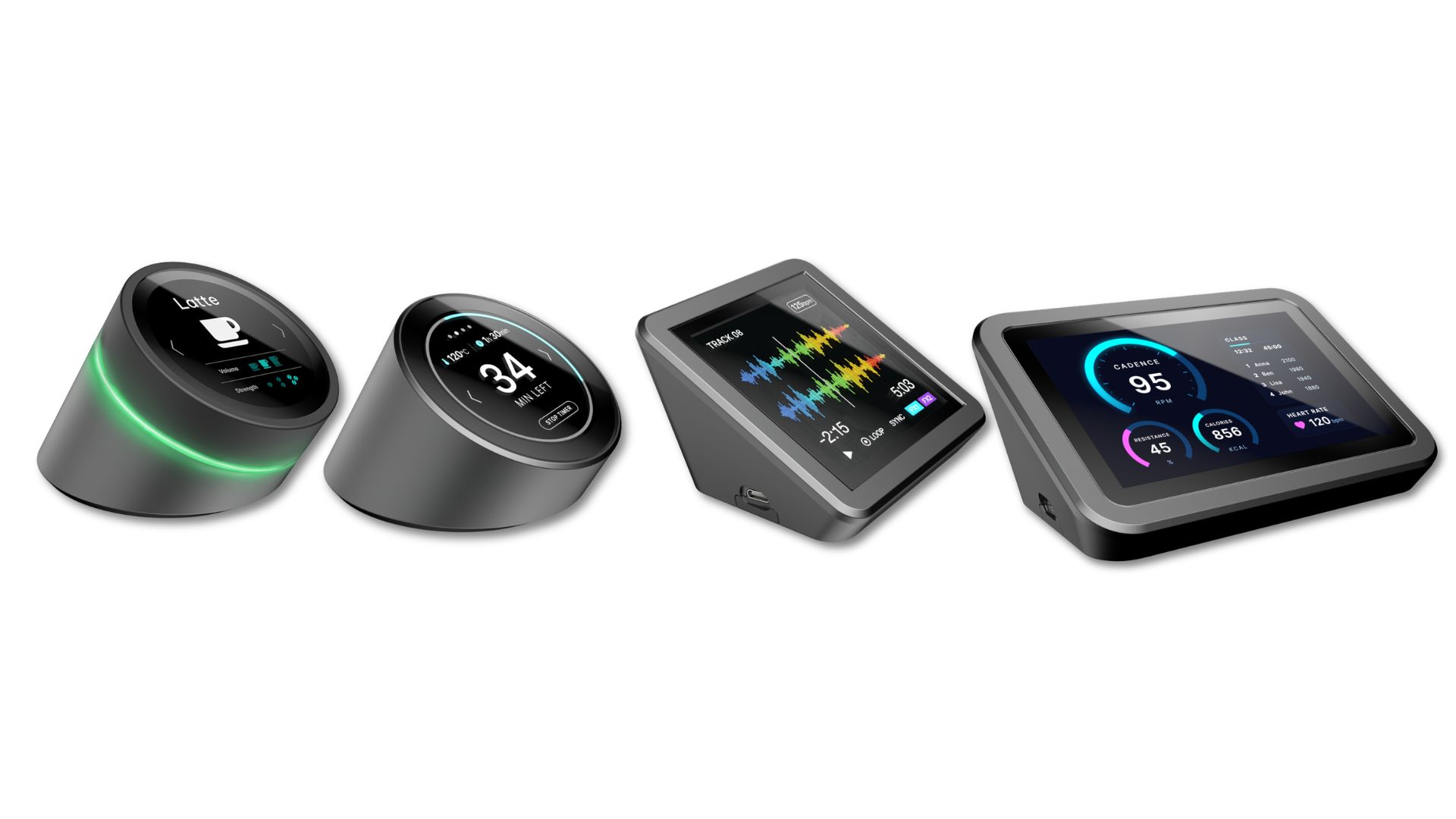
DRAGONEYE™ from AndersDX, a member of the ST Partner Program, has a clear goal in sight: drastically reduce the time engineering teams need to evaluate IP65 and non-IP65 rotary encoder touch displays. Unlike traditional evaluation kits, DRAGONEYE is production-intent hardware. The same module architecture used for prototyping can scale into final production-ready designs with a functional MVP in 24 hours. As demand grows for digital displays to replace traditional knobs, companies increasingly seek faster development, lower costs, and pre-configured solutions that can scale into production. Let’s, therefore, explore what takes place behind the screen of the DRAGONEYE and what lessons developers can learn from it.
Why aren’t there knob displays everywhere already?
Growing in popularity
Rotary displays and knob-style interfaces are gaining momentum, as avid readers of the ST Blog recently saw with the STM32C0. These interfaces offer an intuitive and cost-effective way to interact with graphical user interfaces, thus helping products stand out from their competitors. End users can scroll through menus, adjust parameters, toggle features, and more easily understand what the interface conveys. Solutions like TouchGFX have also made it far easier to develop a GUI for these types of displays. However, developing a rotary display solution still requires expertise across multiple domains: encoder sensing, firmware architecture, framebuffer memory management, GUI rendering, mechanical integration, and environmental sealing. Each of these elements introduces technical risk and can extend development timelines by months.
Fighting constraints
If a knob display can provide rich interactivity while keeping costs down, it also means teams must work within tight constraints. For instance, anything involving graphics can quickly increase RAM usage, flash requirements, and computational load. Consequently, developers may spend months understanding their hardware platform, optimizing drivers, and experimenting to find the best framebuffer strategy. And that’s not even accounting for the design. These considerations often create a gap between managers who want a knob interface and their engineers, who know how hard it will be to implement one.
Facing physical hurdles
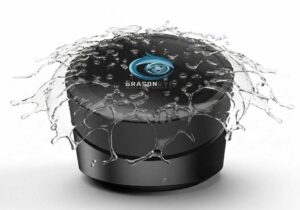
It can be hard to source a display in small quantities, as teams work on a proof of concept and then ramp up demand once a company is ready to manufacture its final product. Moreover, integrating the rotary display into a product can be a significant engineering challenge that’s often overlooked because it requires driver development, firmware tuning, and complex integration. Whether it’s in a smart home appliance, HVAC system, or an industrial setting, there are critical environmental considerations, from EMI protection to long-term reliability in harsh conditions. That’s why teams often need more than just proof of concept; they need a partner that can support them throughout the development process into production.
DRAGONEYE, Enabling rotary knobs at scale
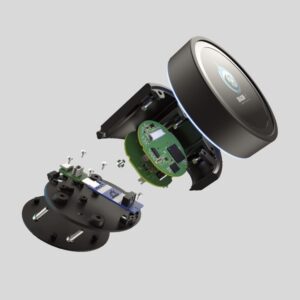
DRAGONEYE is a pre-integrated module combining an on-board STM32 MCU (U5, G0, or H5 depending on size & resolution), an IP65-rated rugged mechanical structure for ingress protection, a pre-integrated display driver and capacitive touch controller, a rotary encoder with integrated haptic feedback, and RGB LED rings, and a pre-validated firmware architecture based on STM32 ecosystem tools. AndersDX has recently developed its next-generation platform, which will use the STM32U5 series to benefit from its ultra-low-power operation, its NeoChrom GPU, and its hardware-based security.
A plethora of models
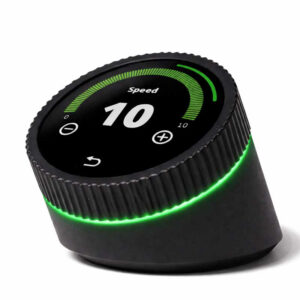
Concretely, Anders developed three DRAGONEYE-ROTARY variants. The latest model, arriving next month, uses an STM32U5 with a 2.1-inch 480 × 480 capacitive touch display and haptic feedback. All variants are fully IP65 sealed for harsh environments. The smaller 1.3-inch 240 × 240 STM32G0 version is ideal for simple instructional graphics, such as audio controls, coffee machines, and showers. Additionally, a 1.8-inch 360 × 360 STM32H5 model will follow in Q3, 2026, for similar applications, including professional kitchen equipment. Users can also choose a touch-panel-only version of the 2.1-inch STM32U5, with larger 4-inch square and 5-inch rectangular variants arriving later this year. These larger models will include Bluetooth, Wi-Fi, and USB connectivity.
A myriad of optimizations
Underneath all this, DRAGONEYE leverages the STM32 Ecosystem, with development supported through TouchGFX Designer upon request. AndersDX even optimized its new U5 variant to utilize [ST’s NeoChrom GPU for enhanced graphics performance. In fact, the company has invested heavily in optimizing its drivers for STM32 microcontrollers. Concretely, it means developers can use Anders’s work to optimize their code, greatly reducing time to market. Instead of benefiting only from ST’s example implementations, engineers get a full integration from Anders that brings them closer to their final application.
A path to production
As an expert in system integration, Anders assists customers with custom PCB design and other integration challenges. With experience across multiple generations of STM32-based products, they help teams navigate complex issues. For instance, they can assist developers or create a rich UI on something as “small” as an STM32G0, or take advantage of the latest features in the STM32U5 for advanced graphical-acceleration UI design. That leaves more time for their customers to focus on features that will make them more competitive.