

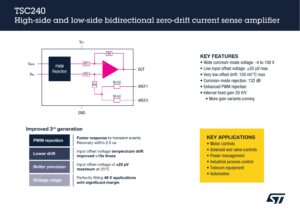
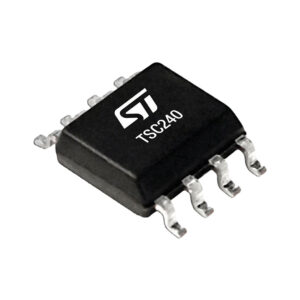
The TSC240 is ST’s first high-precision bidirectional current sense amplifier with enhanced PWM rejection. Concretely, it features the lowest offset drifts over temperature in the industry (150 nV/°C) and a maximum offset voltage of only 20µV. Concretely, it means designers can use smaller shunt resistors. Additionally, combining the high level of precision drift and the PWM rejection opens the way to more efficient motor control applications. Engineers can continuously monitor the current of a BLDC motor and enhance the quality and reliability of the data fed into the motor control algorithm, because inline current sensing provides far more accurate data points that can help control torque.
The new challenges that current sense amplifiers must face
More demanding applications
Over the years, current sensing has gone through a transformation. Instead of simply measuring voltage drops, devices must operate in increasingly harsh conditions. The reason is simple: engineers are using current-sense amplifiers in new applications that require rugged systems. For example, we find more and more devices in battery management systems for electric vehicles, power stages for telecom infrastructure, and fast-switching BLDC motor control applications that govern humanoid robots and smart factories, to name a few. Concretely, that means a long lifespan in a noisy environment with significant temperature fluctuations in 48 V ecosystems.
Harsher environments
Some of the challenges inherent to these use cases include harsh operating conditions, such as wide temperature ranges, which can significantly impact a current-sense amplifier. Indeed, traditionally, the application calibrates its system at startup to avoid measurement errors. However, current-sensing devices may be temperature-sensitive, leading to significant offset drift over time. Too often, engineers wanting to improve accuracy start by increasing the resolution of their analog-to-digital converter, forgetting that a current-sensing device with a large drift is a much more serious issue. Engineers can try to make adjustments, perform checks, and recalibrate, but this often increases complexity and doesn’t always achieve the precision required by certain applications.
New applications
Engineers are increasingly looking to add current-sensing devices to new applications, such as brushless DC motor control, because these devices enable more efficient approaches. For instance, instead of relying on a traditional low-side current sensing to approximate the current measurements for torque control, we can now use inline current sensing in continuous mode. This methodology provides more accurate information and employs an FOC algorithm that requires less computational power. However, the fact that the switching MOSFET can generate significant common-mode voltage transients is a problem because it may degrade the current sensor’s accuracy, preventing the system from obtaining correct measurements. It’s precisely to meet this challenge that ST developed the TSC240.
TSC240: the answer many customers are asking for
Why does an optimized topology matter?
The new current sense amplifier stands out thanks to its improved topology compared to our previous generation of devices. Concretely, whereas less precise components feature a maximum offset voltage of ±150 µV and a maximum offset drift of 0.5 µV/°C, the TSC240 offers ±20 μV and 150 nV/°C, respectively. As a result, engineers can rely on the initial calibration without worrying that temperature changes or prolonged use necessitate significant corrective measures to avoid errors. In fact, this is currently the best offset drift in the industry. Additionally, the TSC240’s wide common-mode voltage range (–4 V to 100 V) makes it suitable for many modern applications.
What does the new IP bring?
Another critical feature of the TSC240 is its PWM rejection. In a nutshell, the best way to filter out the wide common-mode voltage transients from the MOSFET of a BLDC motor is to detect them extremely quickly, meaning in a matter of microseconds. To accomplish this, we added an additional IP to our current sense amplifier that can detect and reject this sudden input common mode voltage change with an output recovery time of only 2.5µs.. Consequently, it’s possible to constantly monitor the current in a BLDC motor application without accidentally triggering the overcurrent protection.
How to get started?
The best way to experiment with the TSC240 is to grab the STEVAL-AETKT4V1 evaluation kit. ST will soon release a daughter board featuring the new device, which is pin-to-pin compatible with the TSC2020. Engineers can, therefore, reuse significant portions of their designs and simply swap in current-sense amplifiers to leverage the TSC240’s updated topology and IP. Put simply, if a team simply requires more accuracy, simply dropping the device onto their design is the quickest way to obtain what they need. Moreover, while the TSC240 currently offers a gain of 20V/V, we will release new models with higher gains at a later time.