
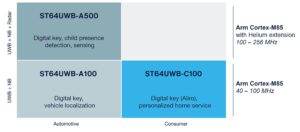
ST is introducing the ST64UWB, the first monolithic IEEE 802.15.4ab device with narrowband assistance (NBA), enabling car manufacturers to ship far more reliable hands-free door locks. In fact, the new device has gained so much traction during the current sampling phase that we are already supplying numerous Tier 1 makers and major OEMs. By using NBA, ST can implement the multi-millisecond mode inaugurated by the IEEE 802.15.4ab to massively increase the link budget. Concretely, that means a far greater range and more accurate detection, leading to wireless keys that are more accurate and reliable. Additionally, the improved radar capabilities enable presence detection within the car’s cabin.
Why IEEE 802.15.4ab?
Shortcomings of 802.15.4z
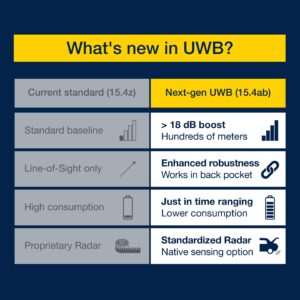
The ultra-wideband protocol 802.15.4z is not new and has helped the industry move toward wireless car keys, among other things. However, real-world implementation revealed unexpected usability limitations. For instance, when the phone is in a back pocket or a key fob is in a bag, it interferes with the signal enough to cause a poor user experience. Another case in point is that the handover between Bluetooth and UWB ranging did not happen as smoothly as expected, since the two RFs are not closely coupled and have different coverage.
This resulted in increased power consumption as 802.15.4z ranging operations got activated when the anchors were still too far from the transmitter. Additionally, while 802.15.4z could theoretically achieve a range of several tens of meters, it performed poorly when objects were not in each other’s line of sight. For instance, when the phone is in a back pocket or a key fob is in a bag, it interferes with the signal enough to cause a poor user experience.
Indeed, while this blog post views ultra-wideband through the lens of wireless car key applications, the technology serves a far broader range of use cases. And while researchers explored how to improve the performance of 802.15.4z in the face of interferences, it was always at the cost of a shorter range1.
The 802.15.4ab solution
To move ultra-wideband forward, the industry worked on an updated standard, 802.15.4ab, which aims to address some of the shortcomings of the previous version. The most important improvement is that the new protocol offers a significantly greater range, thanks in part to optimizations like narrowband assist, and a higher link budget (more on that later). In fact, 802.15.4ab can cover distances similar to Bluetooth LE itself, which means Bluetooth may no longer be required in many designs. That said, BLE can still be valuable for discovery, thanks to its very low power consumption. However, for some applications, a UWB-only configuration will be sufficient, which will help reduce system complexity and avoid the added cost of integrating Bluetooth.
In addition to improving energy efficiency, the greater UWB enabled by 802.15.4ab also makes use cases such as wireless car keys more reliable and opens the door to new applications.
For instance, engineers could use the ranging capabilities of 802.15.4ab for passenger position detection in autonomous cars or people detection in large venues. It was previously impossible because the prior standard didn’t have the necessary performance. In fact, to help teams better understand what they can do with the new standard, ST published a whitepaper to help unlock UWB’s true potential. The paper includes an entire section dedicated to exploring applications “beyond the digital key” in smart cities, industrial environments, retail, smart homes, and more. As more companies try to be the first to launch products in new markets, understanding how to use ultra-wideband technology in original use cases can become one of the most differentiating factors.
As John Lukez, President at LitePoint, a leading provider of wireless test solutions, shared,
“Ultra Wideband (UWB) technology has become the backbone of modern digital experiences—from digital car keys and ‘find my stuff’ services to secure home access and indoor navigation. With the introduction of the IEEE 802.15.4ab amendment, these applications are set to advance even further. The new standard significantly elevates long-range precision ranging through Narrowband Assisted Multi Millisecond Ranging (NBA MMS), unlocking game-changing improvements for digital car key and asset tracking use cases. We, as a leading provider of test solutions for the world’s leading manufacturers of wireless modules and consumer electronics, are confident that ST’s ST64UWB silicon is perfectly positioned to deliver these next-generation capabilities and enable the full promise of UWB technology.”
Why the ST64UWB?
MMS
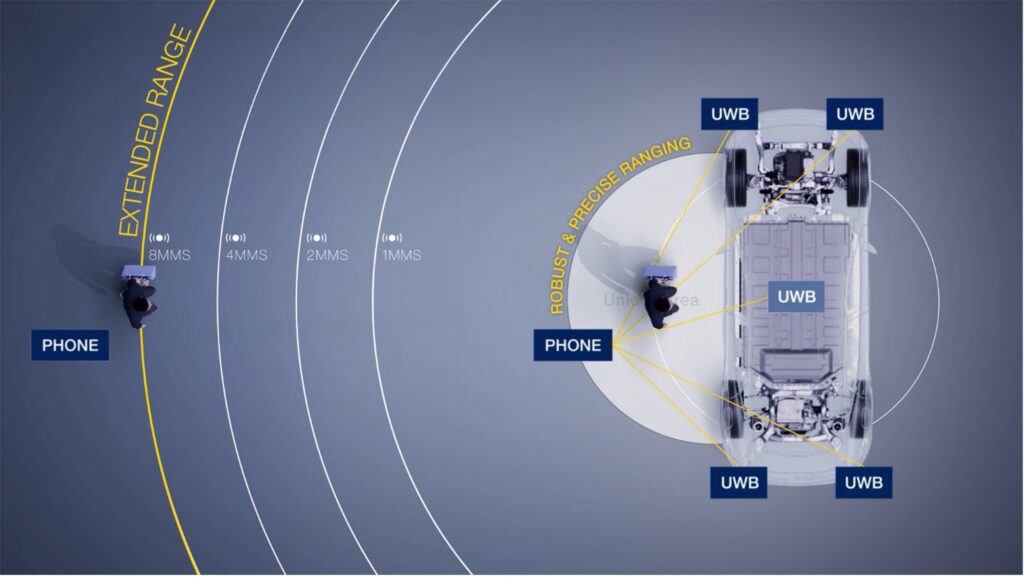
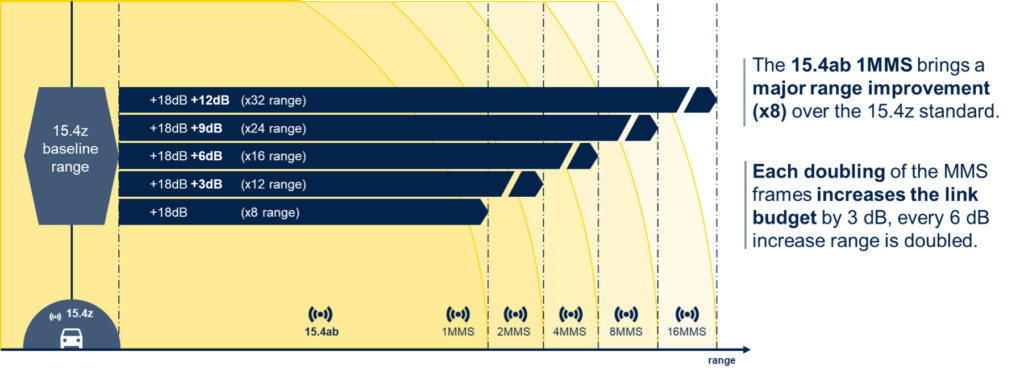
The ST64UWB is the first ST device to support 802.15.4ab and the first commercially available monolithic 802.15.4ab device to provide narrowband assist. To understand why it matters, we need to look at one of the major improvements brought by the new standard: multi-millisecond (MMS) fragments. Very briefly, as the name suggests, the new ultra-wideband standard sends repeated fragments at one-millisecond intervals to increase the link budget by at least 18 dB, starting with the first MMS, thereby moving the entire communication to narrowband.
It increases the energy used for the ranging frame while still respecting regulatory power limits, improving the range by around 8x compared to 802.15.4z. Instead of a one-time handshake, there’s a constant flow of frames every millisecond between the receiver and transmitter, which adds another 3 dB for any doubling of the MMS frames. Consequently, using 16 MMS frames increases the range by up to 30x compared to the previous protocol.
NBA
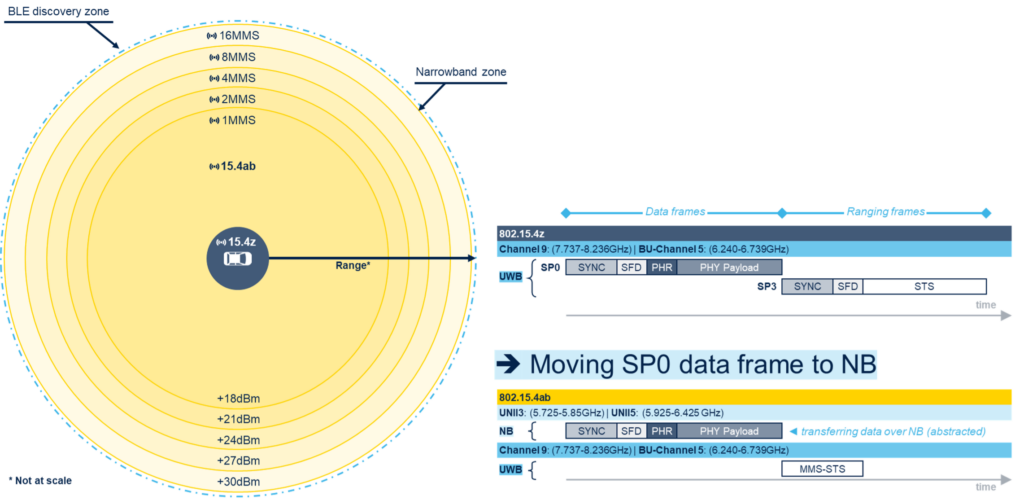
There are potentially many ways to implement MMS, each using different channels. For instance, out-of-band MMS may use Bluetooth LE for wireless communication and UWB channels for MMS, while UWB-Driven MMS uses the UWB channel for everything. However, UWB-driven MMS is barely adding range as the communication packages are still taking their toll on the total allowed power transferred on the UWB channel. On the other hand, the BLE implementation achieves a greater range but is prone to congestion, significantly reducing performance in such cases.
The ST64UWB chose the narrowband-assisted (NBA) approach, which uses narrowband channels for MMS control and UWB for MMS ranging. It is by far the superior implementation, meaning the one with the largest link-budget increase and the most stable operation. It is also the solution with the largest existing ecosystem to be enabled immediately. It’s the reason why, while there are already competing 802.15.4ab solutions, ST is the first to support NBA.
Radar Mode
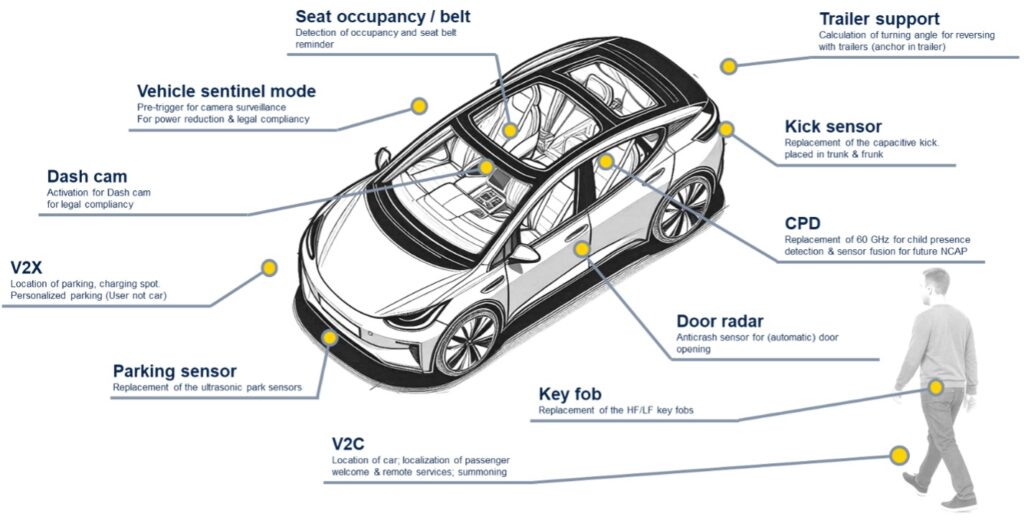
The 802.15.4ab protocol is also introducing radar mode, which sends UWB pulses and then analyzes the reflected signal to determine the presence, position, or motion of people or objects. As a result, it doesn’t require a second UWB device, further increasing its usefulness. Concretely, the high-resolution radar engine of the ST64UWB can achieve absolute distance measurements of under 7.5 cm and relative motion detection down to the millimeter scale. As a result, it becomes possible to detect a baby left unattended in a vehicle, verify that passengers are wearing their seat belts, or recognize a hand gesture to open the trunk without touching a handle, all while using a single chip.
An industry benchmark
Concretely, the ST64UWB can offer a link budget increase of up to 30 dB if using 16 MMS frames, compared to an equivalent solution relying on 802.15.4z. Furthermore, our device is not only compliant with the 802.15.4ab standard but is also expected to work with devices already in the field, meaning car makers can leverage the existing ecosystem. Furthermore, by using FD-SOI technology, we can boost the overall sensitivity of the ST64UWB by 3 dB and extend its range by another 50% compared to existing 802.15.4z-based applications. As a result, designers can now use a single antenna and achieve performance comparable to a competing dual-antenna solution.
There are also additional security features that make ultra-wideband applications more resilient. For instance, the improved ranging capabilities inherent in 802.15.4ab mean that a system can more accurately determine whether a key is truly close to a vehicle or whether relays are trying to sniff a particular signal. Additionally, the ST64UWB can use wideband pulses, sub-nanosecond time-stamping, and protected frames to prevent hackers from replaying messages or exploiting a key in someone’s home. The stronger link budget of 802.15.4ab also offers better resistance to jammers that try to confuse users, making them think their key doesn’t work when it actually does.
-
Tiemann, Janis et al. “Experimental Evaluation of IEEE 802.15.4z UWB Ranging Performance under Interference.” Sensors (Basel, Switzerland) vol. 22,4 1643. 19 Feb. 2022, doi:10.3390/s22041643 ↩︎