
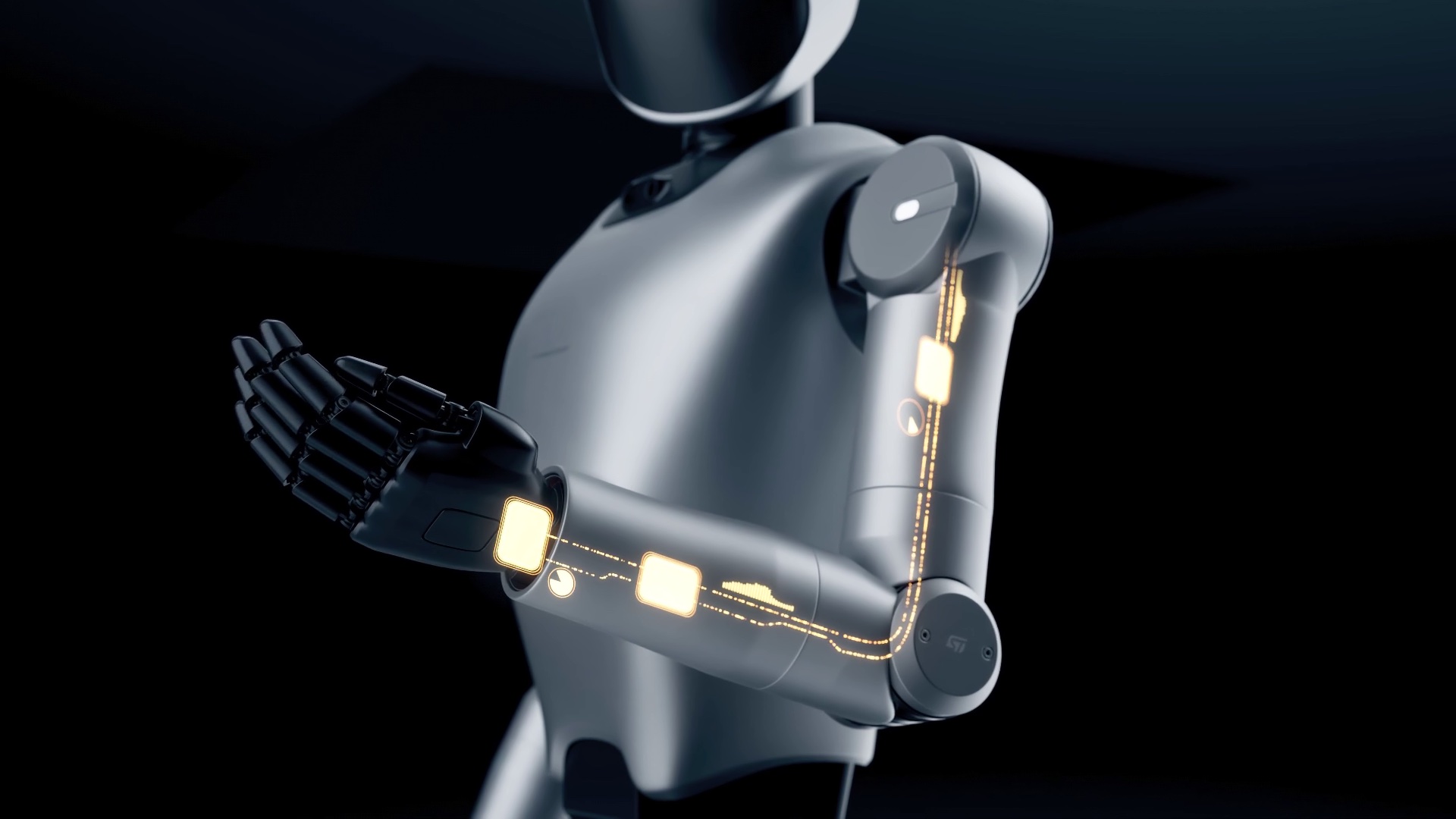
ST is launching the STM32G5, a new series of mixed-signal microcontrollers that features an unprecedented level of analog and digital peripherals, including a 12-channel version 3 timer with a high resolution of 111 picoseconds, a new position encoder, an integrated Programmable Logic Array with 16 logic elements, and an analog-to-digital converter supporting 5 Megasamples per second, up from 4 Megasamples previously, among other things. The STM32G5 is a new solution for engineers working on high-power digital applications for data centers, sophisticated motor control systems for robots championing Physical AI, photovoltaic inverters, EV chargers, battery management systems, and other industrial applications.
The STM32G5 thus becomes our new flagship mixed-signal MCU series for real-time digital power and high‑end motor control in AI servers and physical AI systems, helping developers design faster, scale confidently, and meet evolving power conversion and new security demands.
Understanding tomorrow
Where are we heading? HVDC and physical AI
The industry is at a turning point, as we are now seeing clear solutions that will shape infrastructure and products for decades. The question becomes, “What will we build with?” For instance, many [high-voltage DC power supplies for data centers are moving to 800 V in part due to innovations in GaN and SiC, allowing them to reduce the amount of current required, for smaller cabling and busbars]. However, engineers working on future generations of products are always on the lookout for microcontrollers that will help drive these more demanding systems. Similarly, it is clear that Physical AI is the new frontier in the field of robotics, thus demanding solutions that can deal with more complex motor control logic.
What brought us here? The STM32G4
As the name implies, the STM32G5 is a proud descendant of the STM32G4, which was our first-ever mixed-signal MCU to include five analog-to-digital converters, seven digital-to-analog converters, six operational amplifiers, and seven comparators, while also integrating a 184-picosecond high-resolution timer, CAN interfaces with flexible data rate, and math units accelerating certain trigonometric functions. It helped us anticipate these new trends, which is why, if we pick just one example among many, the STM32G4 is a prominent MCU on our reference high-density power delivery board built for NVIDIA.
How to get there? The STM32G5
This is exactly why we are launching the STM32G5 today. Just like the STM32G4 anticipated trends when it launched in 2019 that are shaping industries today, we wanted our new series to open doors for engineers working on the more efficient data centers or the more intricate robotics systems of tomorrow. Taking a step back, the mission was, therefore, obvious: a more powerful and more capable MCU series. However, in practice, we had to find a way to launch a mainstream general-purpose microcontroller while tailoring it to very specific needs.
We accomplished this goal by launching more dies (five dies compared to three for the STM32G4 launch) and designing a more feature-rich architecture that remains priced for mainstream mixed-signal applications. The STM32G5 thus stands out from the STM32H7P we are announcing today, which targets the high-performance market for teams needing to run more digital power or motor control applications on one device and will benefit more from our Neural-ART NPU than the additional peripherals present on the STM32G5.
Building today with the STM32G5 for precise and reliable digital power and motor control, ready for design scalability
Cortex-M33 for 2x the performance
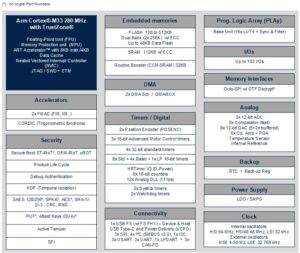
The STM32G5 is our first mixed-signal MCU to feature a Cortex-M33 in a single- or dual-core configuration (STM32G5D coming next year). The processor runs at 280 MHz and scores 1136 points in CoreMark. Comparatively, the Cortex-M4 in the STM32G4 reached 569 points at 170 MHz. Besides the fact that the new series offers twice the performance as the previous generation, it is our fastest Cortex-M33 to date, and it comes with Arm’s TrustZone, which isolates code and assets to offer greater security guarantees. In fact, we have a dedicated blog post on the security features of the STM32G5 to help engineers understand why this is also our most secure mixed-signal MCU to date.
512 KB with ECC and 2 FMAC
The STM32G5 comes with up to 512 KB of flash, with an optional dual-bank setup (2 x 256 KB) for life firmware upgrades, 96 KB of data flash, and SRAM that now supports ECC, improving overall reliability. A version with 256 KB of flash will also be available for teams looking for something more cost-effective and tailored to less demanding applications. We also included the same routine booster in the SRAM, so developers can run a control loop inside it and enjoy 0-wait states. Additionally, we are now featuring two Filter Mathematical ACcelerators (FMAC) instead of only one, which help implement primary filters to optimize signal processing.
Unprecedented peripherals
The new series stands out from other STM32 MCUs and from competing solutions thanks to its rich set of analog and digital peripherals. For instance, engineers requiring advanced pulse-width modulation will appreciate its high-resolution 12-channel timer. Similarly, those working on motor control applications will benefit from the position encoder. It also includes a 12-bit analog-to-digital converter with pseudo-differential mode to improve the signal-to-noise ratio, an ultra-fast comparator (20 nanoseconds propagation delay) with window mode, a USB Full Speed controller, and I3C support.
Supporting multiple mission profiles
The new series offers packages with exposed pads, allowing engineers to better determine whether their design meets the thermal and electrical requirements of their mission profile. That’s why we offer many STM32G5 dies and versions with more or less flash, each with 12-channel high-resolution timers, and we are already announcing dual-core versions that will be in production in 2027. We even ship different firmware for digital power or motor control applications, with specific code. The STM32G5 is also supported by STM32CubeMX2, which comes with live code preview, a more intuitive GUI, and new features to streamline clock tree and pin-out configuration. The new device also enjoys HAL2 support.
How to get started?
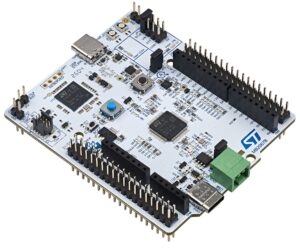
The best way to get started is to grab a development board. There’s the NUCLEO-G564RE, which offers 512 KB of flash, and we are also releasing the B-G564E-DPOW1 and B-G564E-MC1S Discovery Kits. We also updating X-CUBE-MCSDK and X-CUBE-DPOWER. As their names suggest, the former is our motor control SDK while the latter targets digital power applications. We have updated each software package to include example code to help engineers take advantage of the new features on the STM32G5.