
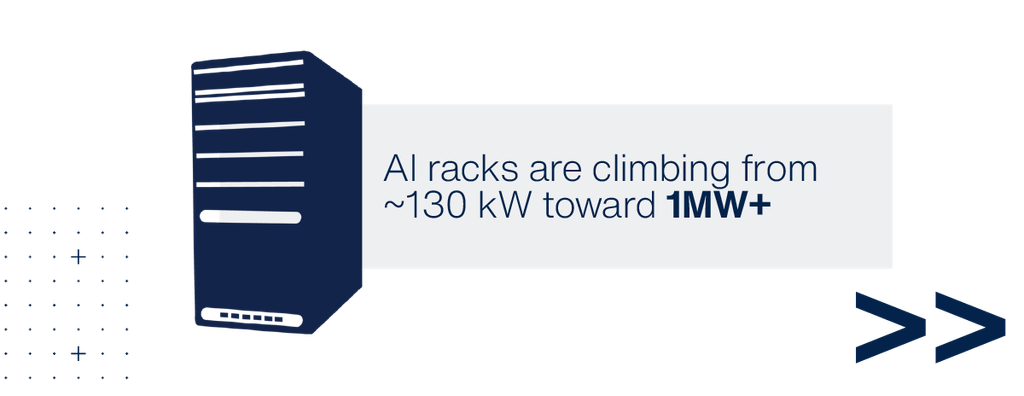
Powering a server used to be a solved problem. For decades, a typical server rack drew 10 to 15 kilowatts from a 48 volt distribution bus, and most racks outside AI still do. The control electronics behind them were mature and unremarkable. Artificial intelligence has ended that. Today’s AI racks already draw around 130 kW, the next generation is designed for a megawatt, and the change comes not for one reason but for several that arrive together. Compute density keeps climbing. Distribution voltage is jumping by more than an order of magnitude. Wide-bandgap power devices switch faster than silicon ever could. Accelerator loads swing in a fraction of a second. And the efficiency, safety and security expectations placed on critical infrastructure keep tightening. Every one of these forces lands in the same place: the digital controller that runs each conversion stage between the grid and the processor. And every one of them follows the same pattern. Copper and bulky passive components leave the rack, and intelligent control takes their place.
Everyone is watching the power devices get bigger and faster. The quieter story is what is leaving the rack: copper, passive bulk and margin. What replaces them is control, and that is where the next decade of AI power will be decided.
— Eric Chou, Director, Head of Power & Energy Competence Center (PECC), PDSA-China Region, STMicroelectronics
The rack that changed everything
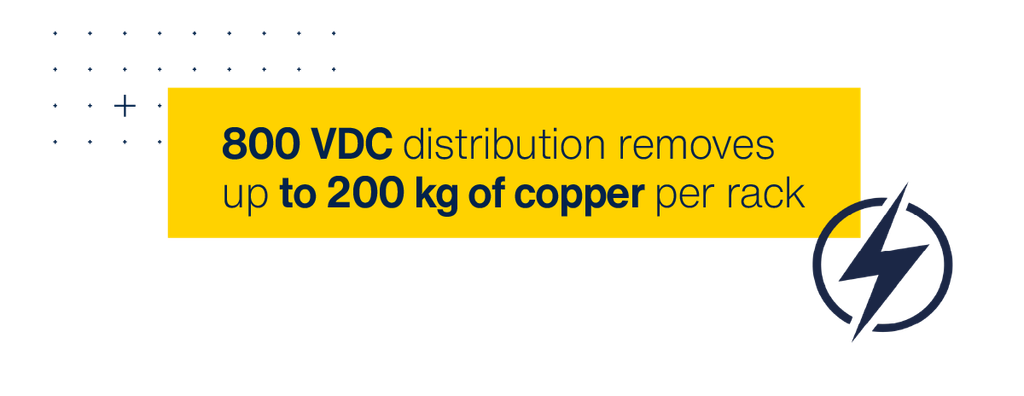
NVIDIA’s 800 VDC architecture is designed to scale from 100 kW to more than 1 MW per rack, with the first megawatt-class racks expected between 2027 and 2028. The 54 volt busbars inside today’s AI racks cannot follow. By NVIDIA’s calculation, a single 1 MW rack at 54 V would need up to 200 kilograms of copper busbar, and a one gigawatt data center up to 200,000 kilograms. Distributing at 800 volts DC removes that copper and, by the same estimate, improves end-to-end efficiency by up to 5%.
The architecture changes with the voltage. Power conversion and IT equipment used to share a rack fed with AC. The designs now being deployed split the two, a dedicated power rack feeding the IT racks with high-voltage DC, an approach hyperscalers are standardizing through the Open Compute Project’s Diablo specification (OCP, October 2025). Heat follows the same curve, and the current generation of rack-scale AI systems is liquid-cooled by design.
Each of these steps takes copper and losses out of the rack, and concentrates responsibility in the conversion stages that remain, the ones that step 800 volts down to the fraction of a volt a processor runs on.
Why 800 volts changes the control problem
Raising the voltage is the right answer for efficiency and a harder one for control. Every switching transition now happens across 800 volts, so it has to be faster and cleaner. A fault at 800 volts is far less forgiving than one at 54, so protection has to be tighter, including at the moment a technician swaps a live module. And the chain is getting shorter. To save losses, the industry is collapsing conversion stages, which leaves fewer, denser stages that each carry more responsibility and less margin. A converter can now step from 800 volts directly to a low-voltage bus beside the processor, a jump that has already been demonstrated for 800 VDC racks.
The load adds a difficulty of its own. An AI accelerator’s power draw swings with the computation, in fractions of a second, which is why the 800 VDC architecture includes energy storage to absorb those swings. Every stage that stores, converts or delivers power is a controlled stage with its own real-time loop, and all of them have to be coordinated so the rack behaves as one clean source.
What is now being asked of the controller
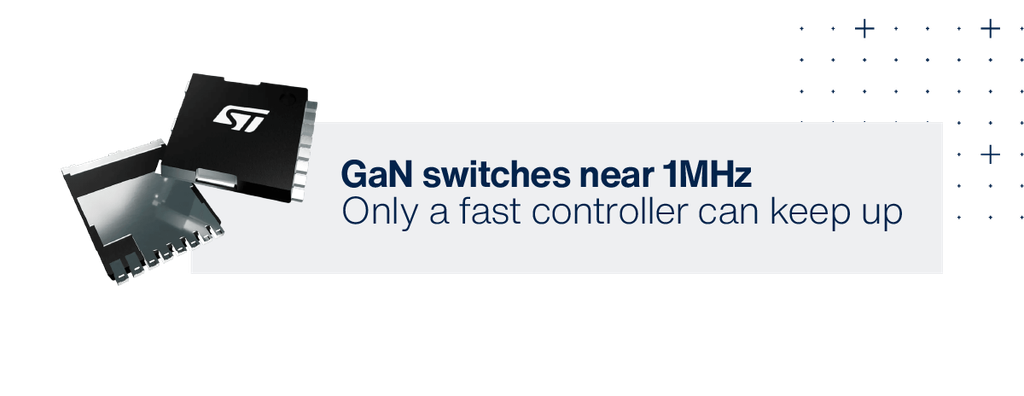
The switches inside those stages are increasingly wide-bandgap devices, gallium nitride (GaN) and silicon carbide (SiC), which switch faster and waste less energy than legacy silicon. GaN can switch near one megahertz, and GaN converters running directly from 800 volts have already demonstrated efficiency above 98%. Faster switching also shrinks the magnetics and capacitors around each switch, which is how passive bulk leaves the power stage. That speed only pays off if the control keeps up. At one megahertz the whole switching cycle lasts a millionth of a second, and every transition has to land inside it with nanosecond accuracy. A nanosecond of error shows up as lost efficiency or as stress on the device.
Put together, these pressures change what the word “control” means in a power stage. For decades the controller’s job was to hold a voltage steady and shut the stage down if something went wrong. In an AI rack it is asked to do several harder things at once, and to keep doing them for years. It has to be fast and precise. It has to think harder, because the control strategies that get the most out of wide-bandgap devices demand far more computation in every cycle, and a loop that answers late is worse than one that never ran. It has to protect, because a fault at 800 volts leaves no time to consult software: the reaction has to be built into the hardware. It has to endure, sitting beside the hottest components in the rack through years of continuous operation. And it has to be trusted. Power infrastructure is critical infrastructure, so the controller has to know its own software is genuine, accept only authenticated updates, and stay trustworthy over a service life that will outlast today’s cryptography, which is why readiness for the post-quantum standards NIST finalized in 2024 is entering the requirement now.
How silicon meets each of those demands is engineering detail, and it belongs to the technical companion to this article. The point for anyone deciding how to power AI is simpler. Capabilities that used to distinguish a premium controller are becoming the baseline for every stage between the grid and the processor.
The power stage becomes a system decision
The digital power stage is no longer a component choice. It is a system decision. The switch, the gate driver, the magnetics and the controller have to be specified together, because the limit of one sets the ceiling for all the others: a faster transistor is wasted behind a slow loop, and a precise loop cannot rescue a poorly driven switch. That is changing how the industry buys and builds power. Operators and their system partners increasingly evaluate the stage as a whole, and suppliers are asked for matched sets rather than parts. It is the pattern we see in every 800 volt program we take part in, and it is larger than any single supplier.
Where this goes next
Racks will keep getting denser. High-voltage DC reaches the rack at scale between 2027 and 2028, when full-scale production of 800 VDC data centers is expected, and it opens the way to the solid-state transformer, in which power electronics replace the conventional transformer between the grid and the DC bus. Wide-bandgap devices will switch faster still. Each step repeats the same move: a passive, forgiving component leaves the chain, and an active, controlled one takes its place.
The next phase of AI infrastructure will be defined not by how much power reaches the rack, but by how precisely it is controlled once it gets there. In that shift, the winners will be the companies that deliver devices, drivers and intelligent control together.
Further reading: our blog explainer on 800 V HVDC in the data center.