

The new STSPIN9P series is our first 75 V high-current motor driver in a QFN 7 mm x 7 mm or 9 mm x 7 mm package, enabling factory or industrial automation, home and building controls, as well as other systems that would have required cruder designs because of space constraints. The low RDS(on) MOSFET, the ability to choose between multiple input modes, and the pulse-width modulating capabilities mean that designers save on their bill of materials. It also makes the STSPIN9P one of the most flexible series of high-current motor drivers. It currently comprises eight half-bridge and four full-bridge devices, each topology offering various control schemes and a committed and uncommitted comparator.
The new requirements of modern motor control applications
The rise of 48 V bus platforms
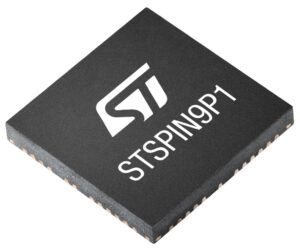
The growing popularity of 48 V bus platforms brings a unique engineering challenge: supporting high-current motors in much smaller spaces than previously needed. Indeed, designs that once required only a 12 V or 24 V bus now use a more powerful one because it lets designers improve efficiency, increase torque, allow greater tolerances for robustness, and create more capable solutions. It also lets engineers adopt a design that previously used a 12 V bus platform while reducing cables and generating significantly less heat, which is ideal when space is a constraint. The challenge is finding a motor driver with enough overhead to handle the much higher nominal power.
The hunger for smaller devices
A new engineering trend is also gravitating toward high-current drivers with smaller packages because even if a design doesn’t necessarily require that much headroom, it still faces significant space constraints that push designers toward smaller form factors. For instance, high-end flight simulator joysticks with haptic feedback can offer a better experience with more capable actuators, but that’s impossible if engineers have to add a discrete gate driver on top of the power MOSFETs and other passive components. This example reflects that ST teams have seen engineers choose a smaller high-current device even if they didn’t need 75 V. It highlights that overall trends prioritize more capable designs in tighter footprints.
The imperative of flexibility
Another important consideration is that smaller designs don’t have to increase design complexity. Engineers must still manage electromagnetic interference, switching losses, regulators, and control schemes to optimize performance, protect against overcurrent events or parasitic resistance, and more. A smaller package isn’t a solution if the device isn’t flexible and robust enough to handle a modern motor control application, especially in harsh industrial environments. This is even more critical for companies looking to qualify a single design that can address a wide range of applications. In this instance, having a portfolio of pin-to-pin compatible devices can make a world of difference. Enter the eight devices of the new STSPIN9P series.
STSPIN9P, 3 reasons why it is a unique solution for modern motor control applications
1. A broad portfolio to target more applications
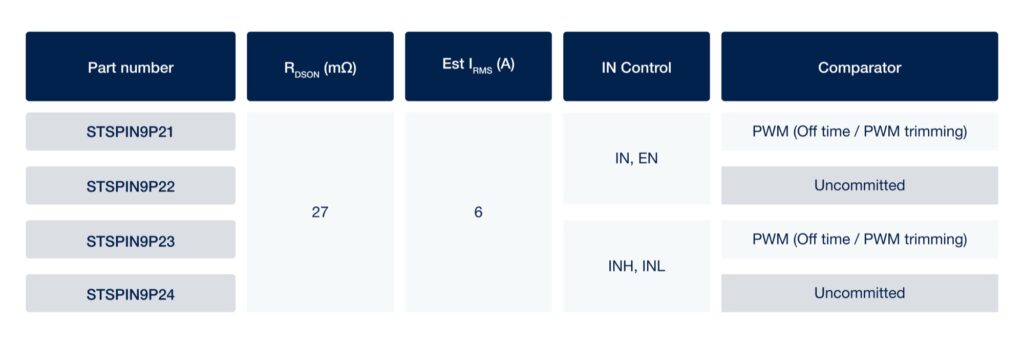
The STSPIN9P stands out as one of the most diverse portfolios of 75 V high-current motor drivers, enabling it to target a wider range of applications than competing solutions. The STSPIN9P1x uses a half-bridge topology for three-phase motors, while the STSPINP2x features a full-bridge topology, which targets brush DC and stepper motors. Part numbers ending in an odd number (STSPIN9P11, STSPIN9P21, etc.) include a comparator that serves as a current limiter, while those ending in an even number do not commit their comparator to a specific purpose. Additionally, since they all include a differential amplifier, designers can take advantage of smaller shunt resistors to implement current sensing.
2. A low nominal resistance to optimize designs
Each STSPIN9P also features a low RDS(on) of 16 mΩ for the STSPIN9P11 through STSPIN9P14 and 27 mΩ for STSPIN9P15 through STSPIN9P18 and all the STSPIN9P2x. This is possible because, in addition to using a low-resistance MOSFET, ST optimized the packaging to ensure, among other things, that the contacts between the pads and the silicon didn’t introduce additional parasitic resistance that would negate the MOSFET’s benefits. This is particularly important in a space-constrained design because it lets engineers use smaller passive components. However, it also shows that the STSPIN9P isn’t just about a small footprint; it leverages manufacturing optimizations to prevent issues often associated with very small housings.
3. A flexible series to tailor to specific needs
The STSPIN9P series is divided into two types of control schemes. Some use one input to switch between low-side and high-side, while others use two inputs, one for each. As a result, if engineers already have firmware that fits a particular switching strategy, they can order an STSPIN9P compatible with it rather than rewrite an entire control mechanism or significantly change the controller and layout. Moreover, the models with a comparator with dedicated current limiter functions can offer fixed off-time or PWM trimming, while the ones with an uncommitted comparator offer more flexibility to the user, who can implement redundant strategies to trigger overcurrent protection, among other things.
A fixed off-time means it’s possible to keep the high-side on longer, thus maintaining the input high to better control the current. However, that can cause random harmonics due to higher ripples. On the other hand, PWM trimming offers a more regular pattern and less granularity for current control, but it is less susceptible to EMIs. Similarly, the STSPIN9P offers an adjustable slew rate to help deal with EMIs. Traditionally, engineers tune the slew rate through a painstaking trial-and-error process and set it with passive components. The fact that the STSPIN9P lets you set it on the device is a huge relief that speeds up prototyping.
How to get started?
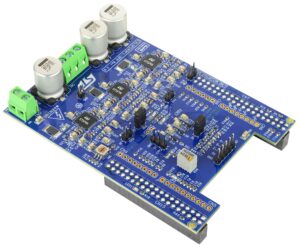
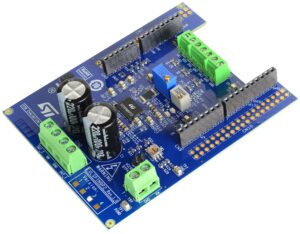
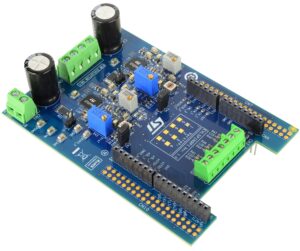
The best way to get started is to grab a development board. The EVLSPIN9P1–3PH features a three-phase driver based on the STSPIN9P12 for BLDC and permanent magnet synchronous motors. Additionally, the board deviates from the original design by using a high-current MOSFET with an RDS(on) of 16 mΩ. We also offer a more general-purpose EVLSPIN9P1 board for each STSPIN9P1 model. It can drive two motors thanks to two half-bridge topologies. Finally, each STSPIN9P2 comes with an evaluation board (EVLSPIN9P2) to drive a motor using a full-bridge topology.