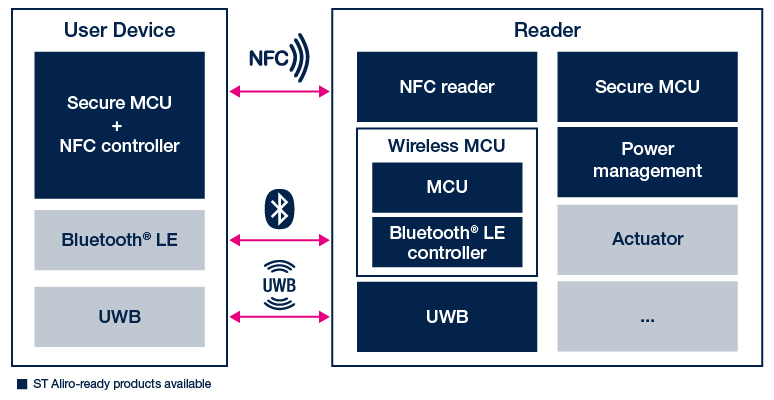
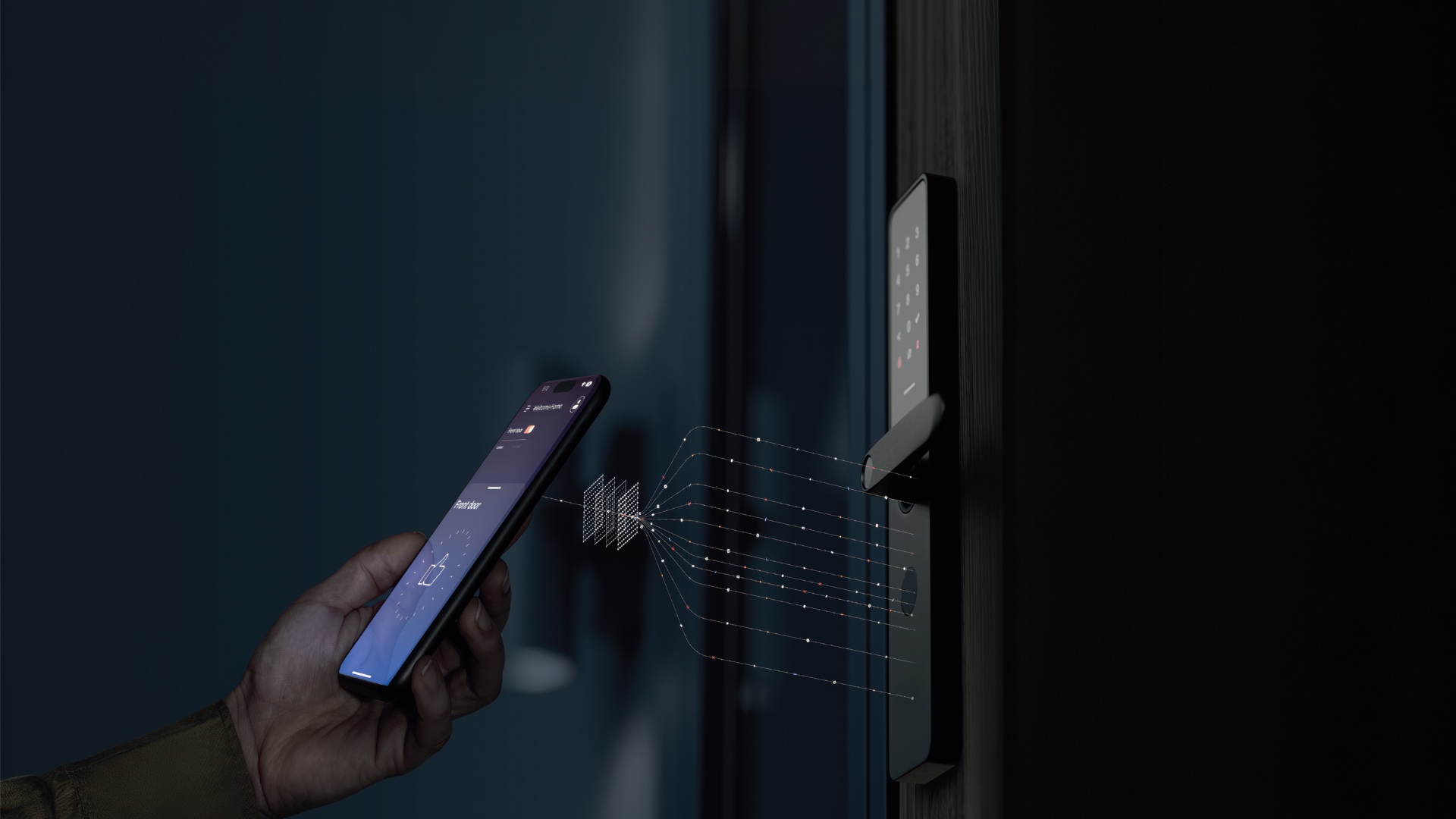
ST is one of a select few Aliro solutions providers to offer publicly available hardware and software that enable the creation of systems capable of using NFC, Bluetooth LE, and Ultra Wideband (UWB). As markets try to meet new customer expectations for ease of use, interoperability, security, privacy, and reliability, smart locks and access control applications are adopting a new standard with a big promise: people can leave their physical keys behind without losing their minds out of fear of being locked out. Let us, therefore, explore what the industry is doing to make this a reality and how ST is helping solution makers by offering wireless devices, software packages, and even an entire reference design to open the door to this new era.
Why is smart lock adoption still a work in progress?
What drives the move away from physical keys
The most technically savvy know that digital keys are nothing new. Some hotels have been trying to implement them for decades. Similarly, phone makers and gate manufacturers, among others, have offered their own versions of digital key systems. The reason is simple: physical keys are extremely reliable, but also cumbersome. It’s one more thing to carry and, therefore, potentially lose. Copying keys is also impractical and in itself a security vulnerability. For instance, people renting their home put themselves at risk if they give renters a reproducible key. That’s why commercial and industrial sites mostly rely on passes, pin codes, and other forms of electronic access control.
What issues are plaguing smart locks
One may ask why we don’t already live in a world that no longer relies on physical keys. The answer is that implementations have lacked reliability and interoperability. In the example above, employees who use a badge to access their office would never think of using the exact same badge to enter their home. Commercial applications are limited in scope, while consumer implementations have not been able to gain their users’ trust. For instance, digital key systems from one phone maker have been incompatible with competing products. And many who have tried to use digital keys at hotels have fallen back to physical key cards due to bugs that left them stranded.
How can Aliro succeed where others have failed?
Establishing interoperability
To solve these challenges, the industry at large must adopt a common solution. It’s the reason why the Connectivity Standards Alliance took on this project. Avid readers of the ST Blog are familiar with the CSA’s work on Matter and its ability to rally the industry around smart home applications. Comprising industry giants such as Apple, Google, Samsung, Assa Abloy, Allegion, and, of course, ST, to name a few, it has the ability to unite all major actors around a standard to ensure its critical adoption. Concretely, that means convincing device makers, designers, integrators, OEMs, and consumer brands to ensure promotion, adoption, and interoperability.
Ensuring reliability and security
The second reason the CSA is leading this initiative is that, after its work on Matter, the consortium has the unique expertise to create a standard that can finally solve the reliability and implementation issues that have plagued other proprietary solutions. Additionally, it can do so while keeping the standard open to ensure its adoption by the industry. Thus was Aliro born, a new standard by the CSA to create a common, secure, and interoperable framework for digital credentials and access control. Just as Matter simplifies connectivity between smart home devices, Aliro simplifies how people access physical spaces, regardless of the mobile device, lock manufacturer, or access control platform.
What technologies drive Aliro?
A union of wireless protocols
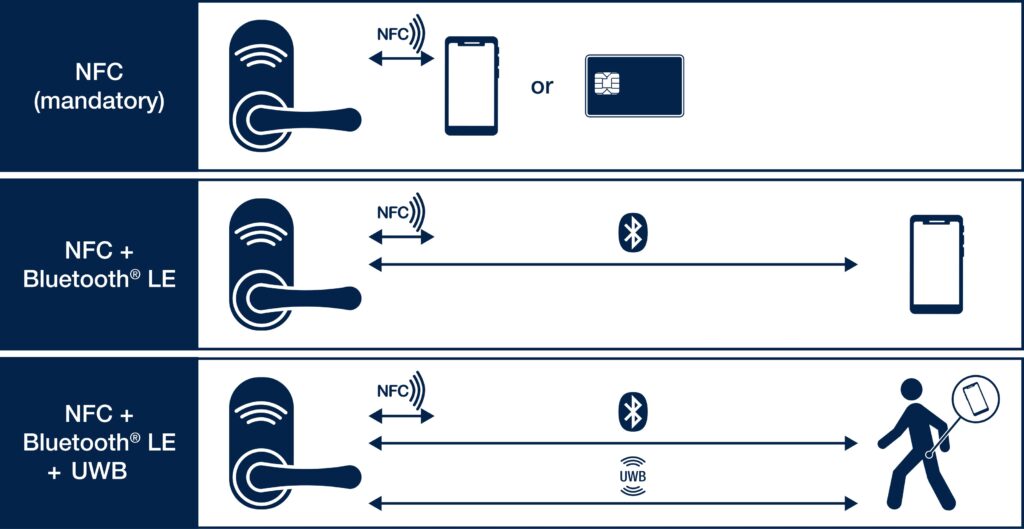
At its core, Aliro relies on multiple wireless technologies, which many proprietary implementations often lacked, as they tended to use only one wireless protocol. For its part, Aliro uses NFC for reliable tap-to-unlock functionality, even when a smartphone battery is nearly depleted, thanks to power reserve capabilities. However, while NFC serves as a backbone, Aliro also supports discovery and authentication through Bluetooth® Low Energy (BLE), while Ultra-Wideband (UWB) allows for highly accurate and hands-free access experiences. Aliro supports flexible implementations, meaning more cost-sensitive products may rely only on NFC, while solutions that require an extensive setup can also use Bluetooth LE and UWB for hands-free access to improve the user experience.
A robust approach to security
The CSA also standardized critical security to make Aliro more trustworthy. The protocol leverages asymmetric cryptography, used during the communication of sensitive information, and standardized authentication protocols to securely validate digital credentials and establish trusted sessions. These measures directly help prevent credential cloning, replay attacks, and unauthorized access. Aliro relies on mutual authentication mechanisms to verify both the credential and the reader, reducing the risk of spoofing and unauthorized devices. Additionally, privacy is a core tenet of Aliro, which minimizes the exchange of sensitive information during authentication to help protect user identity and reduce tracking risks.
How to get started with ST?
A reference design
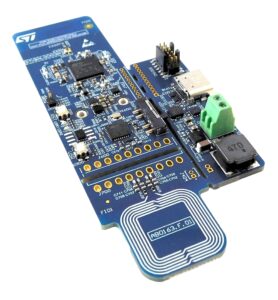
The ST portfolio includes the wireless devices at the heart of Aliro, as well as the microcontrollers and secure element needed to create compatible products today. It’s why we offer the STEVAL-ALOCKCB, a complete smart lock reference design that integrates the key building blocks for an Aliro-enabled access control system. It combines the STM32WBA6 wireless MCU, ST25R300 NFC reader, and STSAFE-A120 secure element, along with power management, battery operation, and protection circuitry representative of a production-ready design. Developers can even use our reference board with a battery or connected to the main power supply. The STEVAL-ALOCKCB also accepts the ST64UWB-C100 Ultra-Wideband (UWB) processor, allowing developers to explore advanced hands-free access experiences.
An entire ecosystem
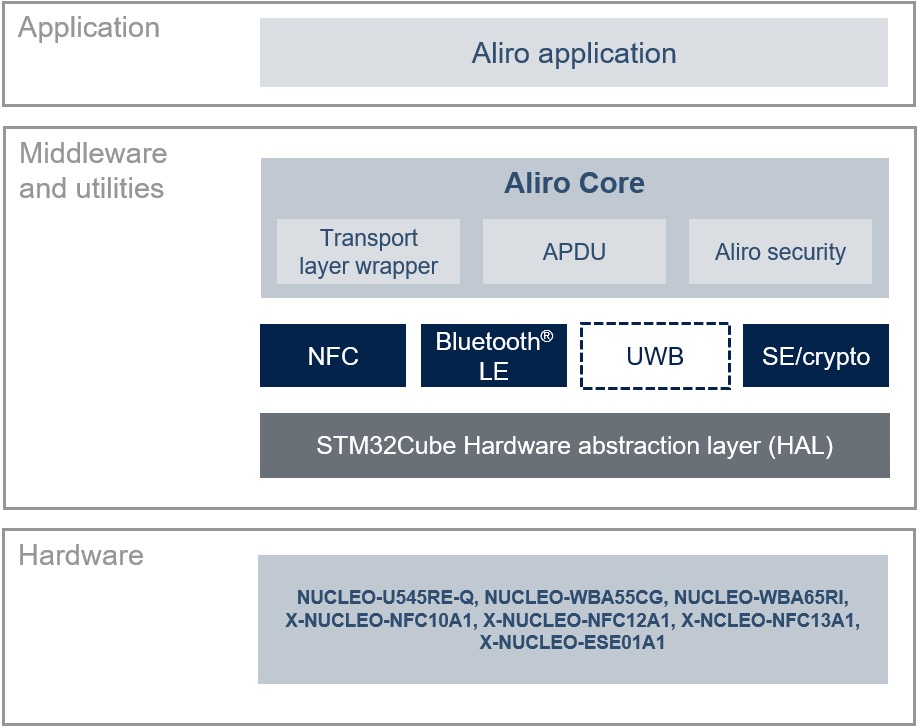
ST complements its hardware portfolio with X-CUBE-ALIRO, a software expansion package that provides the core building blocks required to develop Aliro-compliant access control devices on STM32 platforms. The package currently supports the ST25R210 and ST25R300 NFC readers alongside the STSAFE secure element as well as the STM32U545RE, STM32WBA55CG, and STM32WBA65RI devices.
Concretely, it represents an Aliro-compliant software framework with a certified Bluetooth LE stack, NFC Forum Type A support, cryptographic services, and credential management capabilities required by the specification. Because access control and smart home are closely tied, CSA has added the ability to provision Aliro credentials through the Matter network. X-CUBE-ALIRO works alongside X-CUBE-MATTER, enabling developers to build smart locks and readers that support both Matter and Aliro from a common platform.
How is ST at the forefront?
ST’s hardware and software initiatives stem from our work on Aliro at the highest levels. Not only are we a member of the CSA, but ST employees have also actively participated in developing the standards and their testing protocols. Put simply, we can provide some of the first and most comprehensive solutions because we were there when security considerations were being shaped, and we know from firsthand experience how to address implementation challenges to help get the Aliro certification faster, which is so critical for makers looking to market their first compliant smart locks to early adopters.