
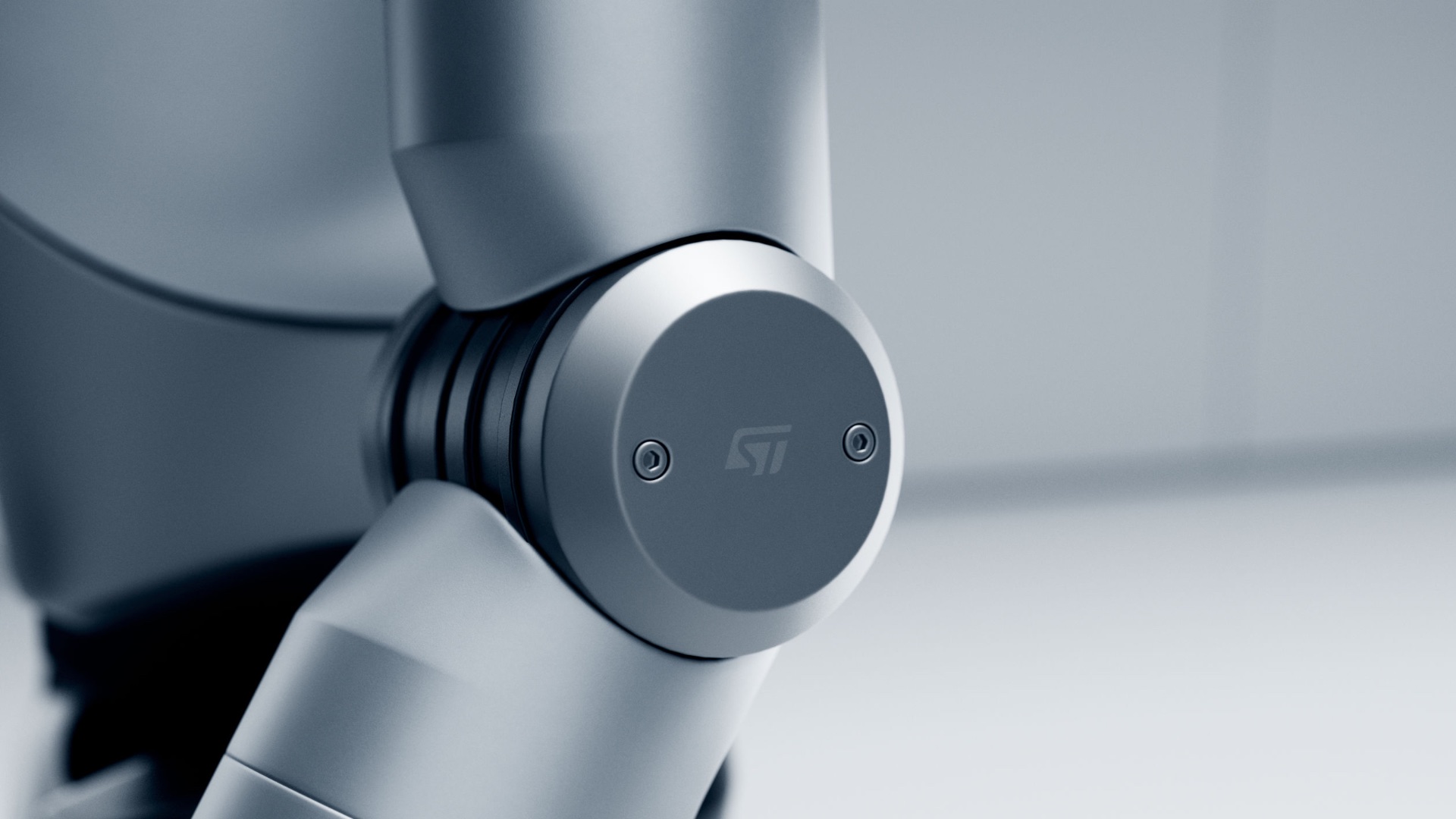
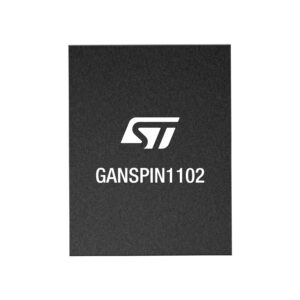
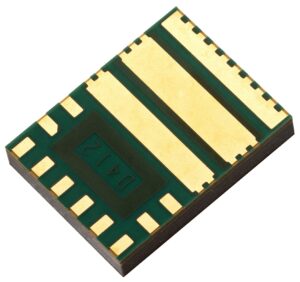
ST is showcasing the GANSPIN1102 and GANSPIN1105 at electronica 2026. They are our first GaN motor drivers with a 100 V input rating, meaning they can support 48 V and 60 V batteries in very tight spaces thanks to a package measuring only 6.5 mm x 5 mm and an RDS(ON) of only 2.4 mΩ. Both devices adopt a traditional half-bridge topology with two GaN power transistors and, as the part numbers imply, we target motor control applications like robotic joints, thanks to their small footprint and ability to function without active cooling and with significantly fewer external components.
Why are humanoid robot joints an engineering challenge?
Bigger ideas, smaller designs
Physical AI is bringing a new constraint that is challenging engineering designs: space. Indeed, when creating a robot arm for industrial manufacturing, other issues often get far more attention than PCB size because production lines are typically large and robot arms have more room to maneuver. There are some spatial challenges to navigate, but they are rarely the top priority for designers. Humanoid robots, on the other hand, must look human and work in confined spaces, and, therefore, cannot look like giants coming out of a children’s story book. After all, if physical AI is about sensing the world and interacting with it, machines must fit within that world.
Smaller designs, bigger power requirements
However, beyond the immediate physical restriction, humanoid robots and other physical AI interfaces are using increasingly more power, which means bigger batteries and higher voltage circuits to cut down on current consumption and wire gauges, among other things. As a result, engineers must conceive custom compact creations to meet these new demands, which can be challenging given the current technological landscape. For instance, in a paper published in the Journal of Electronic Research and Application, two researchers from the Jilin University of Chemical Technology in China shared how “[b]oard size constraints make two-layer routing difficult”, forcing them to adopt a four-layer PCB for their STM32G4 embedded system.
Bigger power requirements, smaller device choices
This is a sentiment shared across the industry, as custom motor drivers supporting high-voltage inputs while also fitting compact spaces are challenging. Packages are often too big and require active cooling or many passive components, which makes the overall footprint larger and more expensive. Some may place the controller right behind the motor to be able to use shorter wires or find other creative solutions to deal with unique electromagnetic issues that may occur when using digital communication in a small and hot environment with multiple motors operating simultaneously. In fact, we even published an application note to help designers jumpstart their humanoid robot joints by offering design recommendations and other technical requirements to take into consideration.
What are the GANSPIN1102 and GANSPIN1105 bringing to the industry?
2.4 mΩ in 6.5 mm x 5 mm
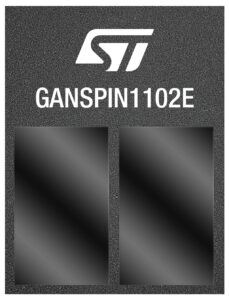
Nothing will be as effective a solution as a new device that tackles this challenge head-on, which is why we are releasing today the GANSPIN1102 and GANSPIN1105. The former features an RDS(on) of 2.4 mΩ, while the latter registers at 5.5 mΩ. They have a maximum current of 60 A and 29 A, respectively, and both come in one of the smallest packages in the industry, measuring only 6.5 mm x 5 mm. Additionally, the GANSPIN1102E uses a housing that dissipates heat from the top. This model specifically targets systems that use metal housings, like humanoid robots, that will conduct heat away from the top of the device.
Far less heat dissipation and EMI
The rated electrical characteristics provide plenty of overhead. Yet, we have multiple customers that chose the GANSPIN1102 or GANSPIN1105 because their size and the features they house enabled them to create designs that would have been impossible otherwise, even if the devices offer way more headroom than they needed. This is largely possible because GaN’s low RDS(on) and low charge enable high-frequency operation with low losses and, in turn, lower heat dissipation. Furthermore, the two devices provide adjustable turn-on speeds, which allow engineers to optimize their behavior to further reduce electromagnetic interference, allowing them to use smaller components and design a smaller PCB.
Fewer external components without trade-offs
Despite their size, the GANSPIN1102 and GANSPIN1105 incorporate components like dynamic bootstrap switches and capacitors, along with traditional protection features such as undervoltage and overvoltage protection, meaning they require fewer external devices for a lower bill of materials and a smaller overall footprint. This is possible because of our manufacturing expertise. That’s why it was important for us to show what these new devices can do at electronica. The demand for smaller and more efficient GaN drivers is not only gaining traction thanks to new applications but also because more and more regions are dealing with these engineering challenges. And the GANSPIN1102 and GANSPIN1105 offer a unique solution that will shape the next generation of three-phase motor control applications.
Simpler PCB layout
ST optimized the pinout of the GANSPIN1102(E) to enable engineers to get good performances even on two-layers PCBs. Concretely, a three-phase motor requires three half-bridges, which, in this instance, means three 6.5 mm x 5 mm GANSPIN devices. We do acknowledge that a four or more layers PCB is best, but we also did tweak the pinout to ensure that a two-layer PCB offers solid performances. Hence, it’s conceivable that thanks to the pinout of the GANSPIN1102(E), the researchers from Jilin University could have adopted the two-layer layout they were originally looking for instead of being forced into extra layers.