

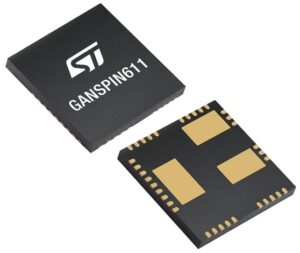
ST is releasing today a new EVLGANSPIN2-3PH evaluation board for the GANSPIN612, launched last January 2026, enabling our community to experiment with the new device and rapidly create a proof-of-concept. This release complements the GANSPIN611 and its EVLGANSPIN1-3PH evaluation board. Both GANSPIN devices bring a more efficient way to drive motor control applications, enabling a smaller system in some harsh environments. Both GANSPIN devices feature two GaN power transistors and high-voltage gate drivers. The 650 V GaN transistors of the GANSPIN612 feature an RDS(ON) of 270 mΩ and support a power of around 300 W, while those in the GANSPIN611 feature 138 mΩ and support more than 400 W.
Why energy efficiency is a constant struggle
New applications and regulations
Motor control applications must sometimes contend with tight spaces and heat-dissipation constraints. Think of a hairdryer, a fridge compressor, or a hot water recirculating pump, for instance. In the case of the former, the motor control IC is often located relatively close to the heating element, the motor, or the hot water pipes, which creates all sorts of problems. Similarly, as regulations become more demanding and manufacturers aim to reduce costs, improving the efficiency of a fridge compressor, for instance, means removing a heatsink and using a smaller PCB. In fact, we chose these examples because ST has customers working on similar products that demand more efficient motor control drivers.
The material challenge
The challenge is that there aren’t many ways to improve energy efficiency. Engineers can work on topologies and control algorithms. AI can help improve overall operations. However, nothing beats a new material design. Indeed, for the most part, the limits of a power transistor come from its material properties. Silicon has a bandgap of 1.1 eV and an electron mobility of 1,400 cm2/Vs, while HEMT GaN features 3.4 eV and 2,000 cm2/Vs. Concretely, it means that its performance at high switching frequencies has hard limits, which is why engineers have been looking at wide-bandgap devices like silicon carbide and gallium nitride, but driving these materials demands new paradigms and new devices.
The wide bandgap challenge
A new material design brings new realities. For instance, because GaN transistors can generate higher-voltage transients, the gate driver must cope with potentially increased electromagnetic interference and hard-switching events. Indeed, when driving an inductor, the current may flow in the opposite direction. Reverse conduction in a GaN device is similar to that in a MOSFET body diode, but at a significantly higher voltage. And not all standard gate drivers can cope with it. Engineers must thus find new ways to operate their device under such conditions while ensuring the same resiliency and reliability as the previous generation of components. That’s why a material like GaN, already in chargers, still struggles to come to motor drivers, until today.
GANSPIN611 and GANSPIN612
Two GaN power transistors
To meet the new energy-efficiency requirements, ST introduced its first GaN motor drivers, the GANSPIN611 and GANSPIN612. Both include two GaN power transistors in a half-bridge topology. As explained earlier, the only difference between the two is their RDS(ON), besides their max drain-to-source current (10 A on the GANSPIN611 and 5.5 A on the GANSPIN612). It thus enables engineers to tailor their motor driver to their application and choose the device that will best suit their needs. And since both include the same gate driver in the same package, designers can really choose a device based on their electrical criteria without compromising performance.
One robust and flexible architecture
When considering a high-power motor driver, a traditional silicon power transistor inverter requires a heatsink or enhanced cooling for an output power exceeding 150 W to 200 W. In contrast, the GANSPIN611 and GANSPIN612 are so efficient that they do not require a heatsink at these power levels, while featuring typical output commutations of 10 V/ns, and an externally adjustable turn-on dV/dt for further energy optimizations. Indeed, because GaN devices are so fast, it’s essential to tune their voltage slope to counter potential electromagnetic interference. By offering adjustable dV/dt, engineers can tailor the output slope to improve overall performance.
Two evaluation boards and one SDK
The best way to start experimenting with the GANSPIN611 and GANSPIN612 is to grab their respective evaluation boards (EVLGANSPIN1-3PH and EVLGANSPIN2-3PH). Both use an STM32G431RB and three GANSPIN devices to control the three phases in a 3-shunt FOC topology. We included EMI filters and tuned the dV/dt values. Users just have to connect their sensored or sensorless motors and experiment with the algorithms running on the MCU, or grab ST’s Motor Control SDK package (MCSDK-PKG) to write motor control applications. Both boards can accept 100 V AC to 230 V AC mains input, simulating real-world conditions when designing a product meant to be plugged into a wall socket.