

STMicroelectronics introduced the DC+ (DCP) family, a new generation of DC-DC converters. With the recent addition of the higher‑current DCP3603, fully compatible with the earlier device, the DCP family now extends its scalability even further. These converters focus on compactness, scalability, and high-voltage capability to meet the needs of modern applications. For example, the DCP3601 stands out for its simplicity and ease of integration. It has a highly compact design and needs minimal external components. This makes it perfect for projects where space is limited, and development needs to move fast. It helps get products to market quicker while ensuring dependable and efficient power management. In this article, we’ll take a closer look at the innovative DCP family and show how the DCP3601 and the DCP3603 combine strong performance with simple integration to help designers tackle today’s electronic design challenges.
Naming convention
STMicroelectronics has released a clear and structured naming convention for its latest DCP family of DC-DC converters, designed to make product identification and selection easier. The naming format provides all the key details at a glance, covering important device specifications and features.
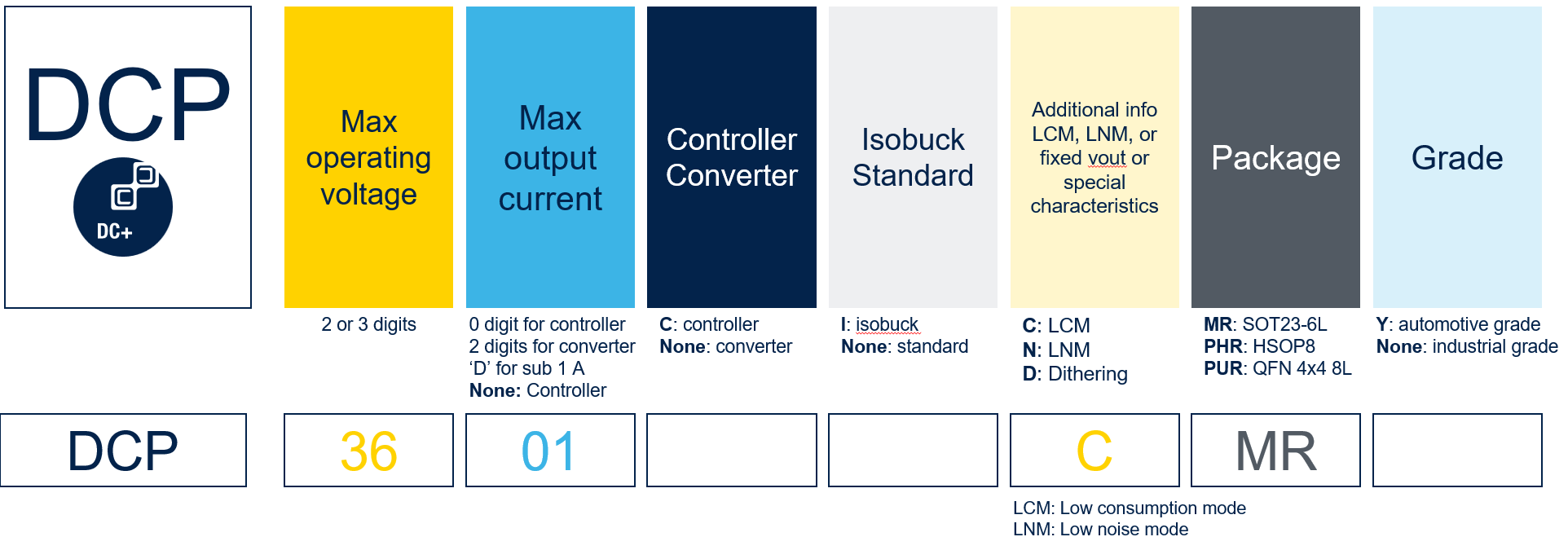
Each part number starts with the DCP prefix, representing the DC+ converter family. This is followed by a series of fields indicating:
- Maximum Operating Voltage: Expressed by the first 2 or 3 first digits, indicating the highest input voltage of the device.
- Maximum Output Current: Represented by the next digits; if there’s no number, it means the device is a controller, while numbers indicate the output current in amps for converters.
- Controller or Converter Type: A letter ‘C’ symbolizes a controller, while absence of this letter indicates a converter.
- Isobuck Standard: A letter ‘I’ stands for the ST’s Isobuck standard for isolated supply applications; if omitted, the device is in standard converter version.
- Additional Characteristics: Letters such as ‘C’, ‘N’, or ‘D’ provide information about features like LCM (Low Consumption Mode), LNM (Low Noise Mode), or dithering for improved EMI performance.
- Package Type: Codes like MR, PHR, or PUR specify the physical package style, such as SOT23-6L, HSOP8, or QFN.
- Grade: A final letter indicates the device grade, where ‘Y’ stands for automotive and none for industrial standard.
By using a simple naming approach, engineers can quickly find the DCP device that best fits their requirements for voltage, current, packaging, and features.
The new DCP3603
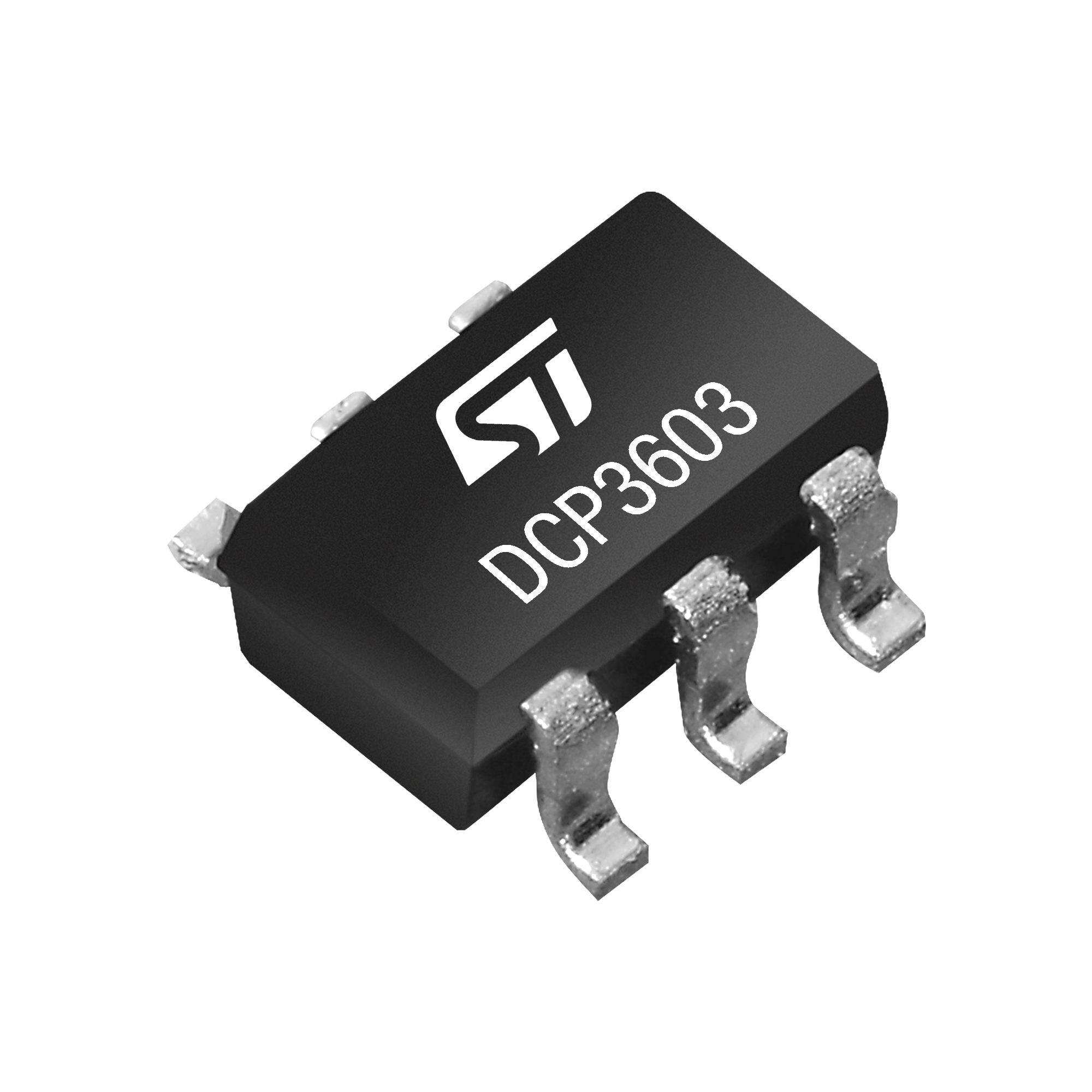
The DCP3603 is the next step in the evolution of ST’s DC+ converter family, offering a straightforward upgrade path from the DCP3601. Fully pin‑to‑pin compatible and sharing the same tiny SOT23‑6L footprint, it allows designers to boost performance without redesigning the PCB. The big difference lies in capability: the DCP3603 delivers up to 3 A of output current, tripling the available power while maintaining the same minimal BOM and simple integration workflow.
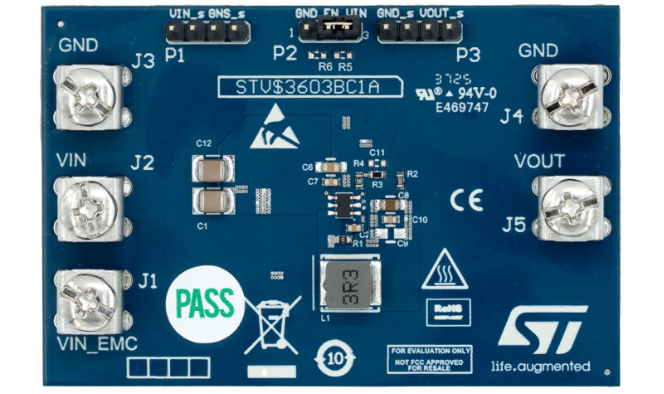
Efficiency also improves, with typical values of 93% at 12 V input and 89% at 24 V input for a 5 V rail at 1 A load. Depending on the variant, designers can choose between 500 kHz and 1 MHz switching frequency, along with options for dithering, LCM for light‑load efficiency, or LNM for low‑noise operation. With its wide 3.3–36 V input range, built‑in protections, and flexible operating modes, the DCP3603 offers a clean, scalable path for projects that need more current or tighter EMI performance while keeping the same design footprint. The matching STEVAL‑3603BC1 evaluation board follows the same simple approach as the DCP3601 board but demonstrates how easily the higher‑current DCP3603 can be integrated into existing designs.
DCP3601
The DCP3601 is a highly integrated, miniature buck converter designed to deliver excellent efficiency, while being simple to design. With power switches and compensation built in, it requires only six external components, including an inductor, capacitors, and feedback resistors, making it ideal for compact, low-BOM solutions.
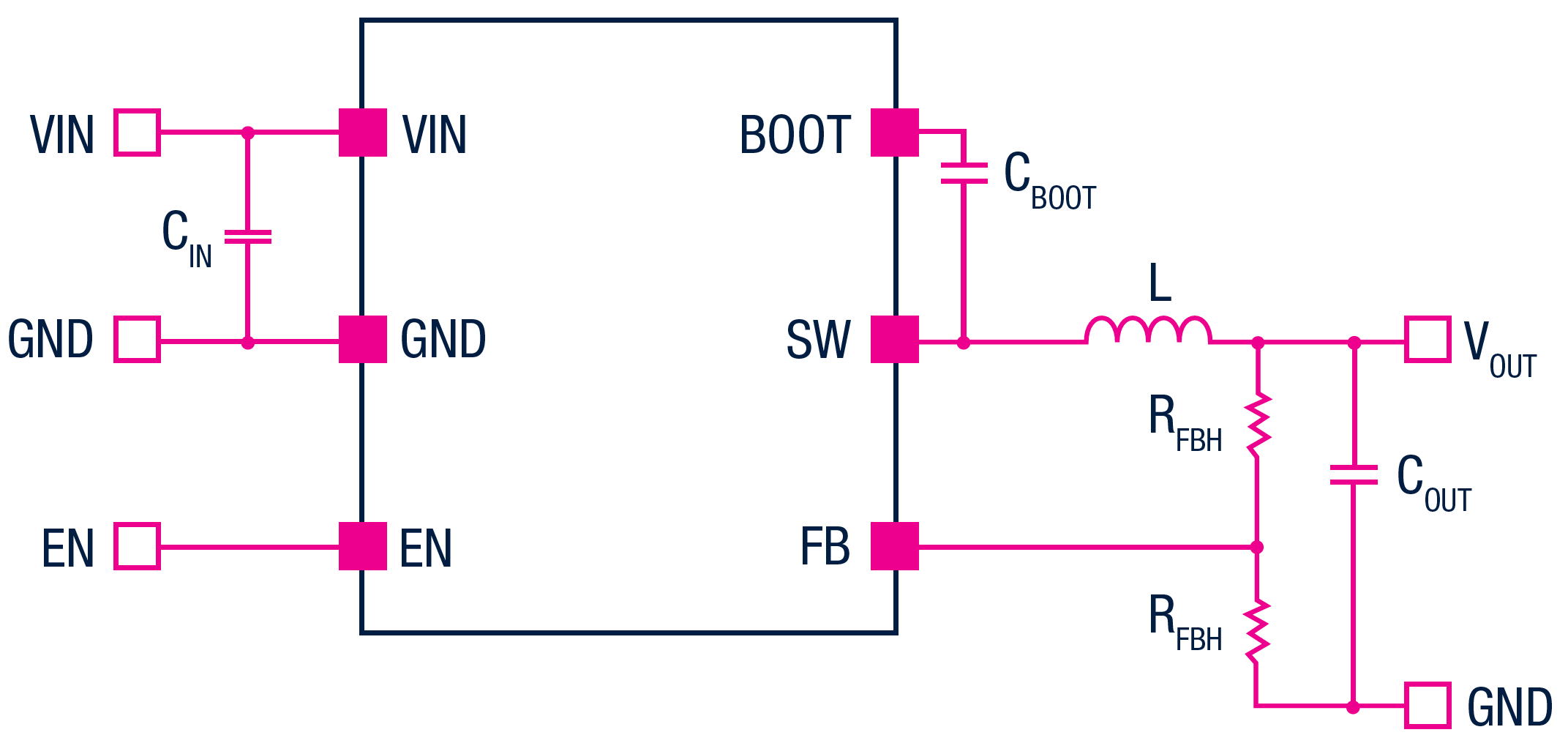
Thanks to a wide input range from 3.3 V to 36 V and a maximum deliverable output current up to 1 A, the DCP3601 can be used for powering low-voltage loads in various applications such as smart metering, home appliances, and industrial 24 V systems. Its synchronous conversion and fixed 1 MHz switching frequency ensure efficiency up to 91%, even under varying load conditions.
With several variants available, the DCP3601 gives designers the flexibility to customize power management to fit their specific application requirements. For noise-sensitive environments and applications, the Low Noise Mode (LNM) version (forced PWM mode) keeps switching stable, helping to minimize noise and electromagnetic interference. Alternatively, the Low Consumption Mode (LCM) version with pulse-skipping operation optimizes efficiency during light-load conditions by reducing switching activity, thereby lowering power consumption.
To further enhance EMI performance, the variants including the frequency dithering are also available. The dithering spreads the switching frequency spectrum across a range of frequencies and reduces peak emissions. Additionally, with the ultra-low quiescent current of just 110 µA, the device is perfect for extending battery life in portable devices. The built-in Enable pin also allows easy on and off control, making it simple to save power during standby or shutdown.
As the first device in ST’s growing buck converters family, the DCP3601 benefits from ST’s 10-year longevity program, which guarantees long-term availability and support. Its compact dimensions of 3 mm × 1.6 mm SOT23-6L package and competitive pricing make it an excellent choice for efficient, space-saving power conversion.
DCP3601 design and evaluation
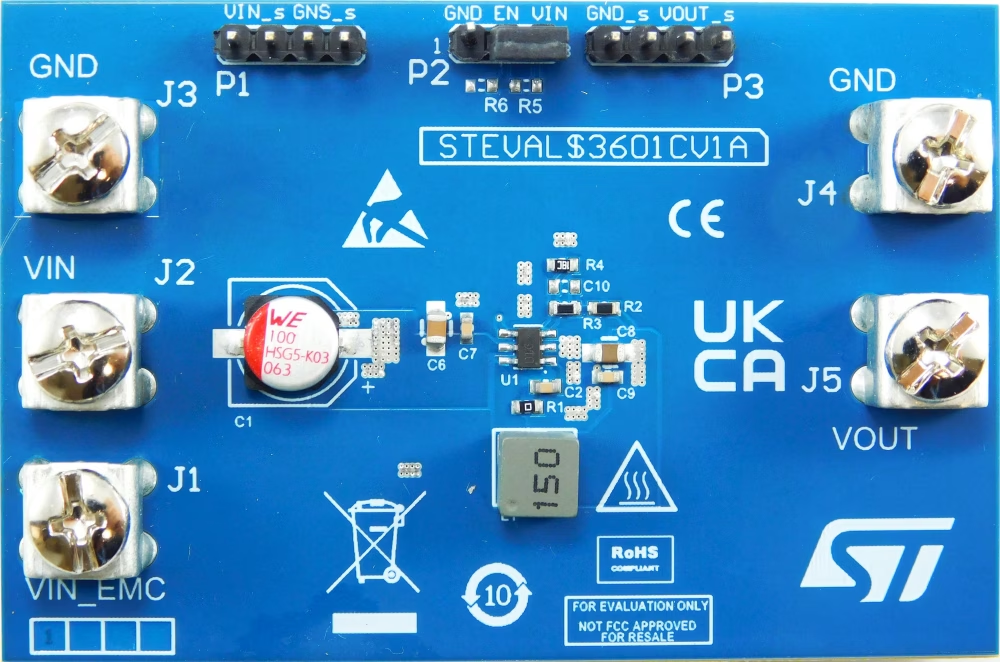
To get started quickly with the DCP3601, the STEVAL-3601CV1 evaluation board is a great place to begin. It comes ready to use with screw terminals and headers, so it can be powered up right away. The board’s compact design shows off the DCP3601’s strengths, high efficiency and a small footprint, making it a solid choice for applications like home appliances, smart meters, industrial 24 V bus converters, and other wide input voltage power supplies.
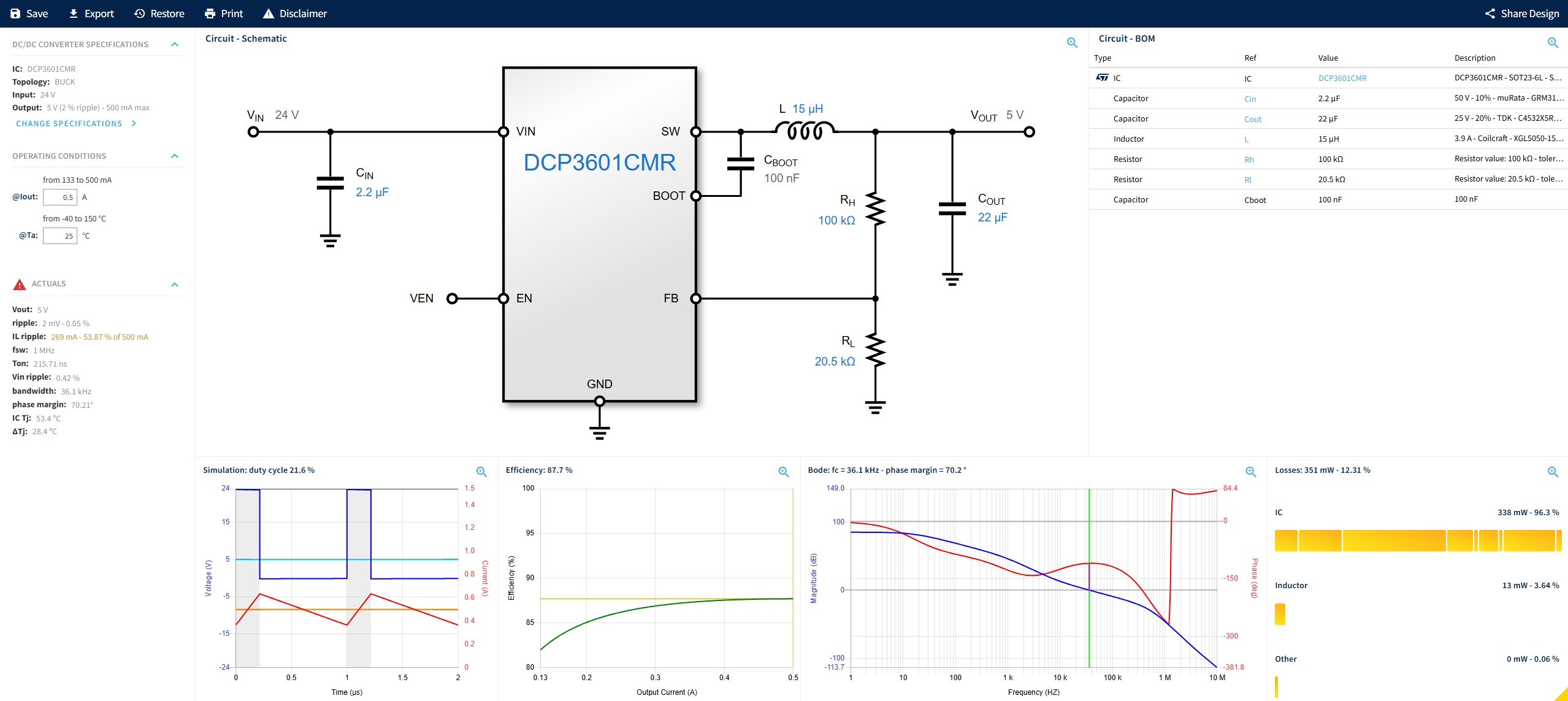
To make things even easier, ST offers the eDesignSuite online tool including the DCP3601 model. Just enter the desired specifications, and the tool generates a custom schematic and a detailed bill of materials. Plus, it gives helpful information on efficiency, power loss, and bandwidth so designers can fine-tune their design early on.
STMicroelectronics’ new DC+ (DCP) family, featuring the efficient and highly integrated DCP3601 and DCP3603 buck converters, give designers compact and flexible power solutions that can easily scale to fit modern needs. Thanks to a straightforward naming system and a range of device options, selecting the right component and designing with it is simpler than ever. Plus, handy tools like the STEVAL-3601CV1 and STEVAL-3603BC1 evaluation boards and eDesignSuite help speed up development and fine-tune performance. Altogether, these advancements deliver reliable, space-saving, and cost-effective power management tailored to a variety of applications.
- Discover more about buck converters
- Learn more on ST portfolio
Author: David Tupy Application Engineer, specializing in system architecture and focusing on analog sensor interfaces