

ST is launching today the STM32MP21x product line, the most affordable STM32MP2, comprising a single-core Cortex-A35 running at 1.5 GHz and a Cortex-M33 at 300 MHz. It thus completes the STM32MP2 series announced in 2023, which became our first 64-bit MPUs. After the STM32MP25x and its 1.35 TOPS NPU, and the STM32MP23x, which targeted industrial AI applications, the new STM32MP21x lowers the barrier to entry by still offering DDR4/LPDDR4 alongside DDR3L and the same Ethernet controllers with time-sensitive networking as the other members of the series. Consequently, teams looking to use an MPU in an industrial setting can now do it while keeping their costs even lower, whether with Linux or bare-metal software.
The contradictions pulling MPU designs apart
Power vs. efficiency
The world of embedded Linux is complex because it operates under very tight constraints. On the one hand, teams choose Linux because they need something far more powerful and extensive than a traditional real-time operating system can provide. However, the same application can significantly benefit from running some of its operations on a bare-metal system, which is why the ability to run an RTOS on ST MPUs since the STM32MP13 has been so successful. Similarly, while teams need the computational power of an MPU, they face power-consumption and cost constraints that can make designing systems challenging.
Computational throughput vs. ease of transition
Engineers face a significant gap when transitioning to the MPU world. Usually, that happens when they have reached the limits of what’s reasonable to run on a microcontroller and must adopt a significantly more powerful device and embedded Linux. Unfortunately, the industry doesn’t always provide an MPU that makes this move easy, as it forces designers to deal with a massive bill of materials and development costs. That’s why the STM32MP21x sets a new standard for affordability, as its bare-metal capabilities mean that teams can port some of their existing applications for an even smoother transition. Moreover, they even get a modern DDR4/LPDDR4 controller with DDR3L backward compatibility to future-proof their system.
The modern solutions to make MPU designs more accessible
A flexible memory controller
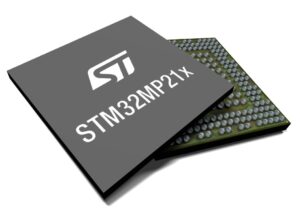
The new STM32MP21x comes with a memory controller supporting 16-bit DDR4/LPDDR4 and DDR3L. Teams wishing to replace their STM32MP13x while keeping their legacy DDR3L can swap the MPU with minimal adjustments. Conversely, teams looking to adopt a more modern architecture without substantially increasing their costs now have an alternative that will serve them for years to come. It also gives teams much more flexibility to weather the volatility of the memory market, since engineers can work with a broader range of memory types. And since the STM32MP21x operates with all memory generations at the same frequency, and the industrial applications are very rarely limited by the RAM bandwidth, the performance difference remains minimal or even imperceptible.
A resourceful architecture
To make the STM32MP21x even more practical, we made it pin-to-pin compatible with the STM32MP23x and the STM32MP25x using a 10 mm x 10 mm package. It also uses the same Cortex-M33 as the other STM32MP2 devices, making it nearly effortless to use our M33-TD implementation in our OpenSTLinux distribution across all STM32MP2s. The new STM32MP21x also handles the same wide junction temperature range (-40 ºC to 125 ºC) and targets the same SESIP Level 3 certification. It also comes with dual Gigabit Ethernet ports with time-sensitive networking, and multiple interfaces, including a CSI-2 for camera pipelines. Put simply, offering a cost-effective solution didn’t mean sacrificing important features for industrial markets.
The next steps to jump on the bandwagon
More cost-effective image processing
Thanks to its architecture, engineers can use the STM32MP21x in an application that captures data from an image sensor and cleans it up before sending it to another MPU with a neural processing unit. It helps spread the computational load while reusing a lot of the work that goes into these microprocessors. Similarly, thanks to its peripherals and security features, teams can use the STM32MP21x for processing sensor data at the edge while meeting the ever-increasing requirements imposed by governments and other regulatory bodies. Put simply, it allows many engineers to create applications that were previously too costly to conceive or lacked the proper hardware support on an MCU or competing MPU.
A Discovery Kit to get started
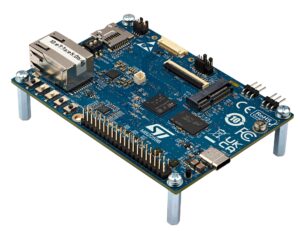
The best way to get started is to grab the STM32MP215F-DK Discovery Kit . It comes with a MIPI CSI-2 two-lane camera interface, one Gigabit Ethernet port with TSN support, 2 GB of LPDDR4, an M.2 connector for accessories or storage (like a Wi-Fi / BT module), and an LCD-TFT display controller for projects that require a UI. The board receives power via a USB-C 2.0 port that also transmits data for debugging and programming with ST-LINK, among other things, and a microSD card slot will help with overall storage.
In a nutshell, the STM32MP215F-DK Discovery Kit is the quickest way to experiment with capturing image or inertial sensor data and see how the STM32MP21x can impact a design. Once they move to a custom design, engineers will have the widest selection of packages, from 14 mm x 14 mm to 11 mm x 11 mm, 10 mm x 10 mm, and 8 mm x 8 mm. Once teams choose their device and configuration, they will get access to a wide range of layout examples available on ST.com to help them start with their preferred package, the PMIC (more news to come soon), and selected DRAM.