
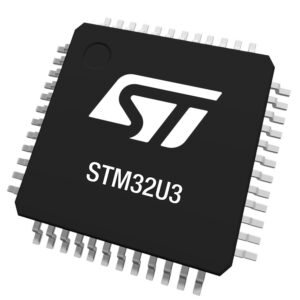
The STM32U3B5/C5 are the first STM32U3 devices featuring 2 MB of flash and our new hardware signal processor (HSP). In a nutshell, the HSP is an embedded signal processor that accelerates certain computations, enabling a whole range of industrial and AI applications on our ultra-low-power microcontroller. While the new models retain the near-threshold design that allowed the STM32U3 series to boost efficiency by a factor of four, the HSP opens the way for sensing and machine learning programs that would have been too demanding before. We wrote an accompanying blog post on the new hardware signal processor to help avid readers grasp the performance gains and what it means for the STM32 community.
What’s new? The new STM32U3B5/C5
The STM32U3B5/C5 primarily stands out from the other STM32U3 devices thanks to its HSP. It’s also why it carries double the flash memory of previous models and 640 KB of RAM, as we expect developers to need a much greater capacity for larger applications and datasets. The new device also comes with one additional group of interfaces, bringing the total to four SPI and I2C, two I3C and CAN-FD, and five UARTs. There are also five more 16-bit timers, for a total of 10. The only difference between the STM32U3B5 and the STM32U3C5 is that the latter includes a cryptocore to accelerate encryption and decryption operations, as well as offer CCB (see more on that later).
What makes the STM32U3 series special? Ultra-low-power consumption and high energy efficiency
117 Coremark/mW
One number sums up the efficiency of the STM32U3: at 117 Coremark/mW, it breaks the 100 symbolic threshold, literally making it a new benchmark in the industry. Indeed, most of the best devices from the competition hover below 100, and the STM32U5 reached 53.9. This significant jump in energy efficiency is due to our near-threshold design. We dedicated an entire blog article to this region of CMOS transistors that many are trying to utilize, but that has remained mainly in the background until now due to its inherent challenges.
0.65 V minimum and 105ºC maximum
In a nutshell, near-threshold conduction in a CMOS transistor occurs when applying a voltage between the gate and the source near a threshold (VT). In most of the devices used in a microcontroller like the STM32U3, that threshold is 500 mV. The vast majority of near-threshold designs apply a VGS of about 700 mV or more. And since near-threshold conduction is a diffusion current as residual leakage current flows under the gate oxide, the transistor itself experiences strict limitations in its operating voltage and temperatures. Most competing devices don’t go above 85ºC, which is why we don’t usually find these devices in industrial applications.
The STM32U3 is different because, thanks to unique optimization in the lithographic processes and manufacturing, ST can apply a lower voltage of 650 mV. The most direct benefit of a VGS value that’s closer to VT is that it helps lower the VCORE further, meaning that we can reach a minimum of 0.65 V and a typical value of 0.75 V. Additionally, as we are experiencing significantly less leakage current than competing solutions, the STM32U3 supports an operating voltage of up to 3 V and a temperature of 105ºC. It can, therefore, tolerate far harsher environments. Hence, the STM32U3 is unique because it makes near-threshold designs mainstream in most industrial applications.
Adaptive Voltage Scaling
Another issue common in near-threshold designs is die variability. Because the near-threshold region is sensitive to the smallest voltage variations, it affects dies on the same wafer more significantly. That’s why tuning each die to account for changes between them can be time-consuming and costly. To solve this challenge, ST implemented a testing system at the factory level, which automates machine learning on STM32 devices. We call it Adaptive Voltage Scaling. Simply put, our machines test each die, and a machine learning algorithm automatically tweaks various aspects to ensure consistent ultra-low-power consumption.
Versatile peripheral offering without compromising cost efficiency
Another challenge of near-threshold designs is performance. Indeed, as the VCORE is low, so is the operating frequency. However, that is not the case with the STM32U3, which features a Cortex-M33 running at 96 MHz. Moreover, we ensured that despite its more cost-effective pricing, engineers would still get a lot of peripherals and timers. Indeed, the new device supports two I3C buses, CAN-FD, one octo-SPI interface, and more. It also comes with 16 timers, including two 16-bit ones for motor control applications, and a touch-sensing controller for those working on a UI.
Robust safety and security for sensitive and mission-critical applications
Besides efficiency and performance, ST also designed the STM32U3 for safety and security. Consequently, the new device offers up to 1 MB of dual bank flash, enabling firmware updates without shutting the system down, which is often a critical consideration in mission-critical applications. The STM32U3 also introduces CCB to securely transmit keys by using independent buses ([patent filed in 2023 and 2024]). And we’ve already updated STM32CubeMX, our initialization tool. After activating the random number generator, users can select “CCB” in the list of cryptographic options and start using the feature. Finally, the STM32U3 can also target PSA L3 and SESIP3 certifications.
What’s next
To ensure the STM32U3 can reach numerous industrial applications, we are offering eight packages, which is unique for a near-threshold design. We are also releasing a Nucleo board to help developers rapidly design a proof-of-concept or run their tests to witness the ultra-low-power consumption for themselves. SmaXtec, a member of the ST Partner Program specializing in bovine monitoring already shared how,
“STM32U3 enables us [smaXtec] to bring our hardware to the next level. Due to its low power consumption in an active mode of only a few µA/MHz, it enables us to reduce the energy needed for current data processing algorithms and allows us even to integrate additional features into the device. Although STM32U3 exhibits major improvements in active modes, its advanced range of low-power modes still allows the device to be put into deep sleep if no data is processed. The newly implemented STOP3 mode, including its wakeup capabilities, is a neat way to keep power consumption low.”