
At a glance
- First all-in-one module integrating NB-IoT cellular connectivity, GNSS, and Wi-Fi positioning.
- Single chip with low power consumption and additional ADC for external sensors.
- RED-DA certified with an evaluation board and daughter card available to quickly get started.
Introduction
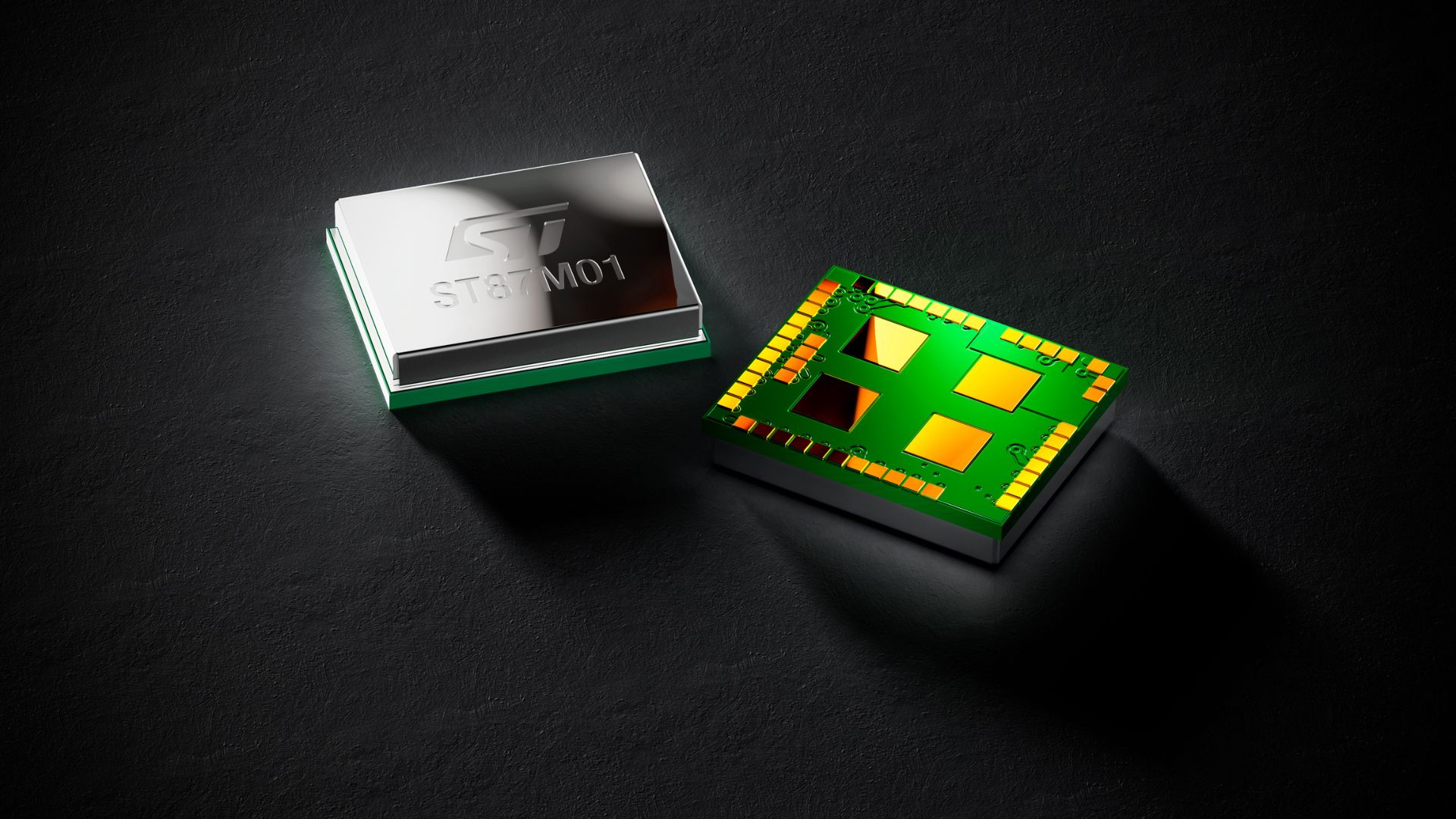
The ST87M01 is the first module to support Narrowband-IoT (NB-IoT), GNSS, and Wi-Fi positioning (in its ST87M01-1301 variant), making it the most flexible device for smart labels or asset trackers, and more. It also includes an extra analog-to-digital converter (ADC) to enable engineers to connect two sensors directly to the module, thereby vastly augmenting its usefulness while simplifying the overall design. Additionally, the ST87M01 line of devices received RED and RED-DA certifications, the latter of which has become mandatory in the European Union. Put simply, it means engineers don’t have to worry about the latest cybersecurity requirements, even if their solution has a long lifespan.
Design challenges in NB-IoT asset tracking and smart label devices

What wireless protocol to choose?
One of the biggest challenges when working on tracking applications or smart labels is choosing wireless protocols. The decision is critical to the overall design, and it’s not easily changed. The engineering team’s choice of standards will have repercussions for battery life, the type of data a system can transmit, the frequency of data transfers, the overall footprint, and more. It’s one of the reasons these systems tend to support multiple wireless platforms, such as Bluetooth for more immediate user communication and GNSS for location data. The problem is that choices like these come with severe limitations. For instance, in a Bluetooth-GNSS setup, the lack of a cellular connection makes sending data to the cloud challenging.
Of course, designers may also opt for QR Codes or NFC tags, which can help with tracking and clearly have their place. However, they both demand a close proximity to the assets, which is not always possible. When companies need to monitor assets remotely or communicate with smart labels via the cloud, they must rely on longer-range wireless protocols. QR codes may also lack resiliency. It is common to see a code scratched or poorly readable due to poor placement, which can slow operations to a crawl or cause confusion. A QR will also lack the ability to dynamically update itself, which can be an important feature, such as when tracking assets with strict temperature requirements.
Multi-radio complexity: how many wireless protocols to support?
The other engineering problem is that multiplying the number of supported protocols tends to increase the bill of materials and overall complexity, which is why engineers don’t favor the “kitchen sink” approach. For example, adding GNSS, Bluetooth, NB-IoT, and Wi-Fi positioning meant, until now, adding multiple SoCs, tuning many antennas, dealing with numerous middleware, and facing various development and certification challenges. And that’s not taking into account the power consumption, which tends to rise rapidly, a problem for devices that are mostly small, battery-powered, and must last for years in sometimes harsh environments.
The other hurdle to the democratization of asset tracking is the need to customize systems for each application. The needs of smart labels are often different from those of a tracking system for humans, which itself varies from other products that track animals or assets. Each application has unique considerations and edge cases, which means it is very hard for a team to qualify and certify a single design across multiple applications. Consequently, costs tend to skyrocket when accounting for different use cases, and teams must handle many more devices than is optimal for their operations. Put simply, it’s hard to find economies of scale when so many markets are just “niche” applications.
ST87M01: Integrated connectivity and positioning for smart cities and industry
All-in-one NB-IoT hardware with optional GNSS and Wi-Fi
The ST87M01 is unique because it is the first in the industry to offer NB-IoT, GNSS, and Wi-Fi positioning, all under one roof (ST87M01-1301). A version supporting only NB-IoT (ST87M01-1001) is also available for those who need only the cellular protocol and want to lower their bill of materials. That’s often the case for smart metering and industrial IoT applications that don’t need satellite or Wi-Fi positioning. By providing multiple versions, we ensure designs can choose the device that’s most cost-effective and power-efficient. Having all these versions of the ST87M01 also means that engineers could reuse a design and offer their customers more options.
Practical connectivity switching with AT commands
The new ST device exposes wireless standards through AT commands. It’s a common approach that most developers are very familiar with, as it not only simplifies orchestration but also makes code more readable and faster to write. Through AT commands, developers can enable or disable the appropriate wireless standard using conditional loops, thus automating the process. For instance, an application could turn on GNSS when the cellular connection drops or use Wi-FI positioning when satellite is unavailable. That means designers can avoid complex RF switching and optimize their code to meet strict connectivity needs and power requirements.
Optimized architecture with low power consumption and two ADCs
The ability to offer an all-in-one solution means keeping the power consumption and footprint down. The ST87M01 offers power-saving modes that require as little as 1.2 µA, and an off mode that needs only 0.5 µA. And despite the wide range of supported wireless protocols, the ST87M01 measures only 10.6 mm x 12.8 mm. The package even includes an additional ADC, so engineers can add a thermometer and a pressure sensor or a gyroscope to get much more information about what they are tracking and its environment. Moreover, the fact that we control the supply chain, since we manufacture the ST87M0 ourselves, and provide a 15-year longevity guarantee, enables customers to trust our device even more.
ST87M01: The growing number of applications reliant on long range connectivity

Asset tracking
Currently, we see the most interest around asset tracking applications. Being able to use GNSS in such a low-power module, while also using a cellular network to send data to the cloud, makes the ST87M01 particularly flexible. Additionally, Wi-Fi positioning means it’s still possible to provide location data when GNSS is unavailable, such as when the asset is in a building or an area with no GNSS reception. Having all these protocols so easily accessible also means it’s possible to qualify a single design for many different assets, making the whole system vastly more scalable.
Smart labels and smart cities
We are also seeing the rise of new applications, such as smart labels for goods or animal tracking. Indeed, it is possible to use smart labels in new ways, such as applying them on or in the animal for better livestock management or conservation initiatives. Similarly, smart cities are benefiting from NB-IoT’s incredibly long range and low data rate as they deploy sensors and alarms to monitor strain on public infrastructure or other major events. Additionally, GNSS and Wi-Fi positioning help monitor hard-to-reach assets, making the ST87M01 a strong candidate for IoT tracking and condition-monitoring designed for secure and long-term connectivity.
Evaluation platforms for NB-IoT tracking and smart city sensors
STEVAL-NBIOTV1: NB IoT sensor node with environmental monitoring
The STEVAL-NBIOTV1 is an evaluation platform and reference design tailored for asset tracking, smart city applications, and metering. It features an STM32U5, a low-power, high-precision LPS22DF barometer, an ultra-low-power three-axis LIS2DUXS12 accelerometer, and a hygrometer from Sensirion (the SHT40-AD1B). We also embedded the LD39100 low-quiescent current LDO and the STBC02 battery charger. Furthermore, the STEVAL-NBIOTV1 features custom PCB antennas optimized for NB-IoT bands 3, 8, and 20 and a dedicated GNSS chip antenna. Developers can thus create asset-tracking beacons, environmental-monitoring modes, smart-parking or smart-lighting controllers, and smart-metering endpoints. Hence, the STEVAL-NBIOTV1 closely mimics the power consumption and RF performance of a real-world application.
EVKITST87M01-2: plug and play NB-IoT with GNSS/Wi Fi positioning
The EVKITST87M01-2 is a daughter card for a Nucleo board. It comes with an ST87M01-1301 module, a SIM slot, and antennas for NB-IoT, GNSS, and Wi-Fi positioning. Thanks to its Arduino connector, engineers can just plug EVKITST87M01-2 into an STM32 Nucleo board and run demo applications, such as NB-IoT attach tests, coverage checks, power-saving (PSM/eDRX) evaluation, and GNSS/Wi-Fi positioning trials. It also allows teams to experiment rapidly with numerous STM32 series and develop a proof-of-concept, since it’s possible to move the card to a broad range of Nucleo boards to determine what would work best for specific applications.
Software tools and firmware for the ST87M01
Taking advantage of the ST87M01 starts with the STSW-ST87MGUI, a graphical configuration and test tool. It exposes most of our module’s features through a GUI and provides a console for entering AT commands. It also comes with a spectral viewer to help evaluate RF performance. Once engineers are more confident, they can explore our evaluation tool, the STSW-ST87ECLIB, which comes with source code examples and APIs to implement modem configurations, manage power saving modes, and build connectivity logic (NB-IoT attach, data send/receive, GNSS/Wi-Fi control) on an STM32 or another MCU.
Finally, once engineers are close to production, the STSW-ST87M01 firmware package will provide the foundation they need to optimize their custom solution. That includes, among other things, support for secure firmware updates and differential firmware over-the-air (FOTA). These software elements enable a smooth transition from lab prototypes to field-ready products. Finally, the device is RED and RED-DA certified, meaning it will significantly help with the final product’s certifications.