

Editor’s Note: We updated this blog post to account for the new Matter support over Wi-Fi and the arrival of new reference designs.
ST and Qualcomm Technologies, Inc. are thrilled to announce the mass-market availability of the ST67W611M1, a Wi-Fi co-processor stemming from our strategic collaboration. Compatible with Wi-Fi 6 and Bluetooth 5.4, Matter over Wi-Fi support is now available through the X-CUBE-MATTER software expansion, while Matter over Thread should come later in 2026. Thanks to its integration into the STM32Cube ecosystem and certifications, the ST67W611M1 is the easiest way to add a Wi-Fi®/Bluetooth®/Matter combo module to an IoT system. The new device can even help simplify PCB designs, thanks to greater integration, or the fact that it’s possible to only use SPI for Wi-Fi and Bluetooth instead of UART.
How to make Wi-Fi meaningful? Seamless integration into the STM32 ecosystem to accelerate development
The optimization problem
Many may wonder why ST and Qualcomm Technologies decided to come together in the first place. After all, engineers who needed Wi-Fi didn’t wait for the ST67W611M1. They just got a device from a third party and installed it on their PCB. The problem was that we also heard from engineers who complained that this approach was complex, costly, and far from optimal. Not all Wi-Fi modules are created equal. Not all drivers are straightforward. And IoT devices are continually seeking to enhance their power efficiency. Put simply, when ST and Qualcomm Technologies announced their collaboration, the feedback we got was overwhelmingly positive.
The collaborative solution
A practical example of the fruit of the collaboration between ST and Qualcomm Technologies is the integration of the ST67W611M1 into our ecosystem. In a nutshell, the RTOS communicates with the Wi-Fi module using the SPI protocol; however, developers only need to use simplified API abstraction layer commands. Moreover, we provide examples to help them get started. And while we don’t ship all BLE profiles in our software packages, as it would make them too onerous to download, developers can rapidly add the relevant ones to their application. Consequently, we didn’t just simplify the device’s integration, but also its use. For instance, writing a basic MQTT application only takes a few hours.
The ST67W611M1 journey
To help integrators take advantage of the new device as rapidly as possible, we released the X-NUCLEO-67W61M1 expansion board and the STDES-67W61BU-U5 reference design that pairs the ST67W611M1 with an STM32U5. We have already updated the STM32CubeMX and X-CUBE-ST67W61 software packages, which contain drivers, firmware for the STM32U5, STM32H5, STM32H7, and STM32N6, and application examples, all helping to reduce development times. Moreover, developers can already use the Wi-Fi module with nearly all STM32 devices. Put simply, this announcement demonstrates why engineers have been seeking a more seamless integration of a Wi-Fi module with the STM32 ecosystem, and how the new solution leverages the ecosystem ST has developed over the years.
Matter-ready: accelerating smart home development
The ST67W611M1 now supports Matter over Wi-Fi through the X-CUBE-MATTER software expansion, making it the fastest path to building smart home devices within the STM32 ecosystem. With wireless complexity offloaded to the co-processor, engineers can focus on their application and bring Matter-certified products to market faster than ever.
Why partner with Qualcomm Technologies? Certified high-performance wireless connectivity
Flexibility and pragmatism
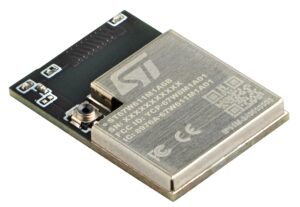
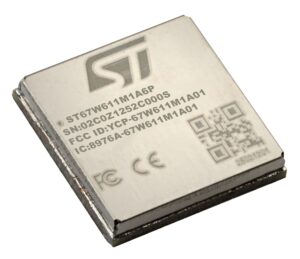
The ST67W611M1 module comes in three variants for greater flexibility. We provide a model with an integrated antenna (ST67W611M1A6B), one with an MHF4 connector for an external antenna (ST67W611M1A6U), and the ST67W611M1A6P, which supports a pinned antenna. All of them are pin-to-pin compatible with each other. Put simply, we ensure engineers can easily tailor their BOM should they choose a different model along the way to their final design. ST is also making the new device pragmatic by ensuring that Wi-Fi and Bluetooth LE come with global certifications (USA, Canada, Europe, UK, Japan, South Korea, Taiwan, Australia, New Zealand, India, Thailand, and more soon), thus making it far easier for companies to bring their products to market.
Performance and energy efficiency
The new Wi-Fi/Bluetooth combo uses a 40-nm process node, 4 MB of flash with over-the-air update capabilities, and supports 2.4 GHz 802.11b/g/n/ax, which is the frequency with the greatest reach. The ST67W611M1 also offers a TCP throughput of up to 18 Mbps, which far exceeds the needs of most IoT applications. It also features a transmit output power of +21 dBm, while providing optimized adjacent channel interference reduction and a deep sleep mode of 90 µA, along with a wake-up time of between 50 ms and 100 ms.
In essence, the collaboration between Qualcomm Technologies and ST not only guarantees a Wi-Fi module that’s easy to use, but one that respects the energy constraints most IoT solutions face.