
A robot is a chain of sensing, decision-making, and actuation that must close within milliseconds. Physical AI is artificial intelligence built into machines that sense, decide, and act in the real world. Unlike a model in a data center, a robot must perceive its surroundings, plan a movement, and execute it safely on a battery. At electronica 2026 in Munich, our robotics area showed robots doing exactly that. Each demo was one link of the same chain, and together they answered one question: what does it take to build a robot that works? For the engineering background, read our article on physical AI.
A humanoid at work
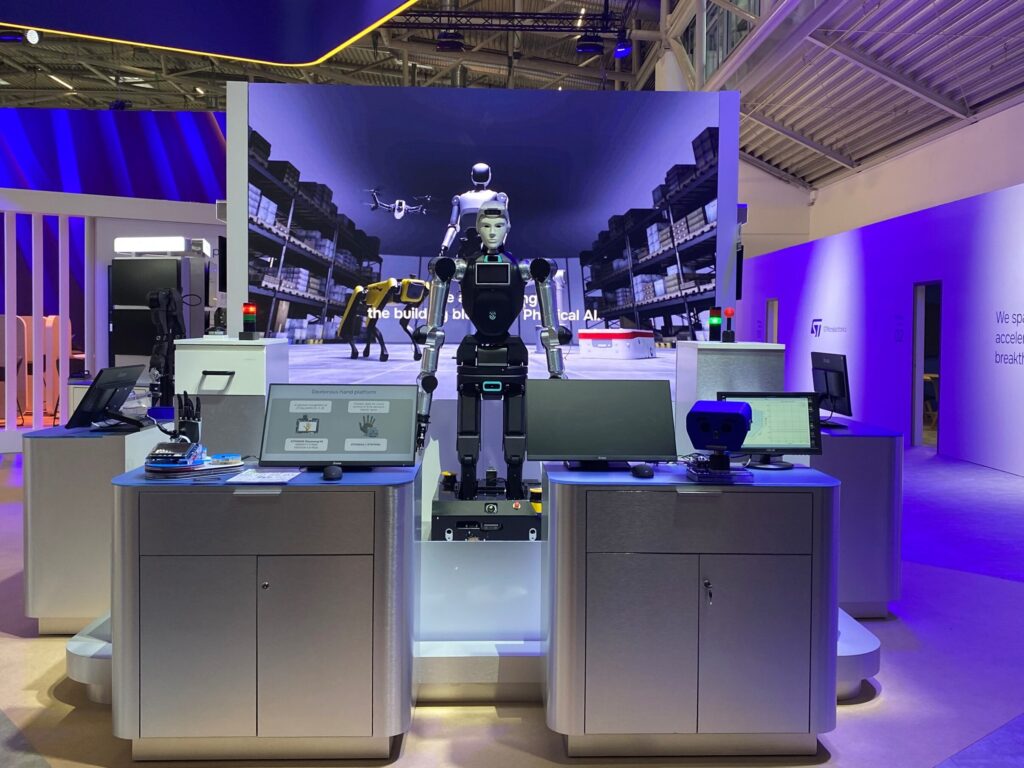
The centerpiece was aRoBee R20, a humanoid robot from Oversonic Robotics running a workflow inspired by semiconductor production. It moved between workstations, handled a circuit board, and operated a lever, a button, and a drawer, the controls found on any factory floor. Then the scenario introduced an unexpected condition. Leveraging cognitive intelligence, the robot recognized the issue, adapted its course of action, and resumed its task.
What made the difference was awareness, not speed. Cameras, torque sensors, collision sensors, and a lidar at the base kept the robot informed at every step. Unlike a traditional robot arm moving from A to B, it checked each time whether the cart was in place and where the lever was, and replanned its movement. If the cart was missing, it switched to another task. If a person stepped into its path, it moved around them.
Repeating a programmed sequence is automation. Adapting when something changes is autonomy. Factories are designed for people, so a robot that can work in them without redesign, and cope when reality departs from the script, becomes useful on a production line. Oversonic sees it as filling a gap, not replacing people. Manufacturers often struggle to find people for these jobs, the Oversonic team said. Consider a clean room: workers wear protective clothing and repeat the same task for eight hours.
Sense: seeing and following the world
Every action starts with perception. Our robotic head identified an object and followed it with its gaze as it moved. A stereo camera module from Leopard Imaging, built on two of our 5.1 MP VB1940 image sensors, captured high-resolution images. Our VL53L9CX time-of-flight lidar, which measures distance by timing reflected light, added depth. A neural network on an NVIDIA Jetson Orin™ module tracked the object, and two STSPIN32G4 motor controllers moved the head.
Perception only becomes useful when it turns into a coordinated physical response, fast enough to keep the object in view. And its quality starts in the sensor. A stereo camera compares two images to calculate the depth of every point, so sharper, higher-resolution images produce better depth maps. Our 5.1 MP sensors offer both a global shutter, for blur-free capture of moving objects, and a rolling shutter with on-chip high dynamic range (HDR). They capture color, infrared, or both, which helps robots tell objects apart and recognize shapes and movement in low light. For robotics, the VD1943 is the industrial version of the family. Resolution alone is not enough, though: vibration, motion, and heat make stereo cameras drift, so robots also need continuous calibration.
Decide: intelligence at the edge
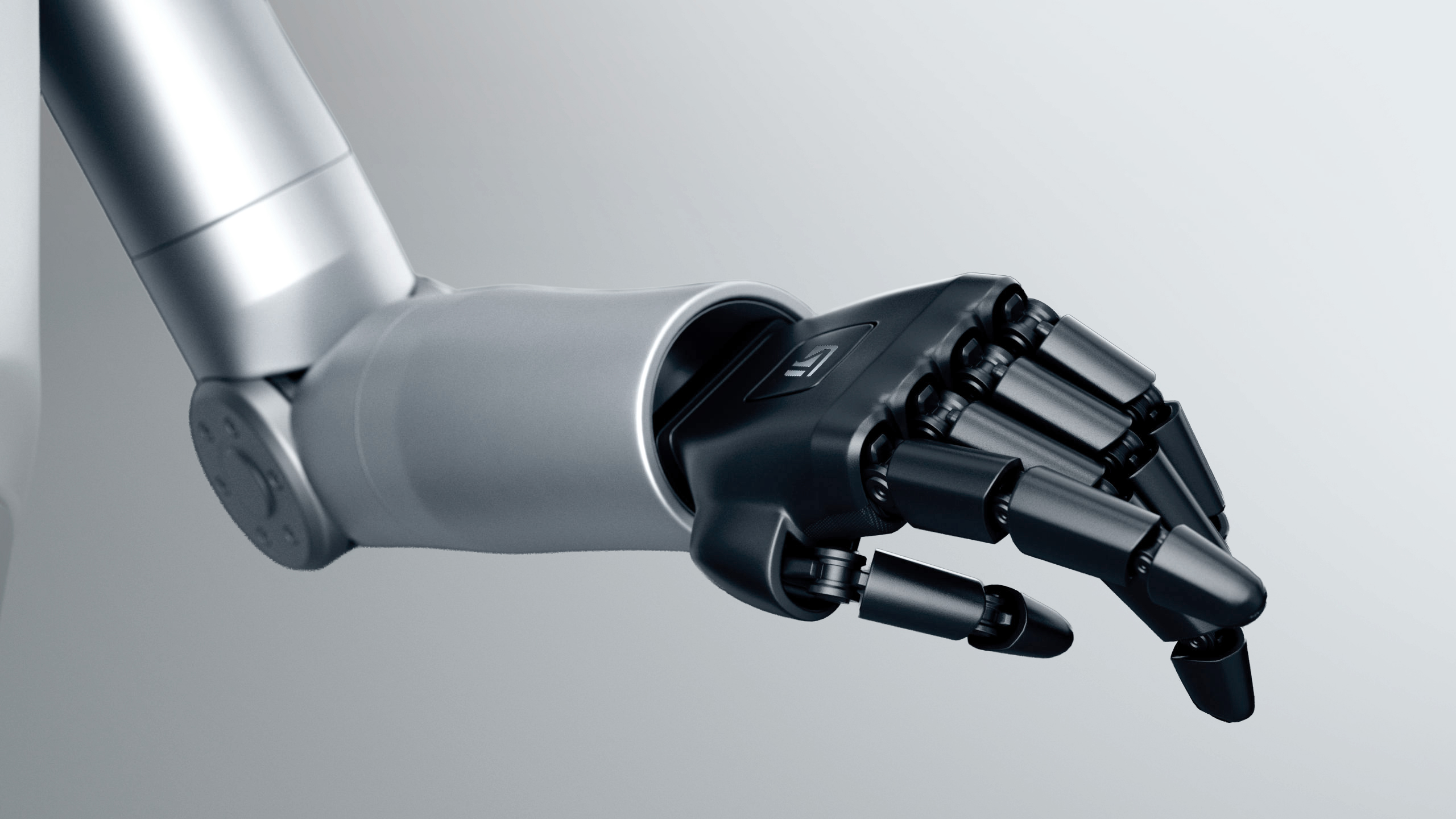
In the robotic hand demo, visitors showed a gesture to a camera, and the hand copied it. A 5 MP camera captured the visitor’s hand, and an STM32N6 tracked each finger. What surprised many visitors is that the STM32N6 is a microcontroller (MCU), not a microprocessor. Hand-tracking models are usually too heavy for an MCU, but the STM32N6 runs them on its Neural-ART neural processing unit (NPU) at up to 30 frames per second. Inside the hand, two STM32 MCUs drive six motors, one per finger and two for the thumb.
When a machine responds to a person, latency is the difference between an interaction and a delay. Processing on the device keeps the response immediate, and it matters even more as robots grow. Imagine a robot with several hands, all sending 30 images per second to one central unit: processing locally means less data to move, less energy, and a faster response. It also helps security and safety. Data that never leaves the hand cannot be intercepted, and a touch sensor that stops a finger keeps working even if the central computer fails.
Act: precise, efficient movement
Intelligence is only as good as the movement it produces. Our joints demo compared two ways to drive a humanoid joint, controlled by STM32G5 and STM32H7 MCUs. One uses the silicon-based STSPIN9P, a well-established solution that integrates the power stage, gate driver, and supplies. The other uses our new GANSPIN1102, based on gallium nitride (GaN), a semiconductor that switches faster and with lower losses than silicon.
Space is the new constraint in robot design. An industrial arm has room to spare. A humanoid must fit into spaces built for people, while its power needs keep growing. Higher-voltage batteries reduce current, but they make it harder to fit the motor driver inside the joint.
The GANSPIN1102 and GANSPIN1105 are designed for that challenge. They are our first GaN motor drivers rated for 100 V, so they run from typically a 48 V and 60 V batteries used in robots. Each packs two GaN transistors into a 6.5 x 5 mm package and needs no active cooling. The GANSPIN1102 handles up to 60 A and the GANSPIN1105 up to 30 A. Low losses mean less heat, adjustable switching speed limits electromagnetic interference, and built-in protection cuts external parts. A top-cooled GANSPIN1102E suits joints with metal housings, and an optimized pinout performs well even on a two-layer board.
Energy-efficient actuation, joint by joint, helps decide how long a robot works between charges. In the demo, the GaN drive reached 99.1% efficiency, and with dozens of joints in a humanoid, every fraction of a percent adds up. Silicon remains cheaper today and can reach even lower losses when there is room for it. The choice depends on the robot, and we offer both.
The whole system
Two exhibits took the same building blocks beyond humanoids. STARtrace1, an autonomous mobile robot platform developed with Arrow and eInfochips, combines STM32 control, our sensors and motor drivers, and NVIDIA processing, an example of our collaboration on physical AI. BionIT, a medical robotic hand, showed how the sensing that gives robots touch can also serve healthcare.
What it takes to scale
Moving robots from pilots to production depends on cost, software maturity, safety standards, data security, and human acceptance. Safety already shapes design: the RoBee at our booth moved on wheels, which, according to Oversonic, is what allows a humanoid to be certified for European factory floors today, while standards for bipedal robots are still maturing.
No single component solves these challenges. What matters is how reliably a robot closes the loop between sensing, deciding, and acting, millions of times a day, in places built for people. For more on how robots are changing the factory, read why factories are now built around people, and for the rest of our booth, see our electronica 2026 overview.
Learn more
• Humanoid robots: automation built from the sensors up
• Physical AI: sensors, robotics platforms, and collaboration