
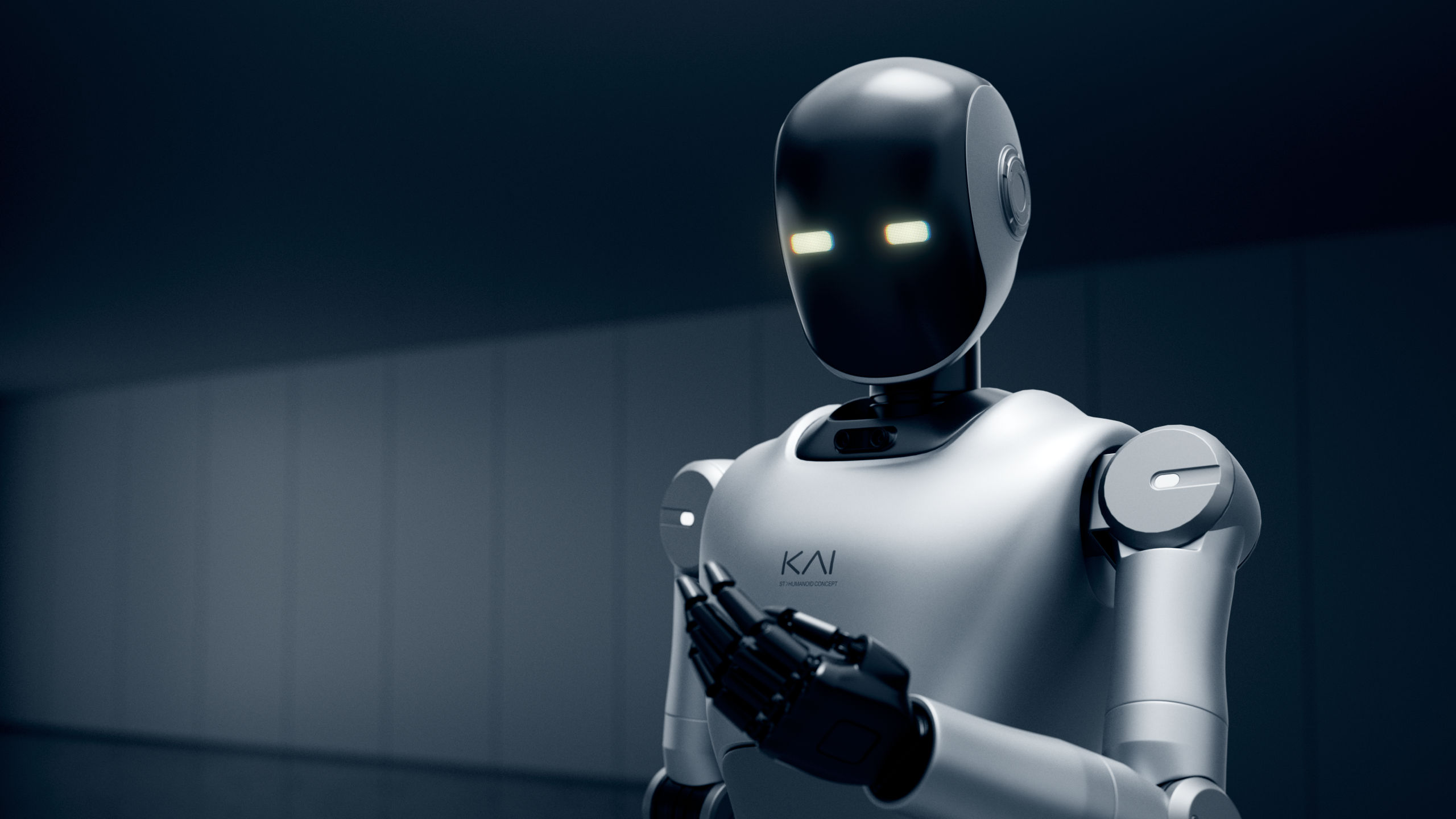
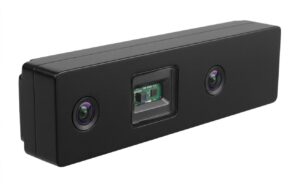
A module from Leopard Imaging that comes with our VB1943 5 Megapixel CMOS image sensor was used in a paper published in 2026 demonstrating that the device’s higher resolution and processing capabilities enable faster, vastly more accurate stereo vision sensing in robotics. In a nutshell, the added information allowed researchers to develop new methods for generating depth maps and other real-time data they could use to build a more impressive robot. New CMOS sensors are, therefore, not simply providing better images; they are at the heart of innovations driving physical AI thanks to modules similar to those NVIDIA recently showed. Let’s explore how an image sensor impacts robotic systems.
What you see is what you get
The impact of a 5-megapixel sensor
Data remains the chief concern for engineers working on computer vision, and this paper exemplifies the challenges they face. No amount of optimizations or clever algorithms can compensate for the absence of quality data. In fact, this whole paper highlights how scientists were able to come up with significantly better algorithms because they got to move to a 5-megapixel resolution. Additionally, capturing color and infrared are also increasingly important. In many new computer vision applications, robots rely on color to distinguish between objects. Similarly, recognizing movements, shapes, or faces relies on IR. Put simply, users are demanding a lot more from computer vision, and a high-resolution RGB-IR CMOS sensor is an important solution.
Using 2 image sensors for 3D applications
Furthermore, the module itself plays a critical role in stereo vision systems, which rely on depth estimation. In a nutshell, the computer vision system uses data from two sensors to determine the position of objects in a 3D environment, which then leads to the generation of the depth map that the system will feed to the AI algorithm. As a result, the distance between the two sensors in the model, the optics they are using, and their computational capabilities all play an important role in triangulating the depth of the various points in a frame. The higher the resolution and the sharper the image, the greater the quality of the resulting depth map.
The need for constant calibration
As the paper explains, “high pixel count alone is insufficient”. Calibration is also critical. Indeed, any system needs a powerful calibration algorithm to accurately interpret what the sensor is capturing. Unfortunately, many often overlook this aspect. Calibration on the production line only goes so far. As the paper explains, not only do image sensors drift and need calibration while in the field, but there are “perturbations that occur frame by frame” due to numerous factors, such as vibrations, movements, heat dissipation, etc. As a result, auto-calibration algorithms are a must, but they take time to compute. CMOS sensors ought, therefore, to have the computational capabilities to handle them.
Love at first sight
VB1943 and the importance of its ecosystem
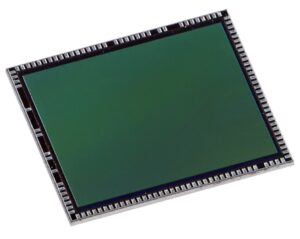
The paper in question used the Leopard Imaging module that comes with ST’s automotive-grade version of the VB1940, while most robotic applications gravitate toward its industrial counterpart, the VB1943. The authors then connected the module to an NVIDIA Jetson Orin AGX developer kit. An important lesson is that engineers must not only evaluate and certify components, but pay close attention to middleware, drivers, implementation examples, and module integration. That’s why we offer the STSW-VD1943 and Leopard Imaging is a member of the ST Partner Program. Collaboration between the module maker and sensor manufacturer makes a huge difference when it’s time to create a proof-of-concept and rely on development ecosystems.
Example of a platform for simulation and testing
The role of the ecosystem is even more important as the industry is now championing Physical AI with functional safety. Recently, ST, Leopard Imaging, and NVIDIA showed how collaboration can lead to the creation of a comprehensive platform that simplifies development, especially because designs almost never use an image sensor by itself, especially in robotics applications. There are often inertial sensors involved. For instance, the Leopard Imaging module includes a six-axis inertial measurement unit (LSM6DSV16X) and a VL53L9CX direct Time-of-Flight LiDAR module for spatial recognition. And ST became the first IMU vendor to offer devices in NVIDIA Isaac Sim™ for simulating and testing AI-driven robots.
VB1943: Why shutter modes and RGB-NIR matter
As sensors play an increasingly critical role in robotics and Physical AI, the way they capture information will increasingly matter. For instance, the VB1940 CMOS sensor from ST was integral to the previously cited research paper because it was the first of its kind to offer both a global and rolling shutter. Both the VB1940 and VB1943 allow artifact-free image capture from the global shutter and better image quality with on-chip HDR from the rolling shutter. This means that the robots that increasingly need color and high-resolution capture for image detection algorithms can now run more complex inference operations with high accuracy.
The VB1943 also has an RGB-NIR architecture that captures RGB, IR, or both, giving engineers more flexibility. The sensor can even switch from color to infrared automatically to optimize applications that depend on both, like computer vision in robots. Similarly, the sensor uses some of the information captured by the red subpixel to complement the IR information, thus further improving the quality of the image generated. Additionally, the ability to run upscaling algorithms on the image sensor, thanks to a more capable computing IP, means that it is possible to generate a significantly sharper image at a much faster rate, enabling computer vision applications previously impossible on affordable embedded systems.