
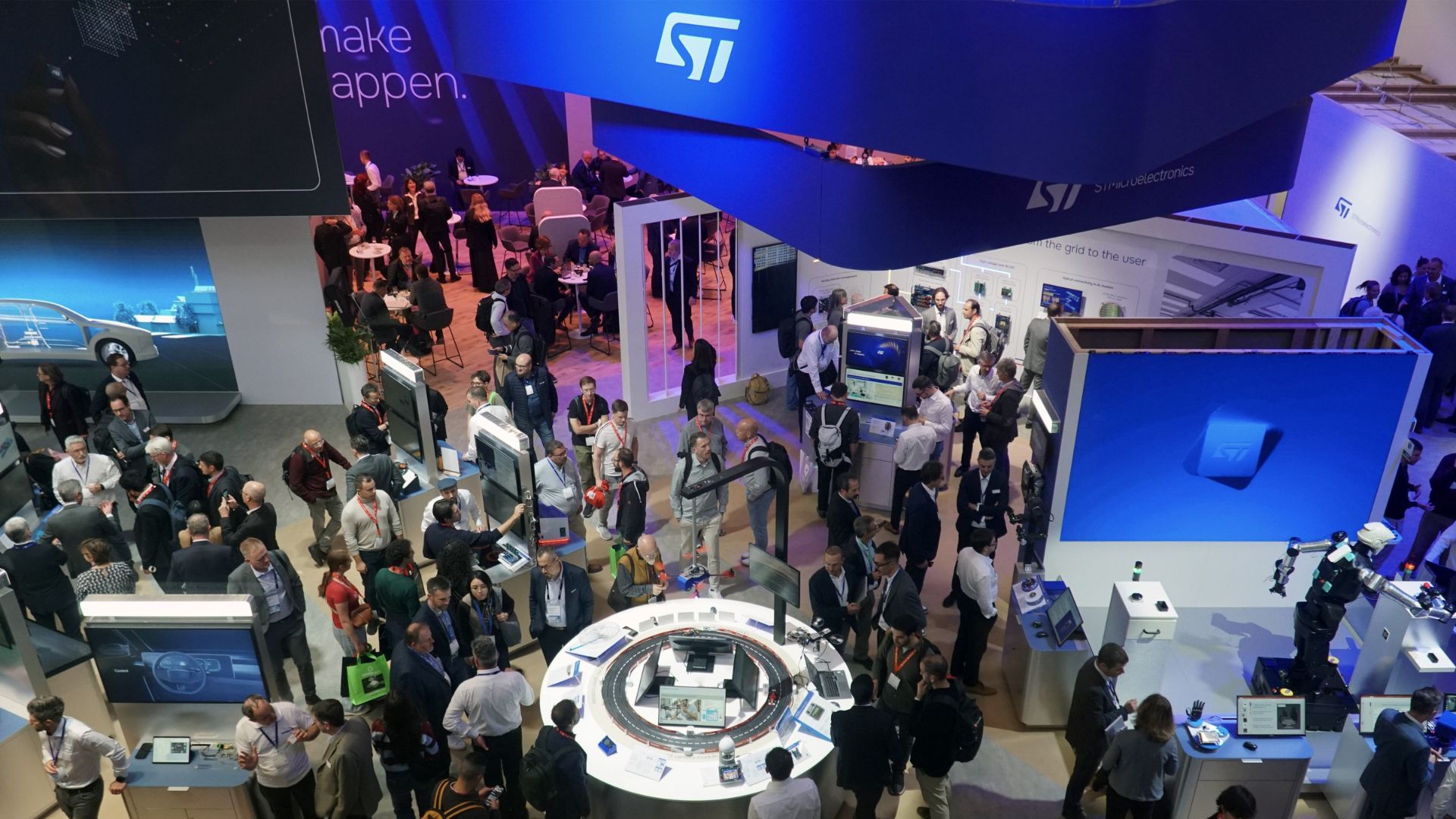
The ST booth at electronica in Munich, from November 10 to 13, 2026, told one story. Automotive, industrial automation, energy infrastructure, communication equipment, and AI computing are no longer separate domains. Electrification is accelerating, AI is moving from the cloud to the physical world, and connectivity links every machine.
Discover the demo we showcased at the event on our YouTube channel:
Three forces, one system
The booth was organized around energy, intelligence, and connectivity. Power must be converted efficiently and distributed safely. Systems have to sense their surroundings and decide in real time. Data has to flow securely between devices, vehicles, infrastructure, and the cloud. That is why every demo showed a complete function, not a single component, and why physical AI ran through the show, as we anticipated in our Top Tech Trends for 2026.
AI factories: power, cool, and connect
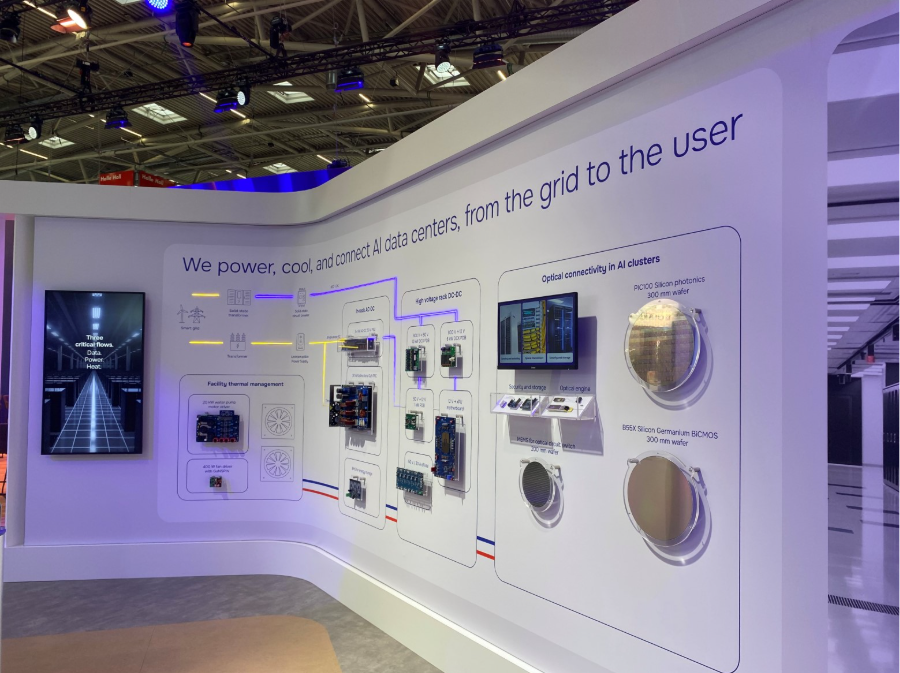
Our AI factory wall traced the three flows of an AI data center from the grid to the end user: power, cooling and connectivity. AI infrastructure only scales when all three evolve together. Every conversion loss becomes heat that must be removed, and every rack that is added to a cluster needs faster links to the other racks.
Power: fewer conversion steps
Today’s AI racks distribute power on 54 V busbars, and next-generation GPUs push that design to its limit. Delivering 600 kW at 48 V would take 12,500 A, far more than copper cables and mother boards can carry, as we explain in our article on 800 V power delivery. Moving to 800 V high-voltage direct current (HVDC) delivers much more power at the same current level and, by NVIDIA’s estimate, improves end-to-end efficiency by up to 5% while removing up to 200 kg of copper per megawatt rack.
Solid-state transformers (SSTs), power electronics that replace the bulky transformer between grid and facility, cut conversion steps further. Silicon carbide (SiC) and gallium nitride (GaN) switch high voltages with lower losses, and electronic fuses protect the power path. Power is also moving into a dedicated sidecar rack with battery backup units for backup power and Capacitor Bank Units for peak shavings, because an AI data center cannot afford downtime.
Heat: efficient liquid cooling
Air can no longer carry the heat away, so liquid cooling is necessary to scale the AI factory. At the wall, a 20 kW pump drive and a 400 W fan drive, built with our GANSPIN GaN drivers and all SiC devices and controlled by the new STM32G5 microcontroller (MCU), brought wide-bandgap efficiency into the cooling loop.
Data: from copper to light
Connectivity is becoming a bigger bottleneck for AI than even compute. Hundereds of thousands of GPUs must act as one machine cluster, yet most are still linked by copper, which is bulky, runs hot, and limits speed. Our PIC100 silicon photonics, which moves data with light on a silicon chip, and our B55X BiCMOS technology, both made on 300 mm wafers in Crolles, France, help customers provide key technology offererings for optical engines and make the switch to optics. Between racks, optical circuit switches route light with arrays of micro mems mirrors instead of converting it back to electricity, and we showed how our micro-electro-mechanical systems (MEMS) mirrors can serve them.
Cars that understand their occupants
Cars are starting to monitor what happens inside the cabin, not just on the road. Our in-cabin sensing demo showed how. Two cameras, built on our VD1940 and VD56GA image sensors, handled driver monitoring and occupant monitoring: spotting drowsiness or distraction, knowing who sits where, and enabling new features such as in-car video calls. An ultra-wideband (UWB) sensor, a short-range radio that measures distance and motion with centimeter precision, covers what cameras cannot see.
Child-presence detection, powered by our ST64UWB chip, shows why the two technologies work better together. A baby typically sits in the backseat where camera systems cannot reach, and a blanket may hide the child’s chest and breathing. Radio waves pass through fabric and pick up the subtle movement of breathing even in blind spots. Because the check runs in a closed, parked car, false alarms stay low. Safety ratings point the same way: since 2026, Euro NCAP awards up to five points for child-presence detection, but only for systems that sense the child directly, as radar does. Read more in our article on in-cabin monitoring.
UWB also powered hands-free car access with our ST64UWB, the first device for the new IEEE 802.15.4ab standard, which offers about eight times the range in the same power budget.
The drone as a complete system
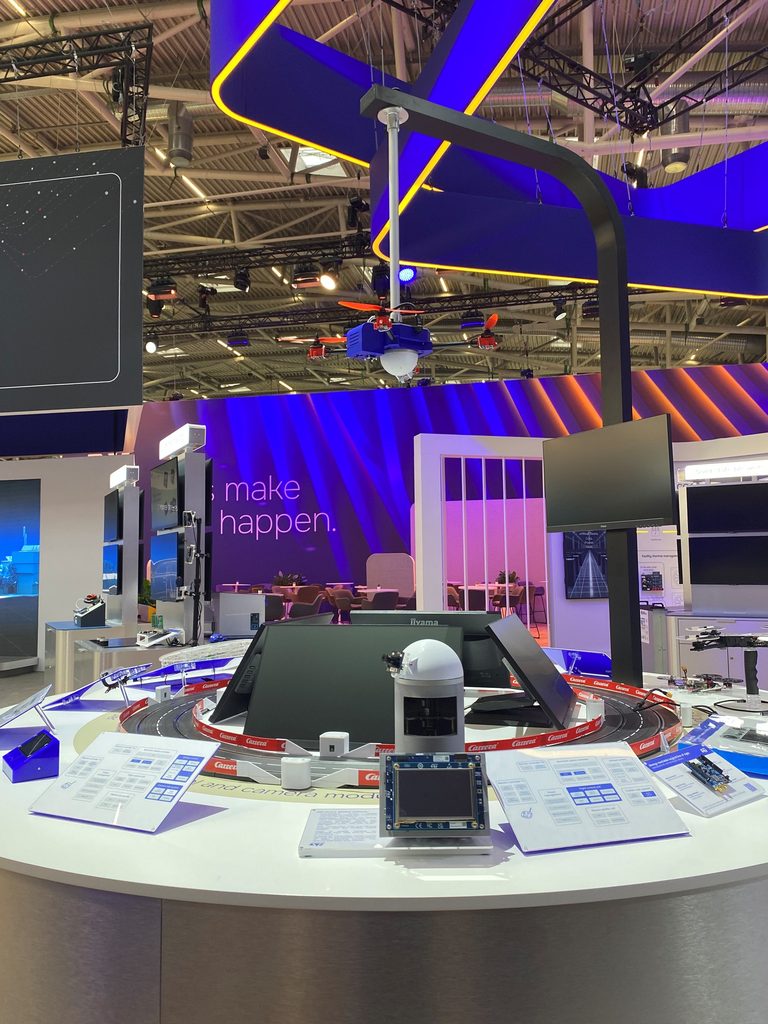
A drone is physical AI in a single object: it senses, decides, and acts, in three dimensions, on a battery. At our drone table, a drone with a 5 MP camera followed the model race car each visitor picked, red or blue, around the track.
The flight controller ran on an STM32N6, our MCU with a neural processing unit (NPU) for AI. One device handles both real-time flight control and vision algorithms such as tracking, obstacle detection, and safe landing. That brings autonomy to entry-level and mid-range drones without a separate high-end processor. Other stations covered the electronic speed motor controller, built around the STM32G5 and ST power stage, the stabilized camera gimbal, and the open-source drone communities’ software. The three main communities have been represented with third party solutions, in fact there were: Betaflight (which added STM32N6 support in its 2026.6 release), the PX4 and ArduPilot provided by CubePilot.
Robotics: from perception to action
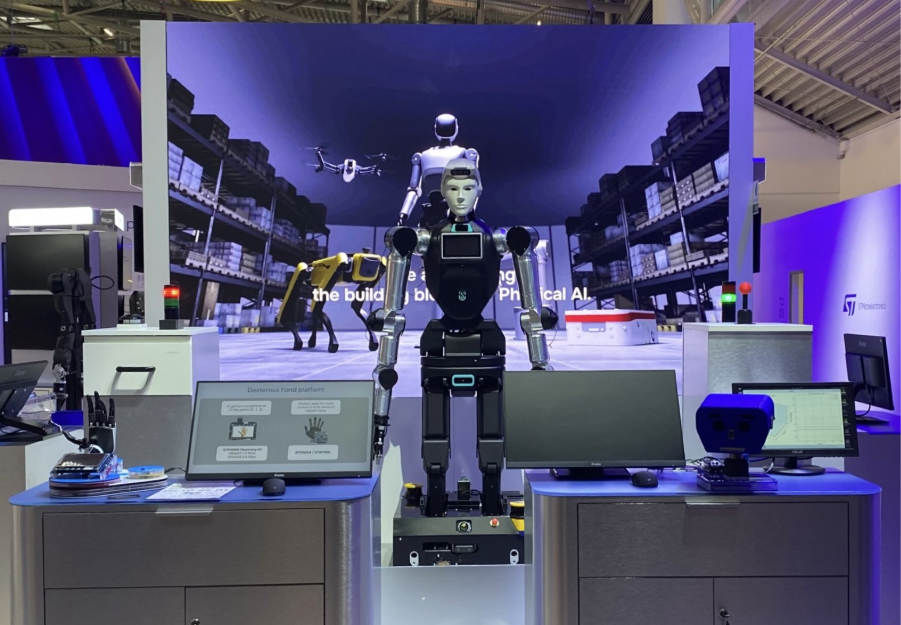
The centerpiece of our robotics area was a humanoid robot from Oversonic Robotics running an industrial workflow on its own: moving between workstations, handling a circuit board, operating a lever, a button, and a drawer, and recovering from an unexpected condition.
Around it, robotic joints ran on our new GANSPIN1102 and GANSPIN1105, our first 100 V GaN motor drivers. A robotic hand mirrored visitors’ gestures, and a robotic head tracked objects with its gaze. We take a closer look in a dedicated blog article.
More from the booth
• Electric vehicles. Single-stage on-board chargers, an 11 kW SiC design and a 7.5 kW GaN design, cut conversion stages and components. Design kits showed SiC power modules in 800 V traction inverters, and a Stellar G3 zonal controller showed how zonal architecture reduces wiring and electronic control units.
• STM32H7P for solar inverters. Announced on November 3, the STM32H7P is our first STM32 with both a Neural-ART NPU and a hardware signal processor (HSP). In the demo, the HSP ran grid-quality monitoring and the NPU detected electrical arcs from loose connectors or damaged cables, a fire risk. One chip handles power conversion, grid monitoring, and arc-fault detection, at up to 125°C.
• Smart home and access. Matter commissioning and Aliro digital keys over Thread, Bluetooth® LE, NFC, and UWB, with STM32WBA6 MCUs, ST25DA-C NFC tags, and STSAFE secure elements, ready for the EU Cyber Resilience Act.
• Smarter sensors. Our IIS3DWB10IS vibration sensor interprets data inside the sensor itself for predictive maintenance.
Learn more
• STM32H7P: our first Cortex-M7 with an NPU and a hardware signal processor
• AI data centers are trading copper for control
• Light into data: silicon photonics and the AI data center
• Inside out: the dual frontier of in-cabin monitoring
• Physical AI: sensors, robotics platforms, and collaboration