

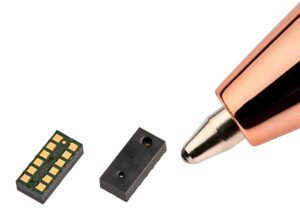
The VL53LB is the smallest (4 mm x 1.8 mm x 1 mm) single-zone time-of-flight sensor to offer ranging performance from 5 mm to 8 m and a standby power consumption of 0.6 µW. In fact, we are already seeing designers simplify their designs by using our new device instead of a proximity sensor on top of a more traditional ToF module. Its size and low power consumption mean it is suitable for smartphones and other battery-constrained systems while also offering excellent performance, even in very bright environments, thanks to a more powerful VCSEL and a more sensitive SPAD.
Why shrinking a ToF sensor is hard

Reduction in range
ST has been offering modules with a range of up to eight meters for a while, but in much larger packages. For instance, the VL53L1 takes about 40% more room on a PCB and is about 50% taller. Ranging at long distance is a challenge. The farther an object, the fewer photons will bounce back off of it and return to the sensor, making detection harder. A smaller lensless package complicates things even more by limiting the aperture size and, thus, the amount of light that can be detected. It’s one of the reasons why there are no competing solutions with the same range that can offer a package size this small.
Increase in crosstalk
Shrinking a time-of-flight sensor to this size comes with other challenges, like optical crosstalk. In a nutshell, a small device means that the emitter and receiver are really close to each other, which, in turn, means that light can bounce off the system cover glass and reaches the SPAD before it even touches the object that’s intended to be detected, leading to inaccurate information. Hence, our teams had to come up with new solutions if they were to shrink the VL53LB device while ensuring its accuracy.
Reduction in ambient light rejection
Another engineering challenge with a thinner package is its optical track length. In a patent application submitted in 2015 by ST Research and Development, our experts explain that one way to better deal with bright environments and overall daylight is to increase the focal length. In a nutshell, a lens with a longer optical track length and thicker packaging can help reduce the field of view, which then improves ambient light rejection. Conversely, a thinner package can significantly hurt performance on bright targets in environments with lots of ambient light, which is a problem, since many ToF sensors are used outdoors in smartphones.
How the VL53LB became a new single-zone flagship
A more powerful VCSEL and more sensitive SPAD
The VL53LB solves these issues by using a more powerful VCSEL and a more sensitive SPAD than our previous-generation single-zone time-of-flight sensors. Concretely, it is one way to address many of the engineering challenges that come with a significantly smaller package. As a result, the new device has a 99% detection rate in a dark environment at up to 8 meters. Similarly, we can detect white targets farther than one meter in extremely bright conditions (100,000 lux). This last indicator is particularly important for outdoor applications, such as smartphone photography. Similarly, our near-range performance has led designers to remove their proximity sensors in favor of simply using the VL53LB.
A new molding process
Another important innovation comes by way of the packaging itself. Instead of the traditional molded plastic cap, ST molds clear resin over the silicon and then applies a black resin layer over the top to seal the device. It was an engineering challenge because such a process created surface roughness, which would scatter light and reduce performance. However, thanks to newly developed expertise and tooling to ensure reliable surface smoothness at scale, we have a more cost-effective manufacturing process that also lets us shrink the ToF sensor even more, which is why we are offering the smallest device with this range and accuracy.
Better electrical specification
The size of the VL53LB has also helped avoid EMI issues. According to early feedback, some teams removed the metal tape used as a shield protecting from the smartphone’s antenna because, among other things, the smaller device was farther away from the source of the disruption, leading to a more optimized bill of materials.
Another critical advantage is its low power consumption. Even in continuous ranging mode, which is typical when using a smartphone camera, we have a power consumption of 59 mW (45 mW AVDD and 14 mW VDDIO) in short range and 46 mW (38 mW in AVDD and 8 mW in VDDIO) in long distance. Moreover, our typical hardware standby mode of 4.6 µW (4 µW in AVDD And 0.6 µW in VDDIO) means that engineers can optimize their battery usage when the sensor is not needed.