

The STM32H5Ex and STM32H5Fx are the first STM32 to feature Chrom-ART2. The new 2D accelerator builds on the initial Chrom-ART to support more effects, more color formats, and new automations, thanks in part to a list of commands developers can use to optimize their operations. The new MCUs also feature a sizable increase in flash and RAM, with the latest devices offering 4 MB and 1.5 MB, respectively, more than double what the previous STM32H5 devices offered. Consequently, engineers can now create new single-chip designs with displays that go up to 600 x 480 and use two 16-bit-per-pixel framebuffers, thereby significantly simplifying PCB layout and reducing the bill of materials.
What’s new?
Chrom-ART2
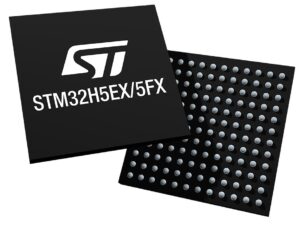
Chrom-ART is a 2D accelerator (DMA2D) for image manipulation. It accesses memory faster and accelerates certain operations, helping developers create more efficient UIs that can run on hardware that would otherwise struggle to handle all those requests. Teams running vastly more complex graphics would turn to our NeoChrom GPU or NeoChromVG GPU if they target vector fonts. However, we also know that many developers don’t need the extensive capabilities of such an IP and would rather use Chrom-ART. Indeed, if an interface doesn’t require 3D perspective correction or texture mapping with bilinear or point sampling, using the NeoChrom GPU may be a bit overkill.
Until now, engineers had the STM32 devices with Chrom-ART, and the STM32U5Fx, which includes the NeoChrom GPU. The STM32H5Ex and STM32H5Fx bridge this gap thanks to Chrom-ART2. For instance, the new IP now supports scaling and rotation acceleration in a similar, albeit more limited, fashion to the NeoChrom GPU. Chrom-ART2 also supports all the standard RGB formats and ones like ARGB2222, RGBA2222, BGRA2222, and ABGR2222. Its stencil buffer allows for textured fonts, its new palette management supports any RGB format, and its new JPEG accelerator is more flexible thanks to arbitrary start and stop. Chrom-ART2 also enables the use of flags or triggers to debug or synchronize specific aspects of the pipeline during development.
Core updates
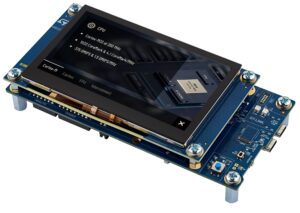
The new STM32H5Ex and STM32H5Fx come with 4 MB of flash, 1.5 MB of RAM, and bring three 12-bit ADCs instead of two as well as two comparators. The more beefed-up configuration also includes a USB High-Speed controller, two I3C, and three CAN-FD interfaces. Additionally, they include six multi-function digital filters, including new audio digital filters. Engineers can thus create more complex motor-control applications or integrate more feature-rich solutions into their systems. For instance, the single-chip design could run a home assistant with wake-word detection and a large screen showing the status of various appliances. It’s already possible to grab a NUCLEO-H5E5ZJ or a STM32H5F5J-DK to get started.
On a side note, ST is also releasing STM32H543 and STM32H553 with 1 MB of dual-bank flash for teams looking for a cost-optimized solution without giving up the security features and peripherals that have made the STM32H5 series popular. Indeed, the new devices come with the same support for TrustZone, secure boot, ST-iRoT, active temper protection, debug authentication, and more. Similarly, developers get support for Ethernet, CAN-FD, and I3C among many others. Engineers will be able to start experimenting with the new device by grabbing the NUCLEO-H553ZG once it becomes available by the end of 2026 or early 2027.
What did ST bring with the first STM32H5?
A high-performance entry point
The first STM32H5 became a new entry point to high-performance microcontroller thanks to the most powerful Cortex-M33 implementation, reaching 1035 points in CoreMark. The new device runs at 250 MHz. It houses up to 4 MB of dual bank Flash and up to 1,035 KB of RAM. It also draws from previous models to offer a CORDIC and FMAC accelerator, as in the STM32G4. Similarly, it takes the security features of the STM32U5 and builds upon them by inaugurating the ST immutable Root of Trust (iRoT) and updatable Root of Trust (uRoT), among other things. In fact, the STM32H5 targets SESIP3 and PSA Level 3 certifications, thus offering important guarantees.
A gateway to embedded applications
Knowing what microcontroller to use is challenging. By serving as the new reference for the high-performance market, the STM32H5 ensures developers can better evaluate their needs. For instance, teams with less experience can start working on their motor control system to assess if the STM32H5’s configuration is sufficient or if they require something more specialized, like an STM32G4, or something more powerful, like an STM32H7. Thanks to STM32CubeMX, developers have always been able to move rapidly from one STM32 to another.
How to build a flexible and forward-looking architecture?
First STM32 MCU with I3C
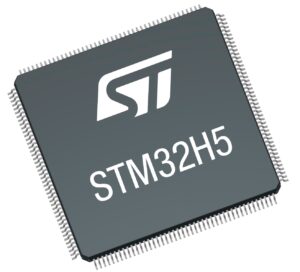
Being the new benchmark for most embedded applications means being future-proof. The STM32H5 is thus the first STM32 device to include an I3C (Improved Inter-Integrated Circuit) interface. The new bus is significantly faster, which is getting ever more critical as embedded systems deal with a myriad of sensor data. Thanks to a frequency of 12.5 MHz, I3C is about 12 times faster than I2C. The new technology also supports dynamic addresses and can help reduce pins utilization by enabling the microcontroller to talk to more devices simultaneously. Despite its forward-looking bus, the STM32H5 remains a general-purpose MCU thanks to many interfaces, such as CAN-FD, HDMI-CEC, and USB-C Power Delivery, among many others.
ADC, DAC, dual-bank Flash, SMPS
Thanks to the new devices, the STM32H5 series can now offer up to three 12-bit analog-to-digital converters, three CAN-FD interfaces, and two 12-bit digital-to-analog converters, serving many applications that require fast data acquisition or multiple interfaces. There are also many timers, including two 16-bit advanced ones for motor control applications, which are identical to those found on the STM32G4. The architecture of the STM32H5 is an exercise in balance between flexibility and future-proofing. Another example of this approach is the presence of dual-bank Flash to enable, among other things, the implementation of an over-the-air update without needing to shut the system down, something essential in industrial applications.
Similarly, the STM32H5 supports a temperature of 125ºC to meet demanding industrial products while providing a switched-mode power supply to optimize its power consumption. Thanks to the SMPS found on some models, the stop mode (with all I/Os enabled) only draws 46 µA. The low power consumption also means that the STM32H5 can use cost-effective packages instead of expensive alternatives that would have had to dissipate a lot of heat.
How to provide comprehensive security features?
iRoT and uRoT
Like the STM32U5, the STM32H5 received a SESIP Level 3 certification, which ensures the presence of security features and guarantees greater assurances against physical and remote attacks. The new STM32H5Ex/Fx also implements a coupling and chaining bridge (CCB) to transmit keys more securely by using independent buses. It builds on the original STM32H5 devices, which addes critical security features, such as a two-stage root-of-trust: the immutable and updatable root of trust or iRoT and uRoT. As the name implies, the former is set at the factory and cannot be modified. It uses a read-only memory containing keys and other mechanisms defined by ST to establish a secure boot without external keys.
Customers can also define their iRoT with permanent and unchangeable information. Once the system passes the iRoT, it moves to the uRoT, which enables developers to store and use sensitive data that may be updated. Implementing both root-of-trust demanded new hardware features to prevent overwriting data in the iRoT and to protect both stages against physical and logical attacks. The STM32H5 also allows developers to choose what they would like to implement. Some may choose to use the iRot, others the iRot and uRot, while others may want both alongside the Trusted Execution Environment and secure services or nothing at all. This is particularly important for teams looking to comply with the European’s Cyber Resilience Act.
Life Cycle Management
The STM32H5 includes other architectural optimizations that bolster security, such as a unique 96-bit ID and complex hash acceleration, such as SHA-2 512 bits or SHA-3 512 bits. Ultimately, the new hardware safeguards and features will enable engineers to isolate sensitive applications from the rest of the system and provide a more fine-tuned security strategy.
The new device will also benefit from a new Life Cycle Management system that enables developers to tailor the activation or deactivation of low-level features depending on where they are in the development process. Traditionally, teams close debug features to prevent malicious intrusions once the device is ready for manufacturing and deployment. Thanks to its Life Cycle Management and Debug Authentication features, the STM32H5 can securely reactivate certain debug capabilities to help field engineers work on deployed systems. Additionally, if a company fears that a secure layer has been compromised, an immutable root of trust allows teams to perform a complete regression to a known secure state, thus ensuring that the device is safe to use.
The world of the STM32H5 in a galaxy of solutions
The STM32H23 and STM32H33
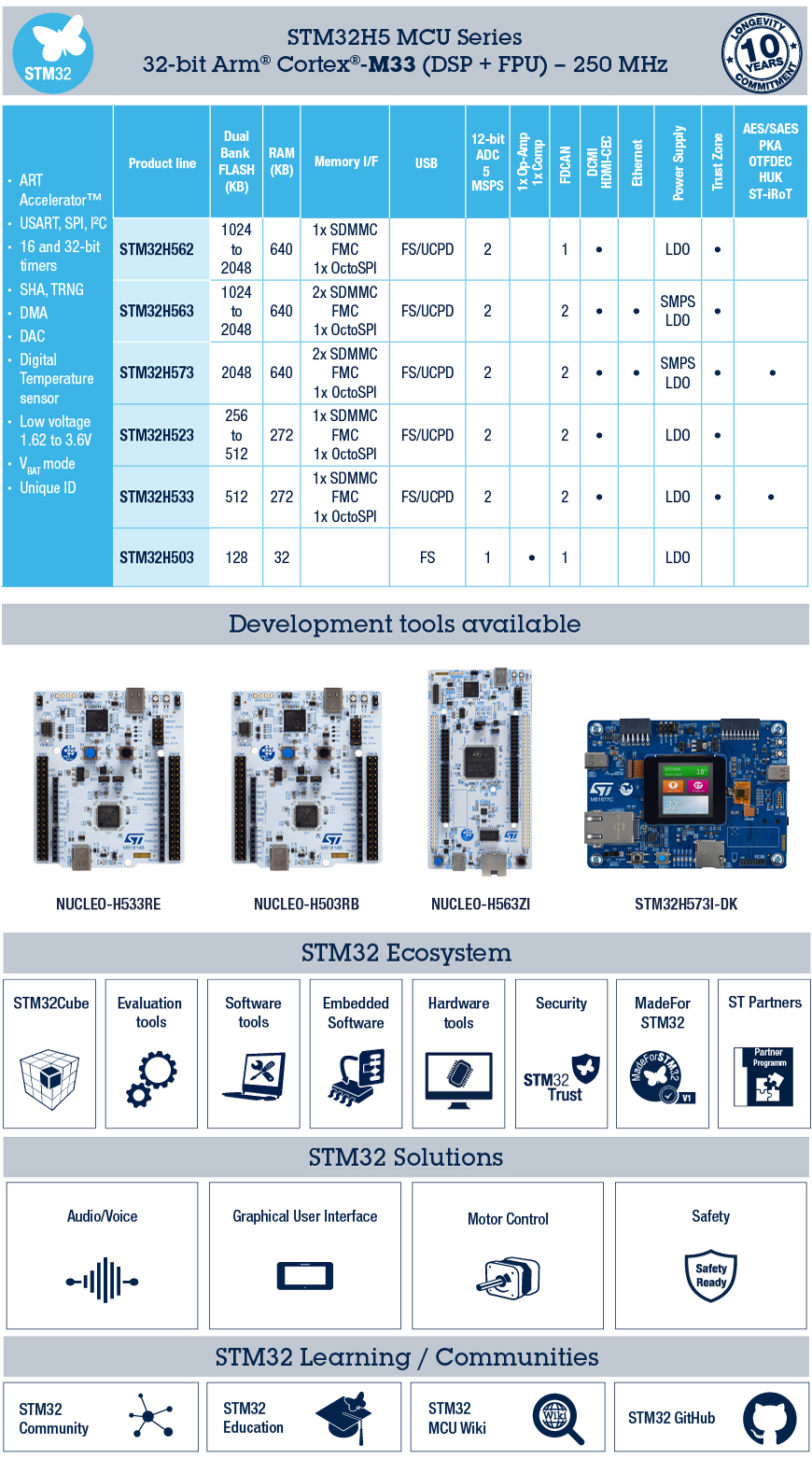
The STM32H523 and STM32H533 were the first STM32H5 devices with either 256 KB or 512 KB of dual bank flash, depending on the model, and 272 KB of RAM. Comparatively, the flagship STM32H5 MCUs have either 1024 KB or 2048 KB of flash. The devices can thus target more cost-constrained applications that don’t need the extra memory but still require more than the 128 KB of flash available in the STM32H503. The STM32H523 and STM32H533 also include two I3C interfaces, one USB full-speed controller with Power Delivery, and one SDMMC interface. The STM32H533 also supports ST-iRoT. Additionally, ST released the NUCLEO-H533RE board, which helps developers determine if their applications can run on a more efficient platform.
X-CUBE-AZURE-H5 or X-CUBE-AWS-H5?
The STM32H5 takes its place amidst the constellation of solutions that make up the STM32Cube ecosystem. We already updated STM32CubeIDE and STM32CubeMX to ensure developers can rapidly create applications for the new device. Similarly, tools like STM32CubeProgrammer will ensure teams can rapidly flash and debug their applications on the MCU. We are also providing new expansion software like X-CUBE-AZURE-H5 and X-CUBE-AWS-H5 to make cloud connectivity more straightforward. Put simply, ST wants to ensure that engineers can do their best work by providing solutions at the crossroads of hardware innovations and software accessibility.
NUCLEO-H563ZI and NUCLEO-H5E5ZJ
The best way to start experimenting with all the features found on the new device is to grab a development board. Besides the Discovery Kit, there are also Nucleo boards like the NUCLEO-H503RB and NUCLEO-H563ZI or the new NUCLEO-H5E5ZJ. Developers can also download our Secure Manager, an entirely new Trusted Execution Environment, to help them, regardless of their expertise level, quickly take advantage of the latest security capabilities of the STM32H5. We worked closely with ProvenRun on the software implementations, and Secure Manager enables engineers to reap the fruits of this collaboration. The binaries included with X-CUBE-AZURE-H5 and X-CUBE-AWS-H5 will also enable developers to test ideas in minutes.
STM32H573I-DK and STM32H5F5J-DK
ST launched the STM32H573I-DK with the first STM32H5 devices. It was the first Discovery Kit to support Secure Manager, a solution that implements security features at the system level to make them vastly more accessible. The board was released alongside X-CUBE-AZURE-H5 and X-CUBE-AWS-H5, two software expansions that help developers connect to Microsoft’s and Amazon’s cloud solutions, respectively. The two packages also include application examples that show how to send sensor data or implement over-the-air updates, among other things. Moreover, we will be releasing the STM32H5F5J-DK during the second quarter of 2026. It includes an STM32H5F5, enabling developers to experiment with one-chip design applications while offering high levels of security.
However, the biggest difference between the STM32H573I-DK we first released and the new STM32H5F5J-DK is their display. The former includes a 1.54-inch capacitive display with a 240 x 240 resolution, showcasing the MCU’s ability to run a graphical user interface on small screens without external RAM. The new model has a similar objective, but can do it on a 4.3-inch 480 x 272 display. Both boards are available in TouchGFX Designer. Additionally, we are offering a demo to help developers get started with the STM32H5F as they evaluate which graphics and applications could run on such a bill of materials.
- Learn more about the STM32H5
- Live Webinar on the STM32H5 and Kudelski IoT keySTREAM
- On-demand webinar: Raise the bar on performance & security with STM32H5 MCUs
- On-demand webinar: Simplify your security journey with the STM32Trust TEE Secure Manager solution
- STM32Trust TEE: in-depth explanations of and discussions on Secure Manager, our turnkey security solution for STM32 at the system level