

The recently released Zephyr 4.5.0 brings a slew of updates to the STM32 ecosystem including support for the STM32WL3, which was the last unsupported series in the STM32 family. With it comes support for the NUCLEO-WL33CC1 and wired peripheral support. It’s a testament to the collaboration between ST and the Zephyr community. Over the years, we have mainlined drivers, optimized performance and supported new features. And while we do have partners who use Zephyr and benefit from these contributions, this also stems from our desire to work with open-source projects that help democratize real-time operating systems and lower the barrier to entry.
What’s new?
Concretely, the support for the STM32WL3 Zephyr port comes with the usual support for basic drivers: GPIO, clock_control, UART, and flash. It also brings the ability to use MCU’s peripherals (SPI, I2C), its direct memory access (DMA) feature, unique ID, random number generator and AES acceleration. Similarly, we are extending support for the STM32C5 by bringing additional peripherals like its DAC, I3C, FDCAN, and Ethernet, among others. We are also adding HAL2-based drivers so developers can use any of our hardware abstraction layers and not worry about implementation. Moreover, the STM32U3 and the STM32C5 can now use low-power modes previously unsupported. The former also gains non-secure Trusted Firmware-M capabilities.
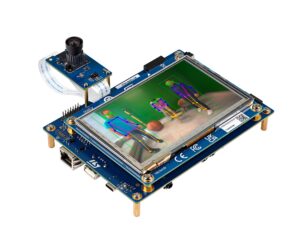
ST’s MPUs are also getting significant updates with Zephyr 4.5.0. The STM32MP13 received more part-number support for its Cortex-M4 and developers can now use a second Ethernet interface, as well as numerous peripherals, timers, and more. This new version also supports the camera pipeline of the Cortex-M33 found on the STM32MP25. Similarly, we improved BLE support on the STM32WBA2, the USB layer on the STM32H7R/S and STM32H5E/F. In a nutshell, this version is about ensuring developers can get more out of our devices. Finally, we are adding 26 new STM32-based development boards from ST and our partners so developers can enjoy greater flexibility and jumpstart more projects faster.
How it started?
The privileged position of the ST software ecosystem
Avid readers of the ST Blog are quite familiar with the STM32Cube Ecosystem and the other ST software that grant developers low-level access to our devices, such as MEMS Studio, which makes machine learning on sensors even more approachable. For many, tools like STM32CubeProgrammer help make our hardware more accessible, while ST’s software packages for its microcontrollers, microprocessors, sensors, and more provide drivers, middleware, example code, and more. Recently, utilities like NanoEdge AI Studio also helped embedded software engineers work on neural networks and optimize their AI applications at the edge, thanks to features like synthetic data generation. Put simply, we strive to always serve more users and make the latest trends more within reach.
The need for projects like Zephyr

Yet we know that some of our customers require projects like Zephyr, which is why we have been involved with this project since its beginning. For instance, some companies deal with a wide range of competing devices and, therefore, need a more agnostic system. It also helps bring a general abstraction layer for complex technologies like wireless connectivity. Instead of adopting a vendor-specific approach, Zephyr can help make projects more portable and interoperable. Others may want to develop a proprietary subsystem and, consequently, choose Zephyr at the start of the project and build on it over time. Finally, some simply gravitate toward open-source projects.
The importance of the collaboration between ST and Zephyr
It’s to help meet these customers’ needs that ST contributes to the Zephyr project and supports its low-level APIs. Concretely, it means we contribute to the Zephyr project to support numerous peripherals and interfaces, including USB stack, LCD-TFT display controllers, networking interfaces, and much more. Since the beginning of the Zephyr project, ST engineers have contributed to the Zephyr codebase and the support community. In certain instances, we even help with critical technologies, such as low-power modes, recognizing that our contribution will benefit more than just the engineers using our products.
Another aspect of ST’s work on the Zephyr project is the significant effort involved in reviewing community contributions to the STM32 codebase. It may include new board support, bug fixes, and even complete drivers pushed and maintained by external contributors. Over time, these contributions have been responsible for a significant part of the STM32’s current status. Put simply, this is the other side of the collaboration on a project like this. Not only do we offer code, but we also bring our expertise to promptly validate and support those who contribute to our platform.
How it’s going?
New MCU support
Zephyr 4.4.0
Zephyr 4.4.0 is a good example of our dedication to the project. Just like our frequent updates to STM32CubeProgrammer bring new STM32 MCU support, this new version of Zephyr adds support for the STM32C5, STM32H5E/F, STM32U3C5, and the STM32WBA2X. In some instances, like the STM32C5, this version adds support for DMA, I2C, SPI, ADC, timers, and watchdog. Zephyr 4.4.0 also brought support for the X-NUCLEO-IKS5A1 daughter board, the EVKITST87M01–1 evaluation kit, and the ST B-DSI-MB1314 touch-sensitive display, among many other things, such as sensors and modems (ST87M01). For other devices in an existing series, the MCU support builds on what is already in place, enabling developers to leverage new part numbers.
New middleware features
Beyond the device itself, ST also brings updates to its drivers or middleware. For instance, among many improvements, v4.4.0 brought performance enhancements on STM32, added RTIO and optimized DMA in SPI STM32 drivers, and added a stream API for ADC STM32 drivers. We also added the ability to inject ADC channels to enable immediate execution, overriding the regular sequence. Similarly, Zephyr 4.4.0 added a portable API to read the one-time programmable non-volatile memory on STM32 MCUs. Usually, that means an ADC sensor can now access calibration data. We also started to make our I3C interfaces available on our STM32MP2 MPU, and we have moved our USB default stack to a newer and more robust version.
How to get started?
The best way to get started is to grab one of the supported ST board or shield and follow the Getting Started Guide. Once developers have installed dependencies, they simply get the Zephyr SDK and build the Blinky light sample program onto their board. The open source project even provides a dedicated page for each ST board. Hence, if one is using the STM32MP257F-EV1 Evaluation Board, the document gives out the exact command line to build Blinky for that particular system and the steps to start debugging. Zephyr also has a dedicated #STM32 channel on their Discord server.