
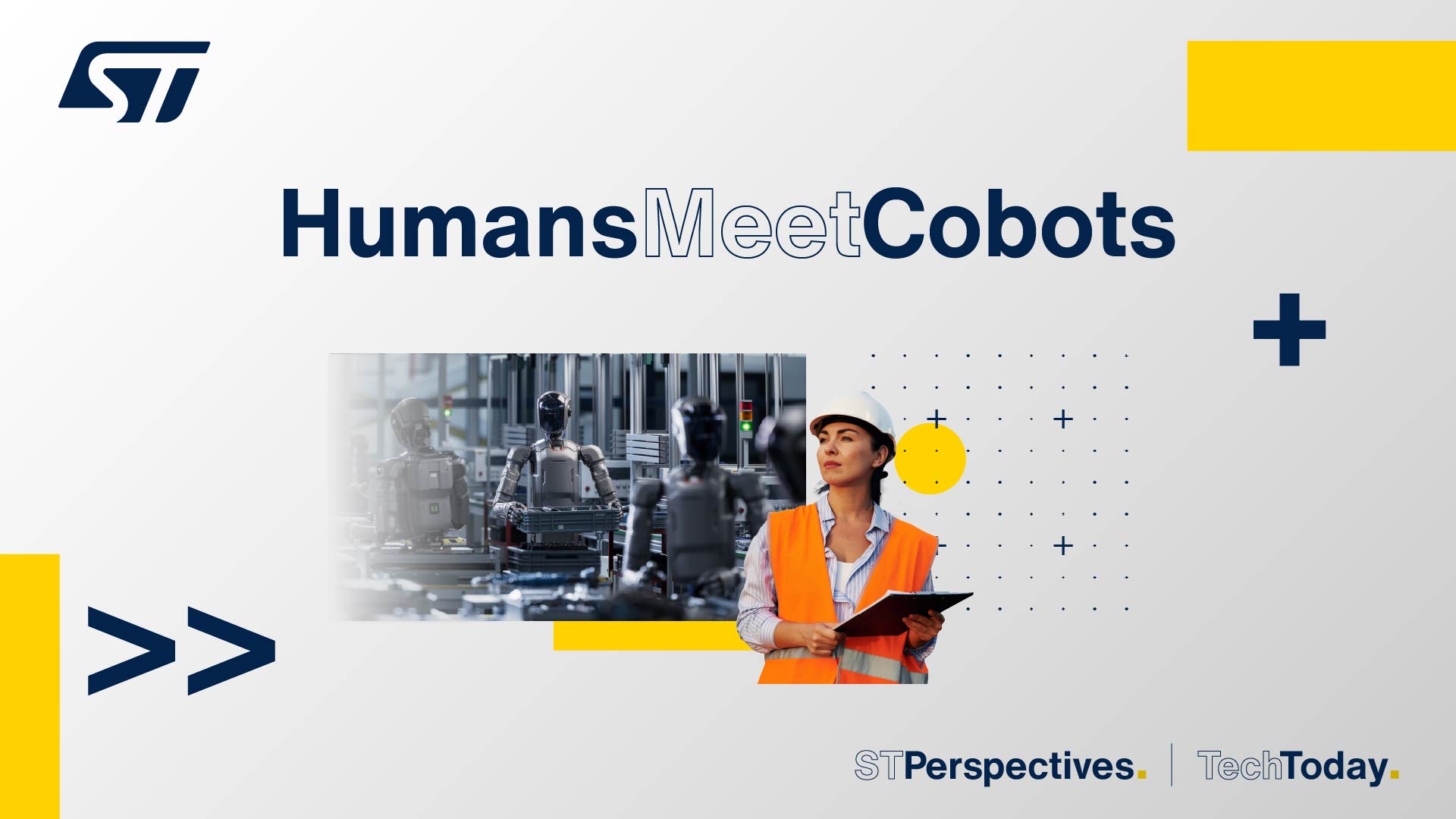
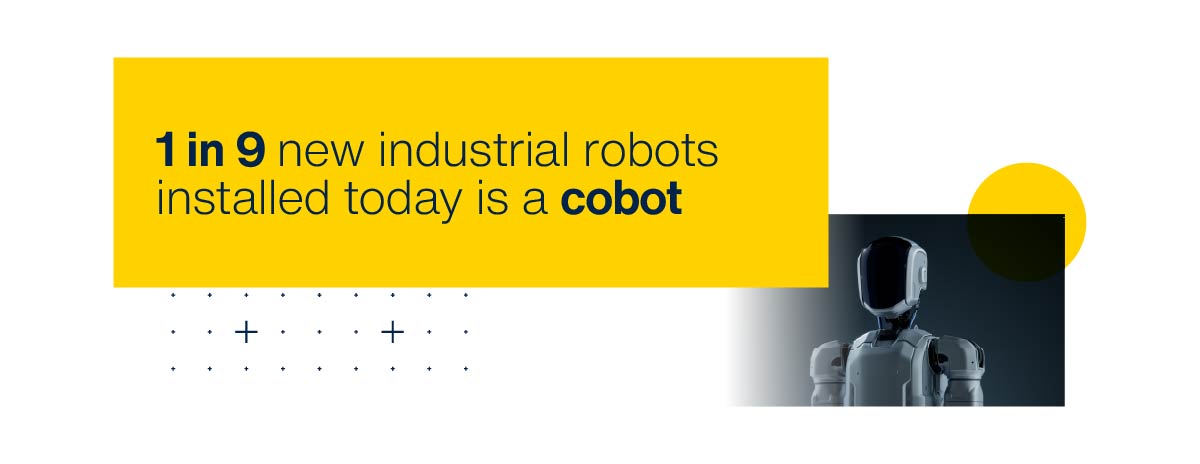
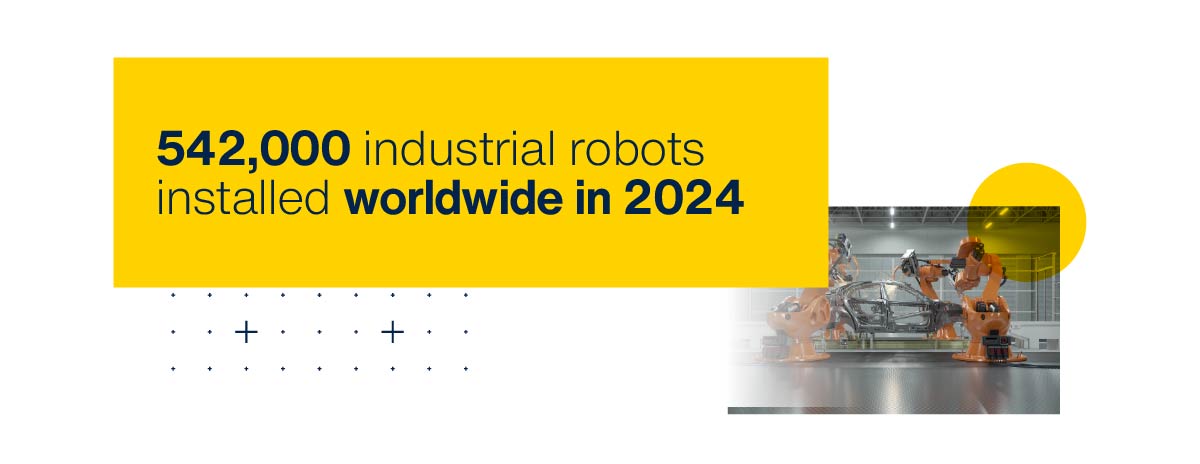
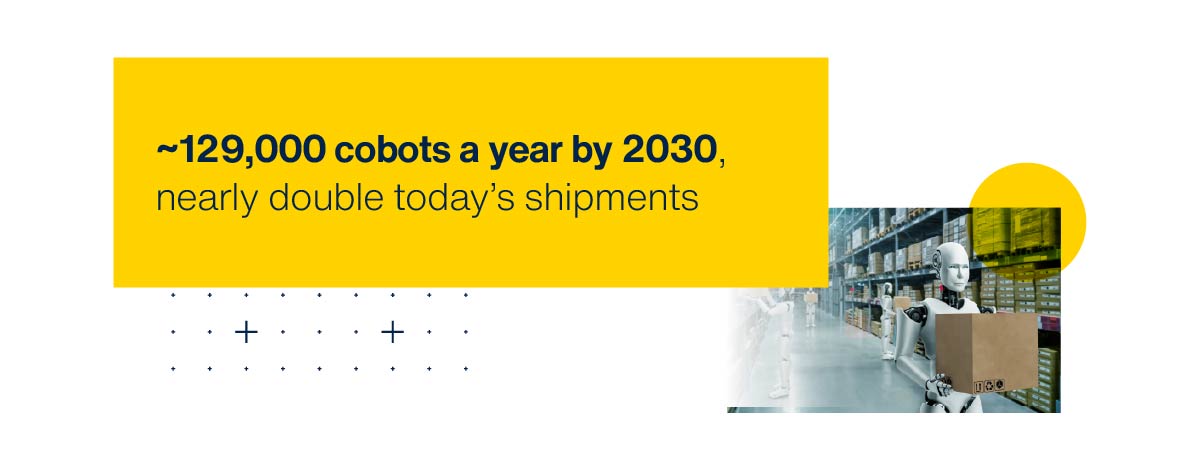
Factories installed 542,000 industrial robots worldwide in 2024, according to the International Federation of Robotics. The more telling number sits inside that one: 64,542 of those machines were collaborative robots, designed to work next to people rather than behind fences. Cobots now account for roughly one in nine new industrial robots, and Interact Analysis expects shipments to nearly double to around 129,000 units a year by 2030.
For decades, the rule of industrial robotics was separation. Robots were fast, strong, and blind, so they worked behind cages and safety barriers. Collaborative robots remove those barriers, and that changes more than the factory layout. It changes what automation is for.
Cobots shared the stage at our Industrial Summit back in 2019, and in our Top Tech Trends for 2026 we predicted that large action models would drive “the widespread emergence of edge AI-powered cobots working alongside humans.” Allan Lagasca, who leads our Smart Industrials segment worldwide, made the case publicly in E&T Magazine this February.
What makes a robot collaborative?
A collaborative robot, or cobot, is an industrial robot built to share a workspace with people safely, without physical barriers. It combines force limiting, environmental sensing, and real-time control so it can detect human presence and adapt its motion.
The distinction matters in practice. A conventional robot executes a fixed program in a controlled space. A cobot operates in a space that changes every time a person leans in, reaches across, or walks past. That single difference drives almost every engineering decision inside the machine, which is why we treat sensing, control, and safety as one problem rather than three.
Why cobots, and why now?
Cobots represent one of the first large-scale deployments of embodied or ‘physical’ AI, where sensing, compute, motion and power management combine to allow industrial systems to operate safely in the real world.
— Allan Lagasca, Smart Industrials, Robotics Worldwide Leader, STMicroelectronics, writing in E&T Magazine
The economics start with people, or the shortage of them. Deloitte and The Manufacturing Institute estimate that US manufacturing alone could need 3.8 million new workers by 2033, with about 1.9 million roles potentially going unfilled. Cobots do not replace the workforce companies cannot find; they extend the one they have. Manufacturers face demographic pressure too: experienced operators are retiring, skills are scarce, and productivity has to rise without moving production away. Cobots are increasingly seen as a practical way to augment the operators a plant already has, capture their process know-how, and add flexibility without a large-scale factory redesign. And the labor gap is only one of the forces converging on cobots: vision and sensing keep getting better and cheaper, programming and deployment have become dramatically easier, production needs a flexibility that fixed automation cannot give, safety standards have matured, and the push to reshore production adds urgency to automating close to home.
Many tasks also benefit from human judgment combined with machine precision, the premise of the European Union’s Industry 5.0 framework. And because cobots cost less and demand less integration work than fenced robot cells, they open automation to the small and mid-sized manufacturers that conventional robotics priced out. Affordable, integrated silicon is a large part of what makes that price point possible.
Technical performance alone does not guarantee a successful deployment, because the system must also be accepted by the people who work beside it. Operators have to trust the machine they share a bench with every day, and that trust is built on transparency, predictable behavior, quiet operation and safety performance that can be demonstrated, not just declared.
How do cobots work safely next to people?
A cobot maintains safety through layered sensing and control: depth sensing, vision, force, torque, and proximity sensors build a live three-dimensional picture of the workspace, while embedded processors run motion and safety logic locally, within milliseconds. International standards define the force, speed and separation limits this machinery must respect: chiefly ISO 10218, revised in 2025 to absorb the collaborative requirements formerly in ISO/TS 15066.
Safety in a real plant also extends beyond avoiding collisions. Machine builders and the manufacturers who deploy cobots must demonstrate compliance with functional safety requirements across the whole lifecycle of the machine, from risk assessment and commissioning through maintenance and upgrades. As collaborative automation spreads, making that compliance simpler to achieve and certification faster to reach is becoming a differentiator in its own right. It is also where the semiconductor layer can help: certified functional safety packages, up to IEC 61508 SIL3, exist precisely to shorten that path for machine builders.
The interesting part is what local intelligence makes possible. When sensor data is processed at the edge, on or near the sensor itself, the robot does not merely stop on contact. It reads trajectories and adjusts before contact happens. In our view, safety is turning into a sensing problem: cages and barriers were a mechanical answer, and the modern answer is layered perception with intelligence at the edge. That layer is being built from technologies maturing fast, time-of-flight depth sensing for short-range presence detection among them, and inertial sensors with embedded machine-learning cores.
Strength and gentleness have to coexist in the same arm. A cobot may lift a heavy housing one minute and hand a fragile component to an operator the next, so its motor drivers continuously adjust torque to the load. Two design constraints are about comfort rather than collision: surface temperature and noise. A machine that runs cool and nearly silent is easier to trust, and trust decides whether collaboration works. As Lagasca put it, “the psychological nature of collaborative working between humans and robots cannot be overlooked.”
Cobots work safely next to people by bringing together real-time sensing, edge intelligence, and precise motion control, transforming machines into trusted partners that protect people, adapt with confidence, and help shape a safer, more collaborative future.
— Allan Lagasca, Smart Industrials, Robotics Worldwide Leader, STMicroelectronics
Where cobots deliver value today
The strongest applications pair machine consistency with human judgment. In automotive plants, cobots position and hold interior components while operators do the fine alignment. In electronics, they handle repetitive precision assembly while people focus on quality. In warehouses, they pick and sort alongside staff.
The current generation is also stretching the category’s limits. Payloads have grown to 25 or 30 kilograms, which makes palletizing a mainstream cobot task. Cobot arms mounted on autonomous mobile robots are starting to move between workstations, a configuration we explored with the Qualcomm AMR reference platform built on ST technology. And AI vision increasingly ships with new cobot models, shortening the path from unboxing to useful work.
Inside the machine: how we see the cobot
For us, a cobot is a study in real-time integration. Sensors, controllers, motor drivers, and power electronics must act as one deterministic system, where a few milliseconds of delay is the difference between adapting to a person and bumping into one. Multi-core microcontrollers and Time-Sensitive Networking keep that coordination predictable; efficient power stages keep the arm cool and quiet.
The challenge does not stop at the robot’s own performance either. A cobot has to integrate into an existing operational technology environment, exchanging data with PLCs, drives, machine controllers and factory software platforms, which is why open connectivity and deterministic industrial networking are becoming critical enablers for scaling collaborative automation beyond the pilot cell.
Inside this layer of industry, the direction of travel is clear: every joint is becoming a smart subsystem, as motor control absorbs computation. A full microcontroller now sits inside the motor drive itself, so each joint runs its own field-oriented control loop. Industrial inertial sensors embed machine-learning cores that can detect an anomaly in a robot arm joint before it fails, and dedicated vibration sensors extend the same idea to predictive maintenance across the whole robotic work cell, the arm and the equipment it works with. On the power side, integrated gallium nitride power stages shrink the electronics inside the arm and cut the heat it sheds into a shared workspace.
Connection cuts both ways, though: as cobots join factory networks, physical safety and cybersecurity converge. Unauthorized access, manipulated software or compromised communications can become operational and safety risks, so secure-by-design architectures, with device authentication, secure firmware updates and hardware-based protection, are part of what makes large-scale deployment trustworthy. That is ground the silicon itself has to cover, with secure-by-design architectures aligned with industrial security standards such as IEC 62443.
The technologies maturing in cobots today, edge intelligence, sensor fusion, precise and safe motion, are the same ones humanoid robots will depend on at far greater scale. We see cobots as the proving ground of physical AI: before humanoids reach scale, the trust, safety, and economics of human-robot collaboration will be settled on cobot arms. Our collaboration with NVIDIA on robotics development carries the same technologies from today’s cobots toward tomorrow’s humanoids. (We tell the humanoid half of this story in a companion ST Perspectives article.)
Working together, literally
Automation used to mean designing people out of a process. Collaborative robotics inverts that: it designs machines into spaces that stay human. Manufacturers get flexibility and consistency, workers shed the repetitive and physically wearing parts of their jobs, and smaller companies get access to automation for the first time.
The next decade of robotics will be defined not by whether machines can replace people, but by how safely and productively they can work with them. In that shift, the winners will be the companies that master sensing, control, and energy efficiency at the edge. To see where that leads, read our perspective on physical AI.